 DriveAtlas
Car Rental in Armenia 2026
Armenia is a country that practically demands you rent a car. The most extraordinary things here — 4th-century monasteries perched on cliff edges, volcanic landscapes that look like another planet, mountain lakes at 2,000 meters — are connected by roads that public transport either ignores or visits once a day at dawn. We spent two weeks driving around Armenia in a rented Hyundai Tucson and discovered that the density of jaw-dropping scenery per kilometer driven is exceeded only by Georgia next door. The difference is that Armenia gets a fraction of the tourist traffic, which means the roads are yours.
Yerevan is a charming, cafe-filled capital, but the real Armenia begins the moment you point the car toward the mountains. Within an hour in any direction, you are among ancient monasteries, Soviet-era mountain resorts, or volcanic highlands where the only other cars belong to shepherds.
Your Armenia Driving Guides
Driving in Armenia
Road rules, speed limits, license requirements, and what the locals are actually doing behind the wheel. Plus the honest truth about Armenian road conditions, from pristine highways to gravel tracks.
Best Road Trips in Armenia
Four tested routes covering Lake Sevan, Tatev Monastery, Dilijan National Park, and the wild south. Distances, driving times, and the stops that make each route worthwhile.
Airport Car Rental in Armenia
Everything about picking up a car at Yerevan Zvartnots Airport. Which agencies operate there, what to expect at the counter, and how to drive into the city without incident.
Best Cities to Rent a Car in Armenia
Yerevan, Gyumri, Vanadzor, and Dilijan compared. Where to find the best rates, what parking is like, and which city makes the most strategic base for your trip.
Car Rental Costs in Armenia
A transparent breakdown of what you will spend: daily rates, insurance, fuel, and the tips that keep your budget under control in the Caucasus.
Why Armenia Works for a Road Trip
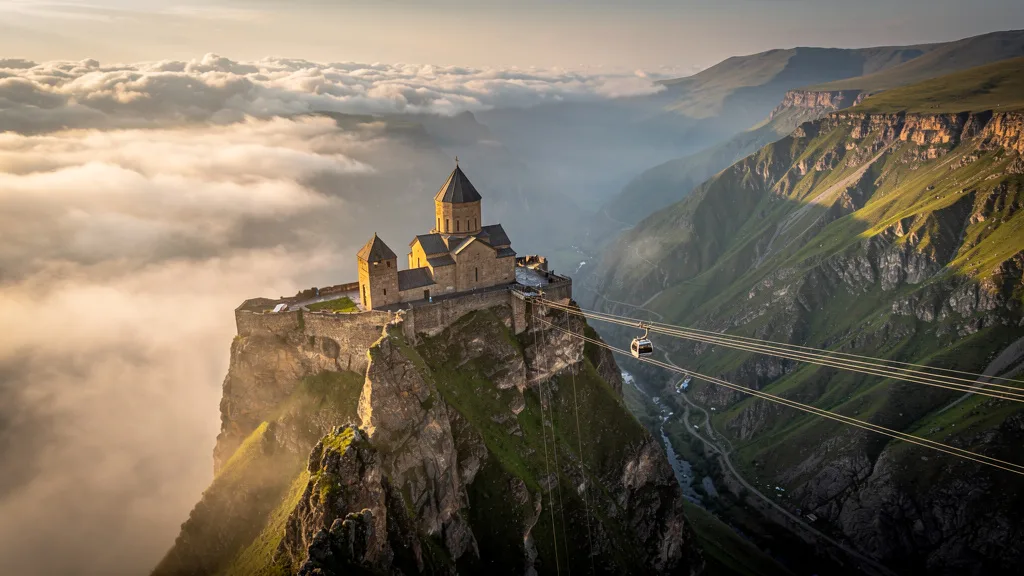
The monasteries are the main attraction, and they are everywhere. Armenia was the first country to adopt Christianity as a state religion, in 301 AD. The result is a landscape dotted with hundreds of medieval churches and monasteries, many in spectacular settings. Geghard, carved into a cliff face. Tatev, at the end of the world’s longest aerial tramway. Noravank, in a red sandstone canyon. None of these have convenient bus connections.
The scale is perfect for driving. Armenia is roughly the size of Belgium, and the longest point-to-point drive within the country is about five hours. You can base yourself in Yerevan and make day trips to most major sights, or do a full circuit in a week without ever driving more than three hours in a single stretch.
Mount Ararat is always there. The biblical mountain sits just across the Turkish border, and from western Armenia, it dominates the horizon. Driving along the Ararat Valley with the snow-capped peak looming ahead is one of those driving experiences that stays with you. The mountain is visible from Yerevan on clear days, which is most days.
The food fuels the journey. Armenian roadside stops are an event. Pull over at any roadside restaurant and you will find lavash bread baked in a tonir (underground oven), khorovats (grilled meat) that puts most BBQ to shame, and fresh herbs served in bushels. A full meal with local wine runs 3,000-5,000 AMD ($8-13). The wine comes from Areni, one of the oldest wine-producing regions on Earth.
The prices are exceptional. Economy car rental starts at 8,000-12,000 AMD ($21-31) per day in high season. Fuel costs around 300-330 AMD per liter ($0.78-0.86) — among the cheapest in the Caucasus. There are no toll roads anywhere in the country. A full week of driving, including insurance and fuel for 1,000 km, can come in under $200 USD. That is not a misprint.
Armenia at a Glance
| Detail | Information |
|---|---|
| Currency | Armenian dram (AMD) |
| Exchange rate | ~385 AMD per USD |
| Driving side | Right |
| Speed limits | 60 urban / 90 rural / 110 highway |
| Fuel price (gasoline 95) | 300-330 AMD/liter ($0.78-0.86) |
| Average rental (economy) | 8,000-12,000 AMD/day ($21-31) |
| Toll roads | None |
| IDP required | Yes — strictly enforced |
| Best driving season | May-October |
| Border crossings open | Georgia, Iran |
| Border crossings closed | Turkey, Azerbaijan |
Practical Information
Armenia uses the Armenian dram (AMD). As of 2026, 1 USD is approximately 385 AMD. Credit cards are accepted in Yerevan and larger towns but carry cash for smaller villages and rural areas.
Driving is on the right side of the road. The country is not in the EU, and land border crossings are available to Georgia (open) and Iran (open). The borders with Turkey and Azerbaijan are closed due to ongoing political tensions — do not attempt to cross.
The best time to drive in Armenia is May through October. Summer temperatures in the valleys can reach 40°C, while the highlands stay comfortable. Spring (May-June) is ideal, with green valleys, moderate temperatures, and wildflowers everywhere. Autumn (September-October) brings harvest season and stunning colors in the forested north.
An International Driving Permit is required alongside your national license. Armenian police are increasingly strict about this at checkpoints, especially for non-EU license holders. Get one before you travel — it costs about $20 and is non-negotiable.
Road conditions on the main highway network are generally good. The M1 to Gyumri, M2 to Sevan, and M4 through the north are all well-maintained. Secondary roads vary from decent asphalt to challenging gravel. Mountain roads to places like the Tatev area include steep switchbacks. Cell coverage is reliable in the valleys but patchy in the mountains — download offline maps before you leave Yerevan.
For the full rundown on driving regulations, start with our driving guide. Planning to combine Armenia with neighboring countries? Our Georgia guide covers the natural next destination, and the Azerbaijan guide explains what to know about the Caucasus neighbor to the east.