 DriveAtlas
Best Road Trips in Bulgaria
We drove up to Rila Monastery on a September afternoon when the light was turning golden and the beech forests around the valley were starting to change color. The monastery appeared through the trees — a massive fortress-like structure, its walls striped in red, black, and white, surrounded by mountains on all sides. We had the courtyard nearly to ourselves. A monk was watering flowers. A cat was asleep on a warm stone step. This is what Bulgarian road trips deliver: world-class historical sites in cinematic settings, reached by mountain roads that are rewarding to drive and almost empty of other tourists.
Bulgaria is about the size of Tennessee. You can cross it east to west (Sofia to Varna) in about 5.5 hours on the motorway, or north to south (Danube to Greece) in about 3.5 hours. This compact scale means you can cover the highlights in a week, though two weeks lets you explore at a more satisfying pace. What strikes most visitors is the variety: mountains, coast, rose valleys, and medieval monasteries, all within a few hours of each other.
Route 1: The Rila and Pirin Mountains — Sofia to Bansko via Rila Monastery (300 km loop, 2-3 days)
This route covers Bulgaria’s two most impressive mountain ranges and its most famous landmark. It is also a route where taking the winding mountain roads rather than the motorway shortcut makes every kilometer worthwhile.
Day 1: Sofia to Rila Monastery to Blagoevgrad (150 km, 3 hours driving with stops)
Take the A3 south from Sofia toward Blagoevgrad, then exit at Kocherinovo for the mountain road to Rila Monastery (25 km of winding road through increasingly dense beech and pine forest). The road is paved and accessible to standard cars; it climbs steadily, the valley gets narrower, and then the monastery appears around a bend in the trees.
Rila Monastery is Bulgaria’s spiritual heart and its most visited non-coastal destination. Founded in the 10th century by St. John of Rila, mostly rebuilt after an 1833 fire, and containing medieval frescoes that cover every surface of the main church (Nativity of the Virgin Church). The striped black-and-white arches, the wooden galleries above the courtyard, and the sheer scale of the complex create an effect that photographs do not fully capture. You need to stand in the courtyard to understand why it is UNESCO-listed.
What to see: the main church’s exterior frescoes, the interior if not a service is in progress (modest dress required), the Hrelyo Tower (14th-century defensive tower), and the museum in the south wing covering the monastery’s history, manuscripts, and art. Entry: free for the complex; museum 8 BGN ($4). Budget 2 hours.
Continue down the mountain and then south to Blagoevgrad for overnight. The city has a large student population (southwest Bulgaria’s main university is here), which means good restaurants and cafes at low prices. Hotels: 60-120 BGN ($33-66) per night.
Day 2: Blagoevgrad to Bansko (60 km, 1 hour)
Drive southeast through the Struma River valley to Bansko, Bulgaria’s premier ski resort and summer mountain base in the Pirin Mountains.
Bansko’s old town is worth more than just a quick walk-through. The traditional stone-and-timber mehana (tavern) houses date from the 18th and 19th centuries, most now operating as restaurants. The architecture is distinctive — thick stone walls, wooden balconies, interior courtyards that keep the summer heat out. The Neofit Rilski birthplace museum (Bulgaria’s national revival figure was born here) is worth 30 minutes.
Food in Bansko: The local specialties are mandatory. Kapama is a slow-cooked dish of multiple meats, sausage, and sauerkraut that takes days to prepare and is served in the clay pot it was cooked in. Banski starets is a semi-hard aged cheese specific to the region. A mehana meal for two with wine: 30-50 BGN ($17-28).
Pirin National Park (UNESCO World Heritage Site) is accessible from Bansko. The park covers 40,000 hectares of mountain landscape — glacial lakes, ancient pine forests, and peaks above 2,500 meters. In summer, hiking trails from the Vihren hut (accessible by gondola from Bansko) lead to the main peaks. The gondola runs year-round: 30 BGN ($17) return.
Day 3: Bansko to Sofia (various routes, 2-3.5 hours)
Option A (quick return): A3 motorway directly — 160 km, 2.5 hours, tolled.
Option B (scenic via Plovdiv): Through the Rhodope foothills east to Plovdiv (150 km, 2.5 hours), then A1 motorway west to Sofia (150 km, 1.5 hours). Adds 3-4 hours but gives you Plovdiv (see Route 3).
Option C (the Pirin loop): South through the Pirin foothills to Melnik (80 km, 1.5 hours) — a tiny town with fewer than 300 residents and the smallest city status in Bulgaria, surrounded by spectacular sandstone pyramids and known for wine production. Then north through Petrich and back to Sofia via A3. Full day.
Melnik wine note: The local Shiroka Melnishka Loza grape variety is indigenous to the Melnik region and produces deep red wines with significant aging potential. Several winery-guesthouses offer tastings and overnight stays. The sandstone pyramid landscape around the town is unlike anything else in Bulgaria.
Route 1 Details
| Segment | Distance | Drive Time | Key Stops |
|---|---|---|---|
| Sofia to Rila Monastery (A3 + mountain) | 120 km | 2 hours | UNESCO monastery |
| Rila to Blagoevgrad | 30 km | 40 min | Valley descent |
| Blagoevgrad to Bansko | 60 km | 1 hour | Pirin foothills |
| Bansko to Sofia (A3 direct) | 160 km | 2.5 hours | |
| Bansko to Sofia (via Plovdiv) | 300 km | 4 hours | Plovdiv Old Town added |
Route 2: The Black Sea Coast — Varna to Sozopol (250 km, 2-3 days)
Bulgaria’s 380 km of Black Sea coastline offers everything from ancient cities to beach resorts to undeveloped coves. This route covers the best of it, driving south from Varna through Bulgaria’s most famous coastal stretches to Sozopol.
Day 1: Varna and the Northern Coast
Varna itself is worth a half-day before heading south. Bulgaria’s “Sea Capital” is a proper city (population 300,000) with genuine urban life year-round, not just a summer resort.
The Varna Archaeological Museum houses the oldest worked gold in the world — artifacts from the Varna Chalcolithic Necropolis dated to 4600-4200 BC. The gold is extraordinary: intricate jewelry, figurines, and ceremonial objects that are 2,500 years older than Tutankhamun’s treasures. Entry: 10 BGN ($6). Budget 1.5 hours.
The Roman Baths in the city center are the largest in the Balkans — remarkably preserved ruins of a 2nd-century complex. The Sea Garden running along the beachfront is well-maintained with views over the Black Sea. The beach in Varna city is decent but gets crowded in summer.
Drive south toward Balchik (45 km, 45 minutes). The E87 coast road initially runs inland before returning to the coast. Balchik is a cliff-top town best known for the botanical garden at the former summer palace of Romanian Queen Marie (who acquired Balchik when it was briefly Romanian territory in the 1930s). The garden cascades down the cliff face toward the sea, with 3,000+ plant species including one of the largest cactus collections in Europe. Entry: 15 BGN ($8). Allow 1.5-2 hours.
Day 2: Drive to Nessebar and Beyond
Continue south on the E87 (100 km from Balchik, 1.5 hours). Several beach stops en route: Byala has good beaches off the main road; Obzor is a low-key resort with a decent beach; Sunny Beach (Slanchev Bryag) is Bulgaria’s largest and most infamous resort — massive, loud, cheap, and worth seeing briefly for the sheer scale of it.
Nessebar is the antidote to Sunny Beach and is only 6 km away. A UNESCO World Heritage Site and one of the oldest cities in Europe (founded by Thracians 3,200 years ago, then colonized by Greeks, Romans, Byzantines, and Bulgarians in sequence), the old town occupies a narrow peninsula jutting into the sea. Walking the cobblestone streets among 40+ medieval churches is genuinely atmospheric.
What to see in Nessebar Old Town: the Archaeological Museum (entry 6 BGN / $3), the Pantocrator Church (14th century, now an art gallery), the Old Metropolitan Church of St. Sophia (partially preserved ruins from the 5th-6th century), and the Byzantine windmill at the causeway entrance. Budget 2-3 hours.
Parking at Nessebar: paid lots at the causeway entrance, 5-10 BGN ($3-6) for half a day. Do not attempt to drive into the old town peninsula itself.
Day 3: South to Sozopol
Continue south past the salt pans at Pomorie (where traditional salt is still harvested using ancient techniques, and therapeutic mud baths have been operating since antiquity) to Sozopol (65 km from Nessebar, 1 hour).
Sozopol is the most charming town on the Bulgarian coast — a fishing port with a small old town on a peninsula, traditional wooden-and-stone houses along the sea walls, and two excellent beaches (Harmani to the north of the old town, Gradina Beach to the south). The atmosphere is significantly calmer than Nessebar or the resort strip further north. Seafood restaurants along the harbor serve fresh fish for 15-25 BGN ($8-14) for a full meal with wine.
The Sozopol Arts Festival in early September is one of Bulgaria’s best cultural events — theater, cinema, and music with the medieval harbor walls as backdrop.
Side trip: Ropotamo Nature Reserve (15 km south of Sozopol). A river estuary protected area with boat tours through subtropical riparian vegetation, lotus flowers in season, sand dunes, and exceptional birdwatching. Boat tour: 15 BGN ($8), 1 hour. The combination of Black Sea coast and this preserved estuary is unlike anywhere else in Bulgaria.
Route 2 Details
| Segment | Distance | Drive Time | Key Stops |
|---|---|---|---|
| Varna (city) | — | Half day | Gold museum, Roman baths |
| Varna to Balchik | 45 km | 45 min | Botanical gardens, cliff-top town |
| Balchik to Nessebar | 100 km | 1.5 hours | Byala beach, Sunny Beach spectacle |
| Nessebar | — | 2-3 hours | UNESCO old town, 40+ churches |
| Nessebar to Sozopol via Pomorie | 65 km | 1 hour | Salt pans, fishing town |
| Ropotamo (side trip) | 15 km | 15 min | River estuary, boat tour |
Route 3: The Valley of the Roses — Plovdiv to Kazanlak (200 km loop, 1-2 days)
Central Bulgaria’s Thracian Plain holds the country’s cultural capital, the world’s most important rose oil industry, and some of its most significant historical sites — all within easy driving distance of each other.
Plovdiv (minimum half-day, ideally a full day)
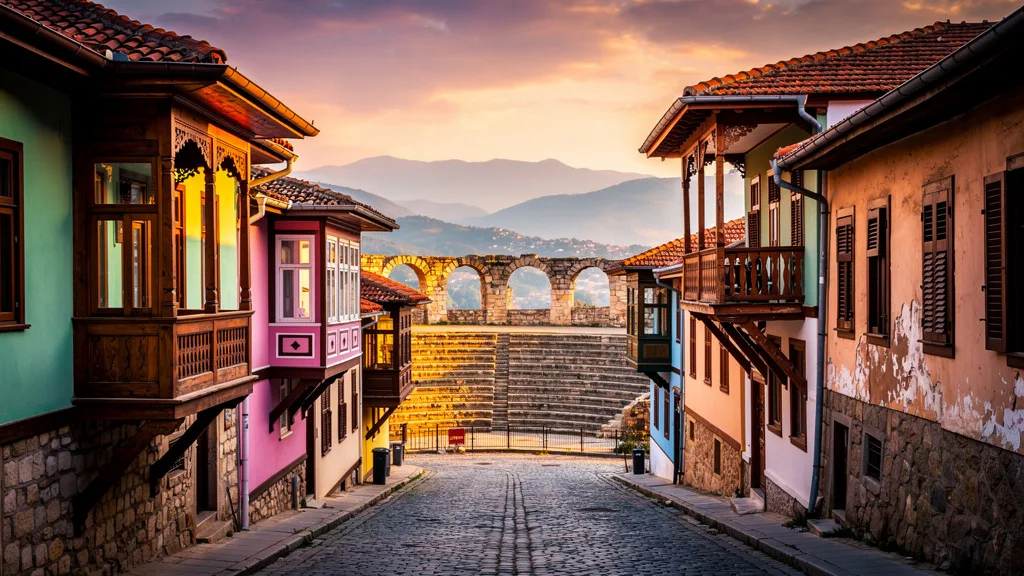
Bulgaria’s second city and European Capital of Culture 2019 deserves genuine time. The old town is built across three of Plovdiv’s seven hills, with 19th-century Bulgarian Revival architecture that is remarkably well-preserved.
The Roman Amphitheater (2nd century AD) is still in active use for concerts and events — 6,000 seats carved into the hillside, completely intact. If there is a performance during your visit, book ahead. Entry: 5 BGN ($3) for the archaeological site.
The Kapana Creative District is a small neighborhood of cobblestone streets that has become Plovdiv’s art and design hub — independent galleries, design studios, good coffee, and restaurants serving everything from traditional Bulgarian to fusion cuisine.
The Old Town (Staria Grad) has the densest concentration of Revival-era architecture anywhere in Bulgaria. Key houses open to visitors include the Hindliyan House and the Balabanov House, both decorated with murals, carved woodwork, and period furnishings.
Plovdiv to Kazanlak via the Rose Valley (100 km, 1.5 hours)
Head north through the Sredna Gora mountains on the E871 or via Kalofer (more scenic). The road climbs through woodland, crosses the range at about 1,100 meters, and descends into the Valley of the Roses — a long, flat valley between the Stara Planina and Sredna Gora ranges that produces approximately 85% of the world’s rose oil.
Kazanlak is the valley’s main town and the center of the rose oil industry. The Rose Museum covers the history and chemistry of rose oil production in detail. Entry: 4 BGN ($2). In late May to early June, the fields are in bloom and the air is noticeably fragrant. The Rose Festival (first weekend of June) involves rose-picking demonstrations, parades, and the election of the Rose Queen — very much a local event rather than a tourist production.
The Thracian Tomb of Kazanlak (UNESCO): A 4th-century BC beehive tomb with the finest preserved Thracian frescos in the world. The original tomb is closed to preserve the paintings; an excellent replica with identical proportions and painting quality is open to visitors. Entry: 6 BGN ($3). Genuinely impressive.
Kazanlak to Shipka Pass and Back to Plovdiv
From Kazanlak, drive north 25 km to the Shipka Pass (1,185 meters) — site of a decisive battle in the 1877-78 Russo-Turkish War that led to Bulgarian independence. The Freedom Monument at the summit has panoramic views over both the Valley of the Roses to the south and the northern Balkan foothills. Free entry; short walk from the parking area.
At the base of the pass on the south side, the Shipka Memorial Church (built in honor of the Russian and Bulgarian soldiers who died defending the pass) is one of Bulgaria’s most photogenic buildings — golden onion domes visible from kilometers away. Entry: free.
Return to Plovdiv west through Karlovo (100 km, 1.5 hours) through the Rose Valley.
Route 3 Details
| Segment | Distance | Drive Time | Key Stops |
|---|---|---|---|
| Plovdiv (base) | — | Half-full day | Roman theater, Kapana, Old Town |
| Plovdiv to Kazanlak | 100 km | 1.5 hours | Rose Valley, Thracian Tomb |
| Kazanlak to Shipka Pass | 25 km | 30 min | Freedom Monument, memorial church |
| Shipka to Plovdiv via Karlovo | 100 km | 1.5 hours | Rose Valley return |
| Total loop | ~225 km | 1-2 days |
Route 4: The Rhodope Mountains — Plovdiv to Smolyan (200 km, 1-2 days)
The Rhodope Mountains in southern Bulgaria are the country’s most forested, least-visited, and arguably most atmospheric region. This is traditional Bulgaria — villages with folk music traditions, herb-scented forests, and landscapes that look like medieval paintings. The roads require more attention than the motorway, but the driving is rewarding.
Plovdiv to Bachkovo Monastery (30 km, 30 minutes)
The Bachkovo Monastery (Bachkovski Manastir) is the second-largest in Bulgaria after Rila, and arguably the more atmospheric because fewer visitors make it here. Founded in 1083 by two Georgian brothers serving the Byzantine Emperor, it sits in a narrow gorge of the Asenitsa River surrounded by forest.
The frescos in the Archangels Church are outstanding — vivid, intact, and remarkable for their detail. The ossuarium (bone church) outside the main complex has wall paintings depicting the weighing of souls. Entry: free. Budget 1-1.5 hours.
Bachkovo to Smolyan (80 km, 2 hours)
The road climbs into the Rhodopes through forests that become increasingly dense and the air increasingly fragrant with pine and wild herbs. This section of road is genuinely scenic — forested valleys, occasional villages with traditional houses (wooden upper floors overhanging the street), and views that open periodically over the range below.
Smolyan is a mountain town strung along a narrow valley at 1,000 meters, created by combining several villages in the socialist era. It has an unexpectedly good Astronomical Observatory (one of the larger in the Balkans) and the Smolyan Lakes — a series of natural mountain lakes 5 km from town with good hiking trails. In winter, Pamporovo ski resort is 20 km away.
The Rhodope Detours
Devil’s Bridge (Dyavolski Most): About 40 km east of Smolyan near Ardino. A dramatic Ottoman bridge from the 16th century spanning a deep gorge, with pointed arches that create distinctive shadow patterns at certain times of day. Free entry. The name comes from the legend that the bridge required a human sacrifice in the foundation (a Rhodope folk legend found at many old bridges). The gorge setting is genuinely dramatic.
Wonderful Bridges (Chudnite Mostove): Natural rock arches formed by karst erosion, about 80 km west of Smolyan near Chepelare. A short (15-minute) walk from the road parking area leads to two large natural arches standing in a forested valley. Free entry. The larger arch is 96 meters long and 15 meters high — impressive in person in a way that photographs understate.
Trigrad Gorge and Devil’s Throat Cave (Dyavolskoto Garlo): 50 km south of Smolyan near the Greek border. The gorge is one of the most dramatic in Bulgaria — sheer 300-meter limestone walls, the Trigrad River disappearing underground. The Devil’s Throat cave is where the river reappears, in a massive underground chamber with a 42-meter waterfall inside. The cave tour takes 30 minutes. Entry: 8 BGN ($4). Bring a jacket — it is cold inside regardless of the outside temperature.
Route 4 Details
| Segment | Distance | Drive Time | Key Stops |
|---|---|---|---|
| Plovdiv to Bachkovo | 30 km | 30 min | 11th-century monastery |
| Bachkovo to Smolyan | 80 km | 2 hours | Mountain road, Rhodope villages |
| Smolyan surroundings | Variable | Half-full day | Lakes, observatory |
| Devil’s Bridge (side trip) | 80 km round trip | 1.5 hours | Ottoman bridge, gorge |
| Wonderful Bridges (side trip) | 160 km round trip | 2.5 hours | Natural rock arches |
| Trigrad/Devil’s Throat (side trip) | 100 km round trip | 2 hours | Gorge, cave waterfall |
Route Comparison Table
| Route | Distance | Duration | Difficulty | Best Season | Highlights |
|---|---|---|---|---|---|
| Rila & Pirin Mountains | 300 km loop | 2-3 days | Easy-Moderate | May-Oct | Rila Monastery, Bansko, Pirin NP |
| Black Sea Coast | 250 km south | 2-3 days | Easy | Jun-Sep (coast) | Nessebar, Sozopol, Varna |
| Valley of the Roses | 200 km loop | 1-2 days | Easy | May-Jun, year-round | Plovdiv, Rose Valley, Shipka |
| Rhodope Mountains | 200 km | 1-2 days | Moderate | May-Oct | Bachkovo, Devil’s Bridge, gorges |
Planning Your Bulgaria Road Trip
The ideal Bulgaria circuit (10-12 days): Sofia — Rila Monastery — Bansko — Plovdiv — Rose Valley/Kazanlak — Varna (3 nights, exploring northern coast) — Nessebar — Sozopol — Burgas — return to Sofia via A1. This covers the four major landscapes (mountains, cultural cities, coast) without backtracking.
Buy the e-vignette before your first motorway. Purchase online at bgtoll.bg with your rental car’s plate number, or buy at the airport fuel station on arrival. A 7-day vignette is 15 BGN ($8). Driving on a motorway without one results in an automatic 300 BGN ($165) fine.
Black Sea coast in July-August: Extremely busy, prices 20-30% higher, accommodation needs booking months ahead. June and September offer the same beaches with a fraction of the crowds and noticeably lower prices.
Mountain roads require daylight. The Rhodope and Rila mountain roads are scenic and manageable but have some sections without guardrails. Drive during daylight. Never attempt the mountain approach roads at night.
Rose Valley timing: If you want to see the rose harvest in full bloom, the window is approximately May 25 to June 10, with the Rose Festival in the first weekend of June. Outside this period, the valley is pleasant but less distinctive.
Route Common Mistakes
Trying to drive the coast and Rila in the same trip without extra days. The Black Sea coast (Varna to Sozopol) and the Rila-Pirin circuit are both 2-3 day routes. Attempting to combine them in 4 days means skimming everywhere. Add at least 2 days or choose one region properly.
Arriving at Nessebar by car on a July afternoon. The old town peninsula is small and beautiful, but the causeway bridge and parking lots can back up significantly in peak summer. Arrive by 09:00 or after 17:00. Alternatively, park in a neighboring area and take the local bus.
Underestimating Rhodope road times. GPS suggests 2 hours from Plovdiv to Smolyan. Reality is 2.5-3 hours because the mountain road requires reduced speed, has frequent curves, and demands active concentration. Plan for 3 hours and enjoy it rather than rushing through.
Skipping Melnik for lack of time. Melnik is 80 km from Bansko and deserves a half-day. The sandstone pyramid landscape, the tiny wine-producing town (population under 300), and the Rozhen Monastery nearby create a combination found nowhere else in Bulgaria. If you are doing the Rila-Pirin route, Melnik is the natural extension on Day 3 before returning north.
Missing the Rose Festival timing. The Valley of the Roses route is pleasant year-round but transformative in late May to early June when the Damask rose fields are in bloom. If your travel dates are flexible and you are choosing between spring and summer for central Bulgaria, choose May.
Bulgaria vs Neighboring Driving Destinations
| Factor | Bulgaria | Romania | Greece (north) | Serbia |
|---|---|---|---|---|
| Road quality (main) | Good-Excellent | Good-Variable | Good-Excellent | Good |
| Road quality (rural) | Variable | Variable | Variable | Variable |
| Rental prices | Moderate | Moderate | High | Low |
| Fuel (95 oct) | 2.60-2.80 BGN/L | Variable | ~2.10 EUR/L | Lower |
| Coast access | Black Sea | Black Sea | Aegean, Ionian | Adriatic (far) |
| Mountains | Rila, Pirin, Rhodope | Carpathians | Olympus, Pindus | — |
| Historical sites | Medieval monasteries | Bran, Transylvania | Ancient ruins | Belgrade, Novi Sad |
| Vignette | E-vignette 15 BGN/week | Rovinieta (~3 EUR/day) | None | None |
Bulgaria represents good value in the Balkan context — more developed tourism infrastructure than Serbia, better roads than interior Romania, and more affordable than Greece. The combination of mountains, Black Sea coast, and UNESCO monasteries in a compact geography is genuinely competitive for self-drive tourism.
For driving rules, see our Bulgaria driving guide. For planning tips, see our road trip planning guide. For the Romanian extension north of the Danube, our Romania best routes continues the journey.