 DriveAtlas
Best Road Trips in Armenia
We were driving the road to Tatev Monastery when the asphalt ended and the gravel began, the valley dropped away on our left with no guardrail in sight, and the passenger in the back seat quietly asked if we had made a wrong turn. We had not. This was the correct road, and at the end of it was one of the most dramatic monastery settings in the world. Armenia has a talent for hiding its best places at the end of roads that test your resolve, and the reward is always worth the white knuckles.
Armenia is small — about 29,800 square kilometers, roughly the size of Maryland or Belgium. This means you can cross the country in a day, but you should not. The landscape changes constantly: volcanic plateaus, deep gorges, alpine meadows, dusty lowland plains, and forested mountains, sometimes all in a single hour of driving. Every route here is scenic because there is no flat, boring stretch long enough to qualify as otherwise.
These four routes cover the main highlights of Armenia, from easy day trips from Yerevan to multi-day adventures in the wild south. All have been personally tested, distances are verified, and the stops are the ones we actually stopped at rather than the ones every guidebook lists without visiting.
Route 1: The Monastery Circuit — Yerevan, Garni, Geghard, Khor Virap (140 km loop, 1 day)
This is the route every first-time visitor should drive. It covers Armenia’s most famous sites within easy striking distance of Yerevan and gives you a taste of the country’s landscapes without any challenging roads. The total driving time is about 2.5 hours; plan for a full day to do it properly.
Morning: Yerevan to Garni Temple (28 km, 30 minutes). Head east from Yerevan on the H3 road through the suburb of Charentsavan. The road climbs gradually, following the Azat River valley. The landscape opens up as you gain altitude, and on clear days you can see Mount Ararat behind you. Garni Temple is a Hellenistic-style structure from the 1st century AD — the only pagan temple surviving in Armenia and one of the very few Hellenistic temples in the entire former Soviet space. It was reconstructed in the 1970s using surviving stones, though some of the reconstruction shows if you look closely. Entry: 1,500 AMD ($4).
Behind the temple, a path leads to the edge of the cliff above the Azat River gorge. The exposed basalt columns below — the “Symphony of Stones” — are a geological phenomenon where hexagonal columns formed as lava cooled and contracted. The view is extraordinary and completely free. Budget 20 minutes here after the temple.
Geghard Monastery (9 km from Garni, 15 minutes). Continue up the valley on the same road. Geghard is a partly-carved-into-the-mountain monastery complex from the 4th-13th centuries. It is a UNESCO World Heritage Site and one of the most atmospheric religious buildings we have visited anywhere. The main church (Katoghike) is free-standing 13th-century Armenian architecture at its finest. The cave churches carved directly into the cliff behind are older and darker and more powerful. If a choir is practicing when you visit — which does happen, as Geghard is used for worship — the acoustics inside the cave churches are remarkable. Entry: free.
Outside the monastery, vendors sell local produce, churchkhela (walnut strings dipped in grape juice), and honey. The churchkhela in particular is better here than in the Yerevan markets — fresher and made with more fruit. Budget 1,000-2,000 AMD ($3-5) for snacks.
Lunch stop: Garni village restaurants. On the way back from Geghard, pull over at one of the restaurants in Garni that serve lavash baked in a traditional tonir oven. Some offer demonstrations — watching the bread being slapped onto the underground oven walls and then pulled out perfectly cooked is genuinely entertaining. A full lunch with khorovats (grilled meat), tabule, fresh vegetables, and local wine: 3,000-5,000 AMD ($8-13). The restaurants are family-run, the portions are enormous, and the food is excellent.
Afternoon: Khor Virap (50 km from Garni, 1 hour). Drive south through the Ararat Valley to Khor Virap Monastery, the most photographed monastery in Armenia. The reason is simple: it sits on a small hill in the flat Ararat Plain with the massive bulk of Mount Ararat rising directly behind it, just 30 km across the Turkish border. The visual is almost absurdly dramatic — a compact medieval monastery dwarfed by a volcanic giant, framed by golden fields in summer and snow in winter.
Inside Khor Virap is a pit where St. Gregory the Illuminator was imprisoned for 13 years before King Tiridates III released him and, under Gregory’s influence, converted to Christianity in 301 AD. You can descend into the pit via a vertical ladder — claustrophobic but memorable. Entry: free.
Clear mornings are best for photography at Khor Virap, as afternoon haze builds over the Ararat Plain. Arrive by 09:00-10:00 for the best light and the sharpest mountain views.
Return to Yerevan (42 km, 40 minutes). Straight back on the M2 highway. Consider stopping at one of the Ararat Valley wineries — Areni-1 wine cave, where the world’s oldest winery was discovered, is nearby if you detoured south. Or return to Yerevan for a rooftop dinner with Ararat views.
Route 1 Details
| Segment | Distance | Time | Highlights |
|---|---|---|---|
| Yerevan to Garni | 28 km | 30 min | Garni Temple, Symphony of Stones |
| Garni to Geghard | 9 km | 15 min | Geghard Monastery (UNESCO) |
| Geghard to Khor Virap | 50 km | 1 hour | Ararat Valley, vineyard views |
| Khor Virap to Yerevan | 42 km | 40 min | Mount Ararat views |
| Total | ~140 km | Full day with stops |
Best Stops Summary
| Stop | Entry Fee | Time Needed | Key Feature |
|---|---|---|---|
| Garni Temple | 1,500 AMD ($4) | 45 min | Only surviving pagan temple |
| Symphony of Stones | Free | 15 min | Basalt column gorge |
| Geghard Monastery | Free | 1 hour | Cave churches, UNESCO |
| Lunch in Garni | 3,000-5,000 AMD | 1 hour | Tonir lavash, khorovats |
| Khor Virap | Free | 45 min | Mount Ararat backdrop |
Route 2: Lake Sevan and Dilijan (265 km loop, 1-2 days)
Lake Sevan is Armenia’s blue jewel — one of the largest high-altitude lakes in the world, sitting at 1,900 meters. Combined with the forested hills of Dilijan (sometimes called “Armenian Switzerland,” which is generous but not entirely wrong), this route shows a different side of the country from the volcanic south.
Yerevan to Lake Sevan via M4 (65 km, 1 hour). The M4 highway climbs steadily from the Ararat Valley through increasingly barren highlands. The road is well-maintained and the drive is easy. The moment you crest the pass and Lake Sevan appears below — a sheet of blue stretching to the horizon, surrounded by brown mountains — is genuinely stunning. The lake looks almost tropical against the austere landscape, which is part of the effect.
Sevanavank Peninsula. The first stop on the lake is Sevanavank, a pair of 9th-century churches on a peninsula (formerly an island before the lake level dropped due to Soviet-era irrigation schemes that were eventually curtailed). The setting is beautiful and the views across the lake are panoramic. The churches themselves are small but well-preserved, with some original frescoes visible inside. Entrance: free. The walk up is steep but takes only 10 minutes. From the top, you can see the full extent of the lake in both directions.
The lakeshore road. From Sevanavank, the road south along the lakeshore is pleasant — not dramatic, but comfortable. In summer, the beaches around Tsaghkadzor and Sevan town are popular with Armenians on weekend getaways. The water is cold (about 18°C in summer) but clean. If you want to swim, the beaches near Shorzha (on the southwestern shore) are generally cleaner than those near the tourist towns.
Lake Sevan to Noratus Cemetery (30 km, 30 minutes). Drive the southern shore road to Noratus, which has the largest collection of khachkars (carved stone crosses) in Armenia — nearly 900 of them, dating from the 10th to 17th centuries. Each is unique. The cemetery is free to visit, open 24 hours, and deeply atmospheric. Early morning or late afternoon light makes the carvings stand out. Budget 30-45 minutes and walk to the back of the cemetery where the oldest stones are.
Lake Sevan to Dilijan via M4 (55 km, 50 minutes). Continue on the M4 north from Sevan. The road passes through a long tunnel (2.2 km, slightly gloomy) and then drops into the forested Dilijan National Park. The change in landscape is dramatic and fast — from treeless highland to dense deciduous forest in a few kilometers. The trees in September and October are spectacular.
Dilijan. The old town of Dilijan has been partially restored, with craft workshops, cafes, and traditional houses along cobblestone streets (Sharambeyan Street is the main restored area). The town has a pleasant, slightly arts-colony atmosphere — many Armenian artists and musicians have second homes here. The Tufenkian Old Dilijan Complex is both the best hotel and a good place to understand what traditional Armenian architecture looked like.
Haghartsin Monastery (15 km from town through the forest). This is one of Armenia’s most beautiful monastery complexes — a cluster of 12th-13th century buildings in a wooded valley with a small stream. The setting is quiet and meditative in a way that more touristy sites are not. Entry: free. The drive through the forest to reach it is pleasant. Budget 45 minutes at the monastery.
Goshavank Monastery (25 km from Dilijan). Less visited than Haghartsin but equally impressive. The complex includes a 12th-century university building — one of the earliest examples of secular architecture in medieval Armenia. The khachkars here are among the finest in the country. Entry: free.
Overnight in Dilijan. Guesthouses and small hotels range from 10,000-25,000 AMD ($26-65) per night. The Tufenkian Old Dilijan Complex is the standout option at the higher end of this range. Smaller guesthouses on Sharambeyan Street are atmospheric and affordable.
Return to Yerevan (100 km, 1.5 hours). Back through Sevan on the M4, or vary the return via the M3 through Hrazdan (similar time, different scenery). Both routes are well-maintained.
Route 2 Details
| Segment | Distance | Time | Highlights |
|---|---|---|---|
| Yerevan to Sevanavank | 65 km | 1 hour | Highland drive, Lake Sevan views |
| Sevanavank to Noratus | 30 km | 30 min | Khachkar cemetery |
| Noratus to Dilijan | 55 km | 50 min | Tunnel, Dilijan National Park |
| Dilijan to Haghartsin | 15 km | 20 min | Forest road, monastery |
| Dilijan to Yerevan | 100 km | 1.5 hours | Return via M4 |
| Total | ~265 km | 1-2 days |
Route 3: The Southern Route — Yerevan to Tatev and Goris (575 km loop, 2-3 days)
This is Armenia’s most dramatic drive. The south of the country is wilder, emptier, and more rugged than the north, and the road to Tatev Monastery through the Vorotan Gorge is one of the most memorable in the Caucasus. Allow at least two days; three is better.
Day 1: Yerevan to Noravank to Goris (260 km, 5-6 hours with stops).
Start south on the M2, passing through the Ararat Valley. The early part of the drive — through flat farmland with Ararat ahead and Aragats behind — is visually striking in a horizontal way before the drama begins.
Stop at Areni village (110 km from Yerevan, 1.5 hours), the center of Armenian winemaking. The Areni-1 cave, just outside town, yielded the world’s oldest known leather shoe (5,500 years old) and the oldest known winery (6,100 years old). The cave is accessible and the contents are now in Yerevan museums, but standing in a cave where humans were making wine 6,000 years ago has a certain resonance. Wine tasting at one of the Areni cellars — Areni Winery or Trinity Canyon Vineyards — costs 2,000-3,000 AMD ($5-8) with 3-4 wines.
From Areni, take the H-45 to Noravank Monastery (10 km side road). The approach through a red sandstone canyon is spectacular — narrow walls of orange-red rock rising on both sides, the road threading between them. The monastery itself, from the 13th century, has remarkable stone carvings, particularly the facade of Surb Astvatsatsin church. The carved vine scroll around the door of Surb Karapet is some of the finest medieval stone carving in the Caucasus. Entry: free. Budget 1 hour here.
Return to the M2 and continue south through the Selim Pass (2,410 m), the highest paved pass in Armenia. The road climbs through increasingly stark highland scenery. At the pass, a 14th-century caravanserai sits intact — one of the best-preserved Silk Road rest stops in Armenia. The views from around the caravanserai over both sides of the pass are excellent. Stop for 20 minutes. Below 2,000 meters, the landscape descends into the Vayots Dzor region, drier and more golden.
Overnight in Goris (a pleasant town with stone houses and a nearby cave city). Hotels: 8,000-20,000 AMD ($21-52) per night. The Old Goris area has houses partly carved into the rock, giving the neighborhood an unusual character. Dinner at one of the restaurants on Mesrop Mashtots Street — the food in Goris is simple but good.
Day 2: Goris to Tatev and back.
The road from Goris to Tatev (25 km) is paved and much improved since the tramway was built, but it includes steep switchbacks down into the Vorotan Gorge and back up the other side. The views into the gorge are dramatic — 1,000 meters of depth, the river a silver thread below.
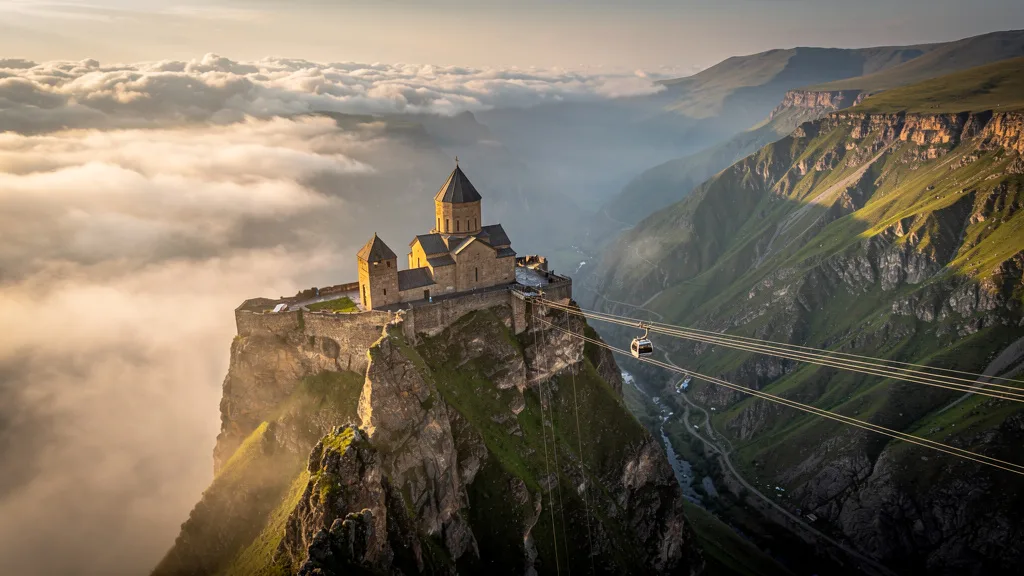
The Wings of Tatev tramway departs from the village of Halidzor (10 km before Tatev on the road from Goris). At 5.7 km, it is the world’s longest non-stop reversible aerial tramway. The 12-minute ride over the gorge, gliding above the river and monastery, is legitimately spectacular. Round trip: 7,000 AMD ($18). If you drive to Tatev instead, you save the money but miss the gorge-crossing perspective. We recommend taking the tramway at least one way.
Tatev Monastery itself, perched on the edge of a 1,000-meter cliff above the gorge, is Armenia’s architectural masterpiece. Founded in the 9th century, it once housed 600 monks and a university that was an important center of learning in medieval Armenia. The main church (Surb Poghos Petros) has an elaborate carved stone iconostasis. The oscillating pillar (Gavazan) — a freestanding column that moves on its base during earthquakes — is either a seismic monitoring device or a miracle, depending on your perspective. Budget 2-3 hours for the monastery and the cliff edge views.
Side trip: Khndzoresk (15 km from Goris, 20 minutes). This abandoned cave village, connected by a swinging bridge over a gorge, is surreal. People lived in these naturally hollowed caves until the 1950s. A 20-minute walk from the parking area gets you to the bridge, which sways entertainingly when you walk across it. Budget 1.5 hours total.
Day 3: Goris to Yerevan via Jermuk (240 km, 4-5 hours).
Take the H46 northwest toward Jermuk, a mountain spa town at 2,080 meters. The road climbs steeply from Goris and passes through impressive highland terrain. Jermuk town itself is pleasant in a slightly faded Soviet-spa way — the architecture is functional, but the mineral springs and the waterfall are genuinely good. The Jermuk Waterfall in the town center drops 68 meters through a narrow gorge — a 10-minute walk from the main road. The mineral spring gallery offers free tastings of various springs (they all taste different, all are sulfurous, all are supposedly therapeutic). Continue to Yerevan via the M2.
Route 3 Details
| Segment | Distance | Time | Highlights |
|---|---|---|---|
| Yerevan to Areni | 110 km | 1.5 hours | Areni wine village |
| Areni to Noravank | 10 km | 15 min | Red canyon, monastery |
| Noravank to Goris | 140 km | 3 hours | Selim Pass, caravanserai |
| Goris to Tatev | 25 km | 40 min | Vorotan Gorge, monastery |
| Goris to Jermuk | 110 km | 2.5 hours | Mountain roads, spa town |
| Jermuk to Yerevan | 180 km | 2.5 hours | Ararat Valley return |
| Total | ~575 km | 2-3 days |
Route 4: The Northern Heritage — Yerevan to Haghpat and Sanahin (360 km loop, 1-2 days)
The Debed Canyon in northern Armenia holds two UNESCO-listed monasteries — Haghpat and Sanahin — along with dramatic gorge scenery and remnants of the Soviet industrial past that give this route a slightly different character from the purely ancient sites of the south.
Yerevan to Vanadzor (180 km, 2 hours). Take the M3 north through Hrazdan. The road is well-maintained and climbs through pleasant highland scenery. Tsaghkadzor (on a side road, 60 km from Yerevan) is Armenia’s main ski resort — a quick detour to the chairlift gives panoramic views without skiing. Vanadzor, Armenia’s third-largest city, is a good rest stop.
Vanadzor to Alaverdi and Sanahin (45 km, 50 minutes). The road descends into the Debed Canyon, following the river through a dramatic gorge. This is one of Armenia’s most striking pieces of landscape — narrow, forested walls dropping steeply, the river below, the road carved into the cliff. Alaverdi is a copper-mining town with a long industrial history — the cable car (now derelict) that used to carry workers up the cliff is visible from the road. Sanahin Monastery (10th-13th century) sits on a plateau above the town. The 10-minute drive up from Alaverdi is steep. The complex includes an intact medieval library building (gavit) and covered walkways between buildings. Entry: free.
Sanahin to Haghpat (8 km, 15 minutes). Cross the canyon via the Alaverdi bridge and climb to Haghpat Monastery, the twin of Sanahin and equally impressive. The complex is larger and better preserved, with remarkable khachkars in the gavit and a refectory large enough to suggest the monastery once hosted hundreds of monks. Haghpat’s position on a plateau edge gives it views over the canyon that are excellent in afternoon light. Entry: free. Budget 1 hour here.
Side trip: Akhtala Monastery (25 km from Haghpat). Drive further northwest in the canyon to Akhtala, a fortress-monastery with some of the finest Byzantine-style frescoes in Armenia. The medieval copper smelting equipment in the courtyard is also interesting context. Entry: 500 AMD ($1.30). The detour adds 50 km and about 1 hour but is worth it if you have the time.
Return to Yerevan (200 km, 3 hours). Head back via Vanadzor and the M3. If you did not stop at Dilijan on Route 2, consider a brief stop — it is on the way, roughly. The total return drive is comfortable and the M3 is well-maintained.
Route 4 Details
| Segment | Distance | Time | Highlights |
|---|---|---|---|
| Yerevan to Vanadzor | 180 km | 2 hours | M3 highway, highland scenery |
| Vanadzor to Sanahin | 45 km | 50 min | Debed Canyon, monastery |
| Sanahin to Haghpat | 8 km | 15 min | Canyon crossing, monastery |
| Haghpat to Yerevan | 200 km | 3 hours | Direct return or Dilijan detour |
| Total | ~360 km | 1-2 days |
Route Comparison Table
| Route | Distance | Duration | Difficulty | Best Season | Highlights |
|---|---|---|---|---|---|
| Monastery Circuit | 140 km | 1 day | Easy | Year-round | Garni, Geghard, Khor Virap, Mt. Ararat |
| Lake Sevan & Dilijan | 265 km | 1-2 days | Easy | May-Oct | Lake Sevan, khachkars, Dilijan forest |
| Southern Route (Tatev) | 575 km | 2-3 days | Moderate | May-Oct | Noravank, Tatev, Selim Pass, Jermuk |
| Northern Heritage | 360 km | 1-2 days | Easy-Moderate | Apr-Nov | Haghpat, Sanahin, Debed Canyon |
Planning Your Road Trip
The ideal Armenia circuit (7-10 days): Combine Routes 1, 2, and 3 for a comprehensive trip. Start with the Monastery Circuit as a day trip from Yerevan. Then head north for the Sevan-Dilijan overnight. Return to Yerevan, rest a day, then commit to the Southern Route for two to three days. Route 4 to the north can be added as a day trip or overnight if time permits — it fits naturally before or after Route 2.
Fuel strategy: Fill up in Yerevan before heading south — gas stations become scarce in the Syunik region. Goris has several stations, but the stretch from the Selim Pass area to Goris has limited options. Keep the tank above half at all times when heading into the mountains. The Eko and Flash chains are the most reliable in terms of quality and card payment acceptance.
Accommodation options:
| Location | Budget Options | Mid-Range Options | Notes |
|---|---|---|---|
| Yerevan | Hostels from 5,000 AMD ($13) | Hotels from 15,000 AMD ($39) | Wide selection |
| Goris | Guesthouses from 8,000 AMD ($21) | Hotels from 15,000 AMD ($39) | Book ahead in summer |
| Dilijan | Guesthouses from 10,000 AMD ($26) | Tufenkian from 25,000 AMD ($65) | Limited options |
| Gyumri | Guesthouses from 8,000 AMD ($21) | Hotels from 12,000 AMD ($31) | Easy parking |
Most guesthouses in Armenia include breakfast. Booking.com works, but many smaller places are only listed on Facebook or local booking platforms.
Mountain road precautions: Routes 3 and 4 include mountain passes and gorge roads. Drive during daylight hours — Armenian mountain roads at night are genuinely challenging. Mountain weather can change quickly — fog appears suddenly, and rain makes some unpaved sections slippery. Download offline maps before leaving Yerevan; cellular coverage in mountain gorges is often nonexistent.
Cross-border continuation: From Dilijan, the Georgian border crossing at Bagratashen is 90 km (1.5 hours) away. Many travelers combine Armenia and Georgia into a single Caucasus road trip, spending 1-2 weeks in each country. Note: the border with Azerbaijan is closed and cannot be crossed. Our Georgia best routes guide covers the Tbilisi-Kazbegi-Batumi circuit that most visitors do after Armenia.
For driving regulations and road conditions, see our Armenia driving guide. For general road trip planning advice, check our road trip planning guide. And for the Georgian continuation, our Georgia best routes picks up where Armenia leaves off.