 DriveAtlas
Driving in Romania
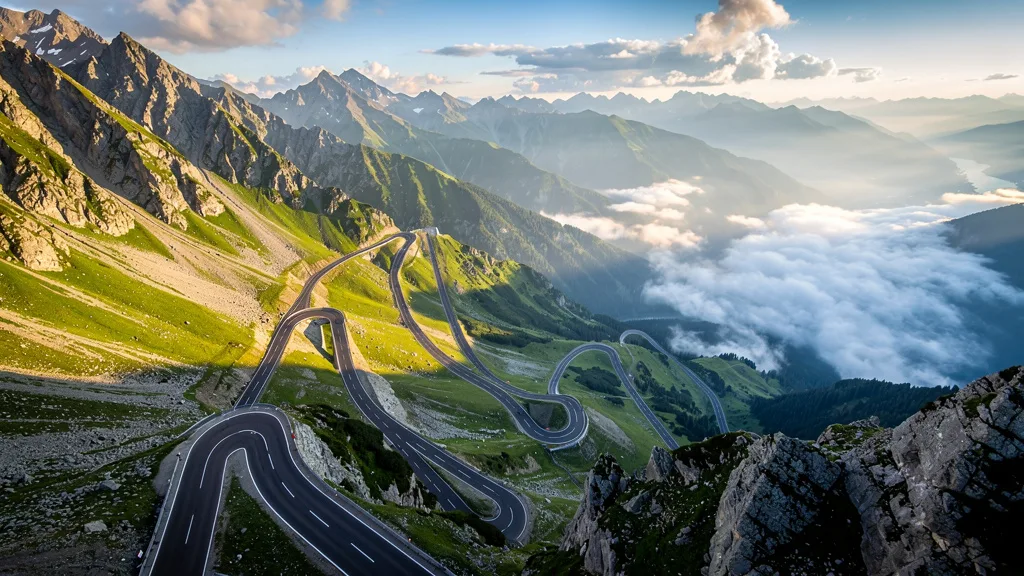
The road from Bucharest to Brasov is one of the most popular drives in Romania, and it is also one of the most illustrative. You start on a modern motorway, smooth and fast. Then the motorway ends abruptly – Romania’s highway network is famously incomplete – and you are on a two-lane national road (DN1) shared with trucks, buses, horse carts, tractors, cyclists, and drivers who treat the center line as a suggestion. Overtaking happens on blind curves. Villages appear without warning. A shepherd may be crossing the road with his flock. Then you enter the Prahova Valley, the mountains close in, and suddenly the road is beautiful, winding through forest with the Carpathians rising on both sides.
This is Romanian driving in miniature: excellent scenery, occasionally excellent roads, inconsistent infrastructure, and a driving culture that requires attention. It is not difficult, but it is not autopilot either.
Road Rules at a Glance
| Rule | Details |
|---|---|
| Side of road | Right-hand traffic |
| Minimum driving age | 18 |
| Seatbelts | Mandatory for all occupants |
| Headlights | Daytime running lights required (or dipped headlights) |
| Blood alcohol limit | 0.0% (zero tolerance) |
| Mobile phones | Hands-free only |
| Child seats | Required for children under 12 or under 150 cm |
| Priority from the right | Applies at unmarked intersections |
| Reflective vest | Required in car |
| Warning triangle | Required in car |
| First aid kit | Required in car |
| Fire extinguisher | Recommended (required for Romanian-registered vehicles) |
Zero alcohol tolerance is the critical rule for foreign visitors. Romania has a strict 0.0% blood alcohol limit for drivers. Not 0.05%, not 0.02% – zero. Even one glass of wine at lunch will put you over the limit, and the penalties include license suspension and potential criminal charges. This is enforced.
The Rovinieta (Road Vignette)
Romania requires a rovinieta (electronic vignette) to drive on national roads and motorways. It is not a physical sticker – it is an electronic registration linked to your license plate number in the national database.
| Duration | Price (approx.) | Best For |
|---|---|---|
| 1 day | RON 4 (~EUR 0.80) | Single day transit |
| 7 days | RON 18 (~EUR 3.60) | Standard tourist trip |
| 30 days | RON 36 (~EUR 7.20) | Longer stays, coverage peace of mind |
| 90 days | RON 65 (~EUR 13) | Extended stays |
| 12 months | RON 115 (~EUR 23) | Expat/long-term residents |
Where to buy: Online at www.roviniete.ro (requires license plate number), at any gas station (Petrom, OMV, Rompetrol, Lukoil, MOL), or at border crossings. Most rental agencies include a 30-day rovinieta in the rental or purchase one for you – verify at pickup. If your trip exceeds 30 days, you will need to purchase an additional period.
Enforcement: Camera-based automatic plate recognition on motorways and national roads. The system reads license plates and checks them against the rovinieta database in real time. Driving without a valid rovinieta results in a fine of RON 250-1,000 (~EUR 50-200) issued automatically and linked to the vehicle registration. The system is efficient and consistent – there are no human inspectors to argue with.
Important: The rovinieta is linked to the specific license plate number. If you switch vehicles (upgrade, breakdown replacement), the existing rovinieta does not transfer. The rental agency must purchase a new one or update the registration.
Road Conditions in Detail
Romanian road quality is genuinely uneven, and understanding the hierarchy matters for planning.
Motorways (Autostrada, A): Modern, well-maintained, comparable to Western European standards. The network includes the A1 (Bucharest-Pitesti-Timisoara, partial), A2 (Bucharest-Constanta, complete and excellent), A3 (Bucharest-Ploiesti, partial), and A10 (partial in Transylvania). Romania has approximately 1,100 km of motorway, with major expansions under construction. When available, use them – the quality difference versus national roads is significant.
National roads (Drum National, DN): The backbone of the network and where most Romanian driving happens. The quality ranges from near-motorway standard (recently resurfaced sections near cities) to genuinely poor (crumbling asphalt, potholes, no hard shoulder). The DN1 Bucharest-Brasov-Cluj corridor is the most important national road and generally acceptable, though it passes through every town along the route.
County roads (Drum Judetean, DJ): Variable. Some are perfectly serviceable; others have potholes, narrowed lanes, or partially unpaved sections. The fortified church detours in Transylvania (to Biertan, Viscri, Saschiz) are on county roads. They are passable in a standard compact car but a Duster is more comfortable.
Mountain passes: The main passes (Transfagarasan, Transalpina) are well-paved and maintained during their open season. The Bicaz Gorges road (E578) is a spectacular canyon drive through limestone walls – narrow in places but paved. The roads to Rasnov, Poiana Brasov, and Sinaia are good standard mountain roads with adequate width.
License Requirements
EU/EEA license holders: Fully valid without any additional documents. Romania is an EU member state.
Non-EU visitors: National license plus International Driving Permit (IDP). Romanian police are familiar with the IDP requirement and will check for it at traffic stops. Rental agencies will require the IDP at pickup – arriving without one can mean being refused the rental.
Rental requirements: Minimum age 21 at most agencies (some require 23 for larger vehicles or premium cars). License held for at least one year (two years at some agencies for SUVs or larger vehicles). Credit card required for deposit. Under-25 surcharge is common: EUR 5-15 per day at international agencies, sometimes waived at Romanian agencies.
Documents to carry:
- National driving license (original)
- International Driving Permit (non-EU visitors)
- Passport
- Vehicle registration documents (in the rental car)
- Insurance documents / rental agreement
- Rovinieta registration confirmation (if not already in vehicle system)
- Emergency contact number for the rental agency
Police traffic checks: Romanian police (Politia Rutiera) run spot checks on national roads and near major towns. They check license, registration, insurance, and may test for alcohol. Cooperate, produce documents promptly, and if you receive a fine, it can be paid on the spot (cash or card at the officer’s device) or at a post office within 15 days for a 50% reduction.
Road Conditions
Romanian road conditions vary enormously depending on the type of road:
Motorways (Autostrada): Modern, well-maintained, comparable to Western European standards. The problem is coverage – Romania has only about 1,100 km of motorway, with significant gaps. The A1 (Bucharest-Pitesti) and A3 (Bucharest-Ploiesti) are excellent but short. Major expansions are underway but incomplete.
National roads (Drum National, DN): The backbone of the road network. Quality ranges from good (recently repaired sections) to poor (crumbling asphalt, potholes, no hard shoulder). These roads often pass through every village along the route, which means constant speed changes and slow-moving traffic.
County roads (Drum Judetean, DJ): Variable quality. Some are well-maintained; others have potholes, unpaved sections, or narrowed lanes. In Transylvania and Maramures, county roads through villages can be charming but slow.
Mountain passes: The famous mountain roads (Transfagarasan, Transalpina, Bicaz Gorges) are well-paved but narrow, steep, and winding. They are subject to seasonal closures (typically November through May or June, depending on snow).
| Road Type | Condition | Speed | Notes |
|---|---|---|---|
| Motorway (A roads) | Excellent | 130 km/h | Limited network |
| Expressway (DX roads) | Good | 100 km/h | Few in existence |
| National road (DN) | Variable | 90 km/h (50 in towns) | Pass through villages |
| County road (DJ) | Variable-Poor | 50-70 km/h | Potholes possible |
| Mountain passes | Good surface, narrow | 30-60 km/h | Seasonal closures |
Speed Limits
| Zone | Speed Limit |
|---|---|
| Urban areas | 50 km/h |
| Residential zones | 30 km/h (where signed) |
| Outside urban areas | 90 km/h |
| Expressways | 100 km/h |
| Motorways | 130 km/h |
| Mountain passes | 30-50 km/h (variable, posted signage) |
| Near schools | 30 km/h (when children are present) |
Speed cameras are widespread: fixed cameras on national roads near town entries (where limits drop from 90 to 50 km/h), mobile radar units parked in lay-bys, police vehicles with speed detection equipment, and ANPR cameras linked to the rovinieta system that also monitor speed. Headlight flashing from an oncoming car is the Romanian informal signal for a speed trap ahead – pay attention to this.
Fine schedule:
| Violation | Fine (RON) | Fine (EUR approx.) | Additional Penalty |
|---|---|---|---|
| Speed 10-20 km/h over | 580-725 | EUR 116-145 | 3 penalty points |
| Speed 21-30 km/h over | 725-870 | EUR 145-174 | 4 penalty points |
| Speed 31-40 km/h over | 870-1,450 | EUR 174-290 | License suspension possible |
| Speed 41-50 km/h over | 1,450-2,900 | EUR 290-580 | License suspension |
| Speed 50+ km/h over | 2,900+ | EUR 580+ | Criminal charge, mandatory suspension |
| Zero tolerance alcohol violation | 2,900+ | EUR 580+ | License suspension, possible imprisonment |
| Mobile phone while driving | 580-725 | EUR 116-145 | 3 penalty points |
| No seatbelt | 580-725 | EUR 116-145 | Points |
| No rovinieta | 250-1,000 | EUR 50-200 | No points, just fine |
The early payment discount: Fines paid within 15 days at any Post Office (Posta Romana) qualify for a 50% reduction. The officer issues the fine paperwork; you pay later. This is standard procedure and the officer will tell you about the option.
Fuel
| Fuel Type | Price per Liter (2026 est.) | Full Tank 50L | Full Tank 65L (SUV) |
|---|---|---|---|
| Unleaded 95 (benzina 95) | RON 7.20 (~EUR 1.44, ~$1.57) | EUR 72 | EUR 94 |
| Diesel (motorina) | RON 7.50 (~EUR 1.50, ~$1.63) | EUR 75 | EUR 98 |
| Unleaded 98 (benzina 98) | RON 7.80 (~EUR 1.56, ~$1.70) | EUR 78 | EUR 101 |
| LPG (GPL) | RON 3.80 (~EUR 0.76, ~$0.83) | EUR 38 | EUR 49 |
Fuel stations are abundant along national roads and motorways. Major chains include Petrom (OMV), Rompetrol, Lukoil, MOL, and Socar. They accept all major credit and debit cards. In rural areas – Maramures, Bucovina, and mountain areas – stations can be 30-50 km apart.
Critical fuel stops to note:
- Transfagarasan (DN7C): No fuel station on the pass. Fill up in Curtea de Arges (south approach) or Cartisoara/Sibiu area (north approach).
- Transalpina (DN67C): No fuel station on the pass. Fill up in Novaci (south) or Sebes area (north).
- Rural Maramures: Fill up in Baia Mare or Sighetu Marmatiei before exploring village routes.
- Bucovina monastery route: Suceava has multiple stations. Fill up before heading out to the monasteries.
Mountain driving fuel consumption: Steep climbs increase consumption by 20-40%. A Dacia Sandero averaging 6L/100km on the highway will use 8-9L/100km on the Transfagarasan. Budget accordingly.
Tolls
Romania does not have road tolls in the traditional sense (no toll booths). Instead, the rovinieta vignette covers motorway and national road usage. Some bridges (notably the Danube bridges at Giurgiu and Calafat) charge a small crossing fee (RON 7-26 depending on vehicle).
Parking
| City/Location | Type | Cost | Notes |
|---|---|---|---|
| Bucharest Old Town | Metered/garage | RON 8-12/hour | Towing is active and expensive |
| Bucharest center (Zone 1) | Metered | RON 5-10/hour | Pay via machine or Ampark app |
| Bucharest malls (AFI, Baneasa, Promenada) | Free garage | Free | Best strategy in Bucharest |
| Brasov old town surroundings | Metered/lots | RON 3-5/hour | Park outside old walls, walk in |
| Brasov (Poarta Schei lot) | Surface lot | RON 3/hour | Convenient for old town entry |
| Brasov hotels outside center | Free | Free | Most hotels have parking |
| Cluj-Napoca center | Metered | RON 3-5/hour | Tight in historical center |
| Cluj-Napoca (Iulius Mall, Vivo) | Free | Free | Free first hours, shopping centers |
| Sibiu center | Metered | RON 2-4/hour | Limited spaces |
| Sighisoara | Free lots | Free | Park near citadel walls |
| Small towns and villages | Unrestricted | Free | Most of the country |
| Mountain trailheads | Surface lots | Free | Arrive early weekends/holidays |
Bucharest towing: The city tows illegally parked vehicles aggressively. The retrieval depot (Depozit Autovehicule) requires a half-day of paperwork and a cash payment. Park legally in Bucharest – it is worth the RON 10 per hour.
Old town access: The historic centers of Brasov, Sibiu, and Sighisoara have restricted vehicle access. Park on the periphery and walk. Attempting to drive into narrow medieval streets with a rental car is a mistake on multiple levels.
Traffic Culture
Romanian driving culture is assertive. Overtaking on two-lane roads is common, sometimes aggressive, and occasionally terrifying. Truck traffic is heavy on national roads, and the combination of slow trucks and impatient drivers creates situations that require caution.
Be prepared for: Aggressive overtaking by other drivers (including on your side of the road), tailgating on mountain roads, horse carts and agricultural machinery on rural roads, dogs on the road in villages, and fog in the Carpathian valleys during autumn and spring.
Headlight flashing: In Romania, an oncoming car flashing its headlights is typically warning you of a police speed trap ahead. Useful local knowledge.
Night driving caution: Avoid driving on rural roads at night if possible. Horse carts without lights, pedestrians in dark clothing, stray dogs, and potholes are all significantly harder to see. The unlit sections of DN roads through villages become genuinely hazardous after dark. If you must drive at night on rural roads, reduce speed to 50-60 km/h even on roads with a 90 km/h limit. Use high beams where the road is clear, dip them promptly for oncoming traffic.
Fog and autumn conditions: The Carpathian valleys get dense fog in autumn and spring, particularly at dawn and dusk. River valleys along the Prahova (DN1 Bucharest-Brasov route), the Olt (near Sibiu), and the Mures are fog-prone areas. Fog on these roads can reduce visibility to 20-30 meters. Reduce speed, use fog lights if fitted, and do not attempt to maintain normal speeds regardless of what other drivers are doing.
Animals on the road: In rural Romania, animals on or near the road are common: stray dogs in villages, cattle being moved between pastures, sheep flocks crossing roads, and occasionally horses. Stray dogs may chase the car – do not swerve sharply. Livestock always have right of way in practice even if not in law. Be patient.
Narrow village roads: Many national and county roads pass directly through village centers, often at the same width as a residential street. The speed limit drops to 50 km/h at village entry signs. In some villages the road is barely two lanes wide. Reduce speed, watch for children and pedestrians stepping into the road, and do not attempt to overtake within the village boundaries.
Emergency Information
| Service | Number |
|---|---|
| General emergency (all services) | 112 |
| Police | 112 |
| Ambulance (SMURD) | 112 |
| Fire | 112 |
| Mountain rescue (Salvamont) | 0SALVAM (0725 826 668) |
| Roadside assistance (ACR) | 0213 222 222 |
Romania uses 112 for all emergency services. Response times vary – fast in cities, slower in rural mountain areas. Mountain rescue (Salvamont) handles hiking and mountain road incidents; they are extremely effective and available via the dedicated number or through 112. Roadside assistance through the Romanian Automobile Club (ACR) or your rental agency’s assistance line is the best option for breakdowns.
In case of accident: Turn on hazard lights. Place warning triangle at least 30 meters behind the vehicle. Put on the reflective vest before exiting the vehicle on a road. Call 112. Both drivers complete the European Accident Statement (Constat) – Romanian rental agencies provide this form. Photograph all damage and the accident scene from multiple angles. Contact the rental agency immediately.
Mountain road incidents: If you get stuck or have a breakdown on a mountain pass, do not attempt to walk for help in deteriorating weather. Call 112, give your location (kilometer marker signs are present on main mountain roads), and wait. Mountain rescue response is faster than you might expect.
Winter emergencies: If caught in unexpected snowfall on a mountain road, do not try to turn around on a narrow road in snow. Turn on hazard lights, call 112, and wait for road maintenance vehicles. Attempting to turn around on an icy mountain switchback is how accidents happen.
Traffic Culture
Romanian driving culture is assertive. Overtaking on two-lane roads is common, sometimes aggressive, and occasionally terrifying. Truck traffic is heavy on national roads, and the combination of slow trucks and impatient drivers creates situations that require caution.
Be prepared for: Aggressive overtaking by other drivers (including on your side of the road), tailgating on mountain roads, horse carts and agricultural machinery on rural roads, dogs on the road in villages, and fog in the Carpathian valleys during autumn and spring.
Headlight flashing: In Romania, an oncoming car flashing its headlights is typically warning you of a police speed trap ahead. Useful local knowledge that can save you RON 580.
Overtaking etiquette: Romanian drivers expect you to move as far right as possible when they want to overtake. On two-lane roads, pulling slightly onto the hard shoulder when a faster car is behind you – even on a straight section – is standard and allows the overtaking car to see ahead. Not doing this when there is space behind you will generate horn honking.
Night driving: Avoid driving on rural roads at night if possible. Horse carts without lights, pedestrians in dark clothing, stray dogs, and potholes are all harder to see. The unlit sections of DN roads through villages become genuinely hazardous after dark. If you must drive at night, reduce speed significantly on any road outside well-lit urban areas.
Trams in Bucharest: Tram tracks in Bucharest can trap car tires if you cross them at an angle. Cross tram tracks as close to perpendicular as possible. Trams have absolute priority and will not stop for a car stuck on the tracks.
Seasonal Considerations
| Season | Conditions | Mountain Passes | Recommendation |
|---|---|---|---|
| June-September | Best driving conditions, long days | Open (Transfagarasan from late June) | Peak season, book ahead |
| October | Spectacular foliage, cooling | Closing in late October | Best scenic driving |
| November-March | Winter tires mandatory, snow possible | Closed | Lowland driving only |
| April-May | Thawing, variable | May still have snow | Wildflower season, passes opening |
Summer (June-September): Best overall driving conditions. Mountain passes are open. Days are long. Carpathian valleys can still get afternoon thunderstorms – check weather before setting out on mountain routes. Tourism peaks in July-August, meaning more traffic on popular routes including the Transfagarasan.
Autumn (October): The best month for Romanian driving. Spectacular foliage on the Carpathian mountain roads, fewer tourists, mild temperatures, and the Transfagarasan still open. The road closes in late October – exact dates vary by year.
Winter (December-March): Mountain passes are closed. Winter tires are mandatory from November 1 to March 31 – rental agencies provide them during this period, but verify. Snow and ice on secondary roads. Bucharest and lowland driving is manageable but can be slow in heavy snow.
Spring (April-May): Roads begin to thaw. Mountain passes may still have snow until late May or June. Wildflower season in Transylvania means the landscapes are beautiful but also means you will want to stop every 10 km. The Transfagarasan typically opens in late June.
The Transfagarasan window: The famous highway is typically open late June through late October. Exact dates are announced by the Romanian road authority (CNAIR) at cnair.gov.ro. The opening depends on snowpack – in heavy snow years, opening is delayed to early July. Check before building your itinerary around it.
Month-by-Month Overview
| Month | Transylvania Roads | Mountain Passes | Bucovina | Rental Prices |
|---|---|---|---|---|
| May | Good | Mostly closed | Good | Low |
| June | Excellent | Opening late June | Excellent | Moderate |
| July | Excellent | Open | Excellent | High |
| August | Excellent | Open | Excellent | Highest |
| September | Excellent | Open | Excellent | Moderate-high |
| October | Very good (autumn) | Closing late Oct | Good | Moderate |
| November | Good | Closed | Variable | Low |
| December-March | Lowlands good, mountains difficult | Closed | Cold, scenic | Lowest |
| April | Improving | Still closed | Improving | Low |
Cross-Border Driving
Romania shares borders with Hungary (northwest), Serbia (southwest), Bulgaria (south), Moldova (northeast), and Ukraine (north). Of these, the most practical cross-border driving is:
Romania to Hungary: The border crossing at Nadlac (A1 motorway) or Bors (north) are the main options. Most rental agencies permit driving into Hungary with prior notice. Additional insurance (green card extension) is typically required and costs EUR 20-30 for the rental period. Hungary uses its own vignette system (e-matrica) for motorways – purchase at the border crossing.
Romania to Bulgaria: The main crossing is at Giurgiu-Ruse (Danube bridge). The bridge toll is RON 26 (~EUR 5.20) for a car. Bulgaria uses a vignette system similar to Romania. Most agencies permit driving into Bulgaria. Useful for extending a Balkan road trip south.
Restricted borders: Most Romanian rental agencies prohibit driving into Moldova, Ukraine, and Serbia. These restrictions are explicitly stated in the rental agreement – violating them typically voids all insurance coverage. If you plan cross-border driving, declare it at booking.
International insurance documentation: When crossing from Romania into another country (even EU/EEA), carry the vehicle’s insurance green card (Carte Verde). The rental agency provides this document. It proves the vehicle has valid third-party liability insurance in the destination country.
Useful Apps and Resources for Romanian Driving
GPS and navigation:
- Google Maps: Accurate for Romania, including traffic and camera warnings. Download offline map before departure.
- Waze: Popular in Romania, excellent for real-time traffic on the DN1 and around Bucharest. Strong camera and police position reporting.
- Maps.me: Good offline option for rural areas.
Road and pass status:
- cnair.gov.ro: Romanian road authority, official source for road closures and mountain pass opening dates.
- CNAIR Facebook page: Often more current than the website for urgent closures.
- infotrafic.ro: Real-time traffic map for Romania.
Useful for driving:
- roviniete.ro: Purchase vignette online (need license plate number).
- Ampark app: For parking payment in Bucharest.
- salvamont.org: Mountain rescue information and emergency numbers for hiking areas adjacent to mountain roads.
The Romanian Driving Experience in Practice
What no guide can fully prepare you for is how satisfying Romanian driving actually is. The combination of genuinely dramatic landscapes, roads that reward attention, and a level of affordability that makes the whole experience feel like a discovery rather than an expense creates something that keeps people coming back.
The Transfagarasan in the morning light is better than photographs of it. The Transylvania towns loop, with fortified churches appearing in fields that look unchanged from the 15th century, is better than descriptions of it. Driving through Bucovina when the monasteries are lit in afternoon sun, and stopping at a roadside stand to buy local cheese from the farmer who made it that morning, is better than any travel blog post can convey.
Romania is one of the best driving destinations in Europe. It remains undervisited relative to its quality, which means the roads are quieter, the prices are lower, and the experience feels more authentic than somewhere where car rental queues stretch around the building. This will likely change as word spreads. It is worth going now.
For specific route ideas, see our best road trips guide. For pricing details, check costs and tips. Romania connects naturally with Bulgaria for a cross-border driving trip – read our Bulgaria driving guide for comparison.
For specific route ideas, see our best road trips guide. For pricing details, check costs and tips. Romania connects naturally with Bulgaria for a cross-border driving trip – read our Bulgaria driving guide for comparison.