 DriveAtlas
Best Road Trips in Georgia
We were an hour north of Tbilisi on the Georgian Military Highway when the Caucasus first revealed itself properly. The road had been climbing through a river valley, green hills on both sides, and then — without transition — the Greater Caucasus range appeared: a wall of rock and ice stretching across the entire horizon, peaks at 4,000-5,000 meters, snow in July, and the road threading through the middle of it. A shepherd with a flock of sheep was standing in the road, entirely unconcerned by our rental car or by the backdrop that would have made a National Geographic photographer weep. He waved. We waved back. This is Georgia in a single moment: world-class scenery, livestock obstacles, and a warmth from strangers that makes you feel like a guest in the entire country.
Georgia has four road trips that define the country. Each showcases a different landscape and a different aspect of Georgian culture. You can drive all four in two weeks, or pick two for a focused one-week trip.
Route 1: Georgian Military Highway — Tbilisi to Kazbegi (150 km, 1-2 days)
This is the one everyone drives, and for good reason. The Georgian Military Highway (originally built by Russia in the early 19th century to establish military control over the Caucasus passes) is 150 km of mountain road connecting Tbilisi to Stepantsminda (Kazbegi), climbing through the Greater Caucasus to the Jvari Pass at 2,379 meters. It is one of the world’s great mountain drives and one of the most accessible — a paved road through the Caucasus, reaching scenery that would require days of hiking to access anywhere else.
| Segment | Distance | Time | Highlights |
|---|---|---|---|
| Tbilisi - Mtskheta (detour) | 20 km | 30 min | Jvari Monastery, Svetitskhoveli Cathedral |
| Mtskheta - Ananuri | 45 km | 1 hour | Gorge, Ananuri Fortress on reservoir |
| Ananuri - Gudauri | 40 km | 1 hour | Ski resort area, mountain ascent begins |
| Gudauri - Jvari Pass | 15 km | 30 min | Cross Pass (2,379 m), both valley views |
| Jvari Pass - Stepantsminda | 30 km | 45 min | Descent into Kazbegi valley |
| Total | 150 km | 3-4 hours driving |
Key stops:
Jvari Monastery (near Mtskheta): A 6th-century monastery on a hilltop above the confluence of the Aragvi and Mtkvari rivers — the exact spot where, according to Georgian Orthodox tradition, Saint Nino planted a cross made from grapevines in the 4th century, establishing Christianity in Georgia. The monastery itself is small and austere but the position is extraordinary: you stand at the edge of the promontory above the junction of two rivers, with the ancient capital of Mtskheta below and the valley stretching into the hills. Free entry. The 20-minute detour from the main highway is essentially mandatory.
Mtskheta itself: While the detour to Jvari takes you above the town, Mtskheta (Georgia’s ancient capital, now a UNESCO World Heritage town) is worth 45 minutes on foot. Svetitskhoveli Cathedral — the burial place of Christ’s robe, according to Georgian legend, and the coronation cathedral of Georgian kings for centuries — is the most important cathedral in the country. Entry: 1 GEL ($0.36). The juxtaposition of this ancient holy site with a normal small town around it (restaurants, craft shops) is characteristically Georgian.
Ananuri Fortress: A medieval castle complex perched on a ridge above the Zhinvali Reservoir — the turquoise artificial lake created in the 1980s by damming the Aragvi river. Two churches inside the walls, a defensive tower, and views down the flooded valley that have a distinctly eerie quality (the former village of Ananuri lies somewhere beneath the reservoir). Free entry. Allow 45 minutes.
Gudauri: Georgia’s main ski resort at 2,196 meters. In winter, a major ski destination with international standard lifts and runs. In summer, a base for paragliding (the thermal conditions above the Aragvi gorge are excellent, with flights covering the entire valley) and mountain hiking. The viewpoint near the Russia-Georgia Friendship Monument — a Soviet-era mosaic arc celebrating 200 years of the Georgievsk Treaty — looks over a breathtaking sweep of the Aragvi canyon. The irony of a monument celebrating Russian-Georgian friendship now being located on a road that defines Georgian independence as a driving experience is entirely intact.
Gergeti Trinity Church: Above Stepantsminda, the 14th-century church sits at 2,170 meters with Mount Kazbek (5,054 m) behind it. This is the iconic Georgian photograph. Access: 7 km steep gravel road from the village (4x4 recommended, 2WD possible in dry conditions with care). Alternatively, hike up (1.5-2 hours, steep, 600 meter elevation gain). The church is active and sometimes closed during services. The view from the approach is as good as the view from the church itself — the combination of the ancient building, the mountain behind it, and the valley below is genuinely one of the world’s great travel photographs in real life.
Car choice: A compact car handles the paved highway to Stepantsminda. For the gravel road to Gergeti Trinity Church, a 4x4 or high-clearance vehicle is recommended. In dry summer conditions, experienced drivers can manage in a 2WD compact, but the road has steep loose sections and the stakes of a wrong move are not trivial.
Best time: June-October. The Jvari Pass closes occasionally in winter due to snow and avalanches — usually for 3-7 days at a time. Check current status before departing. June is particularly beautiful, with wildflowers covering the meadows below the snowline.
Military Highway: What to Know
The fuel gap: There are no fuel stations between Pasanauri (about 70 km north of Tbilisi) and Stepantsminda. This is a 90 km gap. Fill up completely in Tbilisi or Mtskheta before starting the mountain section. This is not a recommendation — it is mandatory. Running out of fuel on the Military Highway above 2,000 meters with no phone signal is a story you do not want to tell.
Accommodation in Kazbegi: Dozens of guesthouses have opened in Stepantsminda over the past decade. Prices range from 30-50 GEL per person for basic guesthouses (most with breakfast and dinner included) to 150-300 GEL for boutique hotels with mountain views. The combination of good food, included dinner, and a view of Kazbek from your window is among the best value propositions in mountain travel anywhere. Book ahead in summer.
The Sno Valley detour: 8 km southeast of Stepantsminda, the Sno Valley offers a quieter alternative to the main Kazbegi approach — medieval watchtowers, traditional villages, and mountain views without the Gergeti tourist concentration. A high-clearance vehicle is more comfortable on the valley track, though a careful 2WD driver can manage in dry conditions.
Wolves and weather: Both are real considerations for overnight hikes from Stepantsminda. The alpine meadows above the village are bear and wolf territory. The weather changes rapidly — clear skies turn to cloud within 30 minutes. If you are hiking to Gergeti Trinity Church, start early (before 9 AM) and carry a layer.
Route 2: Kakheti Wine Country Circuit (350 km loop, 2-3 days)
Kakheti is where Georgian wine began — 8,000 years ago, according to archaeological evidence from Neolithic pottery found in the Alazani Valley, making it the oldest documented wine region on Earth. The landscape is a broad valley between the Greater Caucasus to the north and a ridge of hills to the south, filled with vineyards, monasteries, and villages where qvevri (clay vessel) winemaking continues as it has for millennia.
| Segment | Distance | Time | Highlights |
|---|---|---|---|
| Tbilisi - Sighnaghi | 110 km | 2 hours | “City of Love,” hilltop walls, Alazani valley views |
| Sighnaghi - Bodbe Monastery | 2 km | 5 min | Saint Nino’s burial site, spring |
| Sighnaghi - Tsinandali | 35 km | 45 min | Chavchavadze estate, museum, gardens |
| Tsinandali - Telavi | 8 km | 10 min | Kakheti’s capital, market |
| Telavi - Alaverdi Monastery | 15 km | 20 min | 11th-century cathedral, wine cellar |
| Telavi - Gremi | 20 km | 25 min | Ruined royal city, tower, views |
| Gremi - Kvareli | 15 km | 20 min | Kindzmarauli wine zone, lake |
| Kvareli - Tbilisi | 145 km | 2.5 hours | Return via highway or Gombori Pass |
| Total loop | ~350 km | 2-3 days |
Wine tasting highlights:
Pheasant’s Tears (Sighnaghi): The most internationally recognized natural wine producer in Georgia, run by American-born winemaker John Wurdeman. Amber wines fermented with extended skin contact in qvevri — the ancient technique that gives Georgian wines their distinctive structure. Tasting and meal: 50-80 GEL (18-30 USD). The restaurant attached to the winery serves traditional Georgian food that completes the experience. Reserve in advance for dinner.
Tsinandali Estate: The historic Chavchavadze prince’s estate at the foot of the Caucasus, now a museum and winery. The estate was used as inspiration for elements of Tolstoy’s “Hadji Murat” — the poet-prince Alexander Chavchavadze was a central figure in the cultural meeting of Russian aristocracy and Georgian nobility. Tour and tasting: 15-25 GEL (5-9 USD). Beautiful gardens leading to mountain views.
Alaverdi Monastery’s wine cellar: The 11th-century Alaverdi Cathedral (the tallest medieval building in Georgia at 50 meters) has a functioning wine cellar in its outbuildings where monks produce wine using traditional qvevri methods. The monastery is active and the cellar is accessible to visitors — one of the more unusual wine tasting experiences available. The monks tend to be engaging about the winemaking process for serious wine tourists.
Small family wineries: Throughout Kakheti, roadside signs reading “ghvino” (wine) mark family producers who pour from their own qvevri. The transaction is typically: knock on the gate, be invited in, drink the year’s production from a ceramic bowl, buy a 5-liter PET bottle for 10-20 GEL (4-7 USD), and leave with the wine wrapped in someone’s grandmother’s newspaper. This is Georgian wine culture in its most authentic form. No appointment necessary. Bring cash.
Sighnaghi is the most photogenic stop — a walled hilltop city reconstructed in the 18th century by King Erekle II, with views across the Alazani Valley to the Caucasus. The 23 towers and 4 km of walls are intact and walkable. Stay overnight (guesthouses 30-60 GEL / 11-22 USD per person including breakfast and dinner — Georgian hospitality means dinner is often included and substantial).
The Gombori Pass Return Route
Instead of returning to Tbilisi on the main highway, the Gombori Pass route (1,620 m) through the forested hills between Kakheti and Tbilisi offers exceptional scenery — particularly in autumn when the beech forests turn gold. The road is paved throughout and navigable in a standard car. Allow 30-45 minutes extra compared to the highway route. In winter or wet autumn conditions, the pass road can be icy — check conditions before using.
Kakheti: Harvest Season (October)
October is the best time to visit Kakheti. The rtveli (grape harvest) involves every village in the country — families return from Tbilisi, the roads carry trucks loaded with grape-filled vessels, and the smell of fermenting wine fills the air. Visitors can participate in harvest at family wineries, pressing grapes by foot (Georgians call this gordering, and it involves standing in a large stone press). The autumn light on the Alazani Valley, with the Caucasus still snow-free but golden in the September-October sun, is spectacular. Book accommodation far in advance for October.
David Gareja from Kakheti: On the Kakheti circuit, a detour to David Gareja monastery complex (70 km south from Tbilisi via the steppe road, or accessible from Sighnaghi direction via Sagarejo) is worth the extra distance. The cave monastery complex carved into a rocky escarpment above the Azerbaijani steppe is unlike anything else in Georgia. The final 15 km is unpaved — manageable in a compact car in dry conditions, advisable in a high-clearance vehicle. The ridge trail between the Georgian and Azerbaijani sides offers a 180-degree panorama across the steppe.
Route 3: Svaneti Mountain Road — Zugdidi to Mestia (130 km, 3-4 days including Tbilisi approach)
Svaneti is the wild heart of the Caucasus — a remote mountain region of medieval stone towers, glaciated peaks reaching 5,000 meters, and a distinct culture that has preserved traditions lost elsewhere in Georgia. Svans maintained their independence from invaders for centuries partly by building defensive towers attached to their houses — over 175 of these towers survive in the Mestia district alone, giving the landscape a quality that is immediately recognizable and entirely unlike anything else in Europe.
| Segment | Distance | Time | Highlights |
|---|---|---|---|
| Tbilisi - Kutaisi | 230 km | 3 hours | E60 highway, comfortable driving |
| Kutaisi - Zugdidi | 100 km | 1.5 hours | Colchic lowlands, subtropical landscape |
| Zugdidi - Mestia | 130 km | 4-5 hours | River gorge, cliff roads, waterfalls |
| Mestia - Ushguli (optional) | 45 km | 3-4 hours | Unpaved, 4x4 required, Europe’s highest village |
| Total (Tbilisi-Mestia) | ~460 km | 8-10 hours (split over 2 days) |
The Zugdidi-Mestia road: This is not a casual drive. The road is paved throughout but narrow, with sharp hairpin turns, steep drops to the Enguri River below, and sections carved directly into cliff faces with no barriers. During rain, rockfalls are possible — not commonly life-threatening, but enough to block the road temporarily. Budget 4-5 hours minimum for the 130 km, which communicates the road conditions more accurately than the distance alone.
The scenery is staggering. Glaciated peaks appear above the gorge walls. Waterfalls cascade from side valleys, some substantial enough to form their own mist clouds. The Enguri River runs far below, turquoise in the morning light. In the late afternoon, the entire gorge turns golden. For the last 30 km before Mestia, the valley opens up and the Svan tower villages become visible against the mountain backdrop. We stopped the car and stood outside for 10 minutes without speaking.
Mestia: The capital of Upper Svaneti, a small town (population around 2,000) dominated by medieval defensive towers dating from the 9th-12th centuries. The Svaneti Museum has extraordinary medieval gold and silver church treasures — icons, crosses, manuscripts — that locals hid here from invaders over centuries and that were never fully looted. Entry: 15 GEL (5.50 USD). Budget 1.5 hours for a proper visit. Guesthouses in Mestia: 40-80 GEL (15-30 USD) per person with breakfast and dinner.
Ushguli: The highest permanently inhabited settlement in Europe at 2,200 meters, a cluster of medieval tower villages at the foot of Mount Shkhara (5,193 meters, Georgia’s highest peak). The road from Mestia is 45 km of unpaved, rocky track that crosses rivers without bridges — 4x4 with low-range gearing is mandatory. The 3-4 hour drive each way is worth it. The setting, with the towers emerging from a meadow above the snowline with a glacier visible behind, is one of those places that does not look real.
Car choice: A SUV handles Mestia in dry conditions. A high-clearance 4x4 is more comfortable on the rough sections. For Ushguli, 4x4 only — specifically, a vehicle with genuine four-wheel drive and low range, not just an AWD crossover. Verify with the agency that your 4x4 rental specifically permits the Ushguli track.
Svaneti: Practical Planning
Fuel gap on the Svaneti road: There are no reliable fuel stations between Zugdidi and Mestia (130 km). Fill up completely in Zugdidi before the mountain section. There is a small fuel station in Mestia, but availability can be inconsistent. Carry a full tank into the mountains.
Svaneti accommodation: Guesthouses in Mestia include dinner and breakfast — essential, because restaurant options are limited. The food is excellent: shkmeruli (chicken in garlic sauce), kubdari (Svan spiced meat bread), and local cheese that is unlike anything produced in lowland Georgia. The local salt blend (svan salt, with dried herbs and spices mixed in) is one of Georgia’s best food souvenirs.
Weather window: Svaneti is accessible July through September with reasonable certainty. May-June and October are possible but subject to sudden weather changes. The Mestia-Ushguli track becomes treacherous in October rains. The Zugdidi-Mestia road is typically open year-round except during heavy snowfall.
The Hatsvali cable car: In summer, a cable car from Mestia provides access to high-altitude mountain meadows (2,350 meters) without the hiking. One-way: 10 GEL ($3.65). The views from the top station extend across the entire Svaneti valley and to the major peaks — a good orientation for understanding the landscape.
Svaneti music: The Svan polyphonic singing tradition (UNESCO Intangible Heritage) is still practiced. Some guesthouses host informal performances after dinner — ask the host whether this is available during your stay. The three-part male harmonies performed in Svan towers or around a table of wine are among the more genuinely moving musical experiences in the Caucasus.
Route 4: Black Sea Coast — Batumi and Surroundings (370 km from Tbilisi, 2-3 days local)
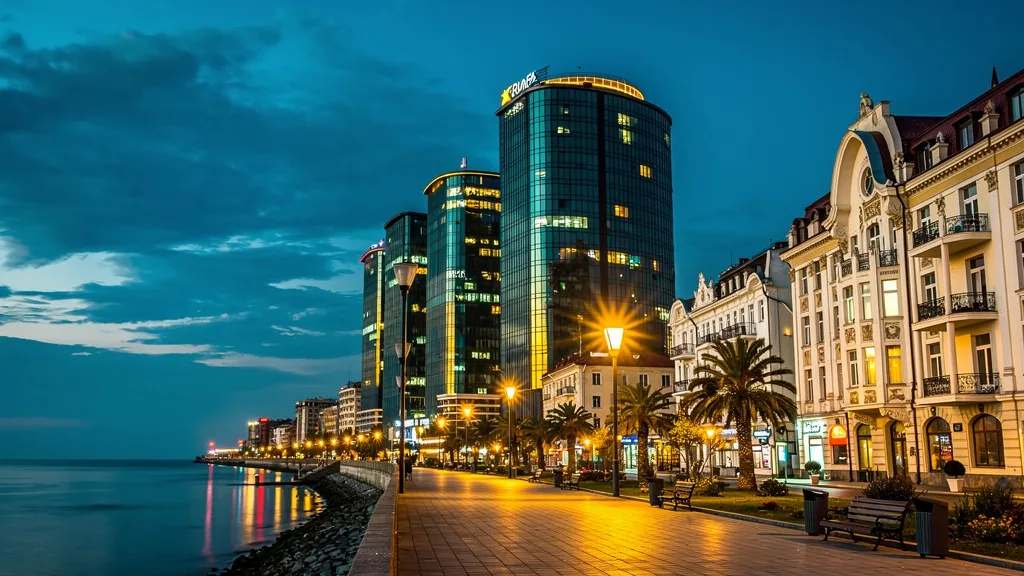
Batumi is Georgia’s second city and Black Sea resort capital — a subtropical mix of Soviet-era architecture, audacious modern towers, palm trees, pebbly beaches, and a nightlife that punches far above Georgia’s overall profile. The coastal drive and the hill country above Batumi offer a completely different Georgian experience from the mountains.
| Segment | Distance | Time | Highlights |
|---|---|---|---|
| Tbilisi - Batumi | 370 km | 5-6 hours | E60 to Kutaisi, then Adjara highway |
| Batumi - Gonio Fortress | 12 km | 20 min | Roman fortress ruins, Black Sea views |
| Batumi - Botanical Garden | 9 km | 15 min | Subtropical gardens on sea cliffs |
| Batumi - Machakhela Gorge | 30 km | 45 min | River gorge, forest, Turkish border area |
| Batumi - Mtirala National Park | 25 km | 40 min | Wettest area of Georgia, subtropical rainforest |
| Batumi - Kobuleti/Ureki | 35-70 km | 40-75 min | Coastal resorts, magnetic black sand |
| Total Batumi area | ~80 km local | 1-2 days |
Batumi highlights:
Boulevard: 7 km of seaside promenade stretching the length of the city beach. Cycling paths, sculptures (including the moving “Ali and Nino” figures that merge and separate on a timer — one of Georgia’s more successful modern art installations), cafes, and the entire social life of Batumi on a summer evening. Free. In July and August, the boulevard is packed until 2 AM.
Old Town: A compact grid of renovated streets with colorful balconied buildings mixing Ottoman, Soviet, and Art Nouveau architectural details. The best restaurants in Batumi are concentrated here. The interaction of architectural styles — a balconied Ottoman wooden house next to a Belle Époque facade next to a Soviet apartment block — should be jarring but somehow works.
Piazza Square: A theatrical space designed to evoke an Italian piazza — mosaic-covered surfaces, outdoor cafes, rotating art installations — that works better than the concept suggests. Evening dinner here for two: 40-60 GEL (15-22 USD). The fountain show in the center runs hourly after dark.
Batumi Botanical Garden (Mtsvane Kontskhi): Established in 1912, the garden occupies 108 hectares on the coastal cliffs north of the city. Over 2,000 plant species from subtropical and tropical zones thrive here — bamboo groves, Mexican cacti, Japanese section, Himalayan trees. Entry: 15 GEL ($5.50). The cable car within the garden (5 GEL additional) runs to the top section with sea views.
Machakhela Gorge and Turkish border area: The drive east from Batumi into the Adjara highlands follows a river canyon toward the Turkish border. Dense forests, waterfalls, small villages with Turkish-influenced architecture, and the sense of being in a landscape that has not changed much in a century. The road narrows toward the border — standard car, drive slowly, turn back at the last village if the road deteriorates.
Mtirala National Park: Georgia’s wettest corner (up to 4,800 mm of precipitation annually), the park contains subtropical Colchic forest unlike anything else in the Caucasus — ancient walnut, chestnut, and rhododendron forest that was isolated from glaciation and retains species found nowhere else. The hiking trails are accessible from the road without any special equipment.
Gonio Fortress: 12 km south of Batumi toward the Turkish border, a Roman-era fortress (1st century BC-4th century AD) with an unusual claim: local tradition holds that the Apostle Matthias is buried within its walls. Archaeologists have found a grave in the expected location but cannot confirm the attribution. Whether or not the Apostle is there, the fortress is substantial and the Black Sea backdrop is excellent. Entry: 3 GEL ($1.10).
Route Comparison
| Route | Distance | Days | Difficulty | Best Season | Car Required |
|---|---|---|---|---|---|
| Military Highway | 150 km | 1-2 | Moderate | Jun-Oct | Compact (4x4 for Gergeti track) |
| Kakheti Wine | 350 km loop | 2-3 | Easy | Sep-Oct (harvest) | Any car |
| Svaneti | 460 km (Tbilisi-Mestia) | 3-4 | Hard (road) | Jun-Sep | SUV minimum (4x4 for Ushguli) |
| Batumi Coast | 370 km + 80 km local | 2-3 | Easy | May-Oct | Any car |
Planning Tips
Two-week Georgia circuit (full coverage): Tbilisi (2 nights) - Military Highway/Kazbegi (2 nights) - Kakheti wine country (2 nights) - Kutaisi overnight (1 night) - Svaneti/Mestia (3 nights, including Ushguli day) - Batumi (2 nights) - return to Tbilisi by marshrutka or fly. This covers all four routes with a logical routing that minimizes backtracking.
One-week highlights (focused): Tbilisi (1 night) - Kazbegi (2 nights, including Gergeti) - Kakheti (2 nights, Sighnaghi base) - Tbilisi (1 night). Skip Svaneti and Batumi for a shorter trip. This delivers the two most accessible “Georgia defining” experiences without the intensity of Svaneti’s approach road.
Car choice matters more in Georgia than anywhere. For Military Highway and Kakheti, a compact car is fine. If adding Svaneti or any unpaved mountain destinations, a high-clearance SUV is strongly recommended. The price difference (10-20 USD/day) pays for itself in access to places like Gergeti Trinity Church (4x4 track), Ushguli (4x4 mandatory), David Gareja monastery approach (last 15 km unpaved), and countless winery side roads in Kakheti.
Fuel before mountains: Fill up completely in Tbilisi, Gudauri, Zugdidi, or Telavi before any mountain segment. The 90 km gap on the Military Highway and the 130 km Svaneti road both have no reliable fuel. Running low at altitude is a significantly worse problem than running low on a motorway.
Guesthouse accommodation changes the experience. Staying at family guesthouses in Kazbegi, Sighnaghi, and Mestia rather than hotels means meals included, local knowledge freely shared, and the kind of hospitality that Georgia is genuinely famous for. Book in advance for peak season (July-August); walk-in is possible in shoulder season.
Speed limits and police: Georgian police operate speed traps on the E60 motorway and on the approaches to Tbilisi. Speed cameras are increasingly common. The official limit on the E60 is 110 km/h; enforcement is inconsistent but real. Keep documents accessible — police checkpoints are not uncommon in rural areas and near the Russian border.
The David Gareja detour: 70 km southeast of Tbilisi toward the Azerbaijan border, the David Gareja cave monastery complex is one of Georgia’s most striking sites — cliff-face cave monasteries carved into the rocky escarpment. The last 15 km is unpaved. In a compact car, manageable in dry conditions but the ground is rough. The views at the top span into Azerbaijan. Entry free, hiking the ridge trail takes 2-3 hours.
Tusheti — for the very adventurous: Georgia’s most remote inhabited mountain region, accessible only via the Abano Pass (2,926 m) — a vertiginous dirt track with 70 hairpin turns that is only open June through September and only in a proper 4x4 with experienced drivers. The villages of Tusheti have preserved Bronze Age traditions and the landscape is the most dramatic in Georgia. This is not a route for first-time visitors to the country; it is an objective for experienced mountain drivers returning specifically for it.
For driving rules, see our driving guide. For rental costs, check costs and tips. For airport pickup, read our airport rental.