 DriveAtlas
Car Rental Costs in Romania 2026
Romania is one of the cheapest car rental markets in the European Union, and it is not even close. A compact car for a week costs what a single day costs in Iceland. Fuel is among the cheapest in Europe. Tolls do not exist (just a cheap vignette). And the food and accommodation you encounter along the way are priced at levels that make Western European travelers feel like they are getting away with something. We spent ten days driving across Romania – Bucharest to Brasov to the Transfagarasan to Sibiu to Cluj-Napoca to Bucovina and back – and the total car-related expenses (rental, insurance, fuel, vignette, parking) came to EUR 380. That is EUR 38 per day for two people in a comfortable car on some of Europe’s best roads.
Daily Rental Rates (2026 Estimates)
| Vehicle Category | Romanian Agency (per day) | International Agency (per day) | Weekly Rate (Romanian agency) |
|---|---|---|---|
| Economy (Dacia Logan, Hyundai i10) | EUR 16-24 (~$17-26) | EUR 22-35 (~$24-38) | EUR 95-150 |
| Compact (Dacia Sandero, Skoda Fabia) | EUR 20-30 (~$22-33) | EUR 28-42 (~$30-46) | EUR 125-190 |
| Mid-size (Skoda Octavia, VW Golf) | EUR 28-38 (~$30-41) | EUR 35-50 (~$38-54) | EUR 175-245 |
| SUV (Dacia Duster 2WD) | EUR 28-38 (~$30-41) | EUR 38-52 (~$41-57) | EUR 175-240 |
| SUV (Dacia Duster 4WD) | EUR 32-45 (~$35-49) | EUR 42-60 (~$46-65) | EUR 200-285 |
| Premium (VW Passat, Skoda Superb) | EUR 40-55 (~$44-60) | EUR 50-75 (~$54-82) | EUR 260-360 |
| Automatic surcharge | +EUR 5-12/day | +EUR 8-15/day | Varies |
Low season: November through March (excluding Christmas/New Year). Mountain passes are closed, fewer tourists arrive, and prices are at their lowest. A Dacia Sandero from Autonom in February can cost EUR 16-20 per day.
High season: June through September, particularly July-August when the mountain passes are open and European tourists arrive in volume. Prices increase 20-40% from low season. The Transfagarasan is most crowded on July-August weekends.
Shoulder season (May, September-October): The sweet spot. Mountain passes open (Transfagarasan from late June), good weather, lower prices than peak summer, fewer crowds. September foliage on the Carpathians is genuinely spectacular.
The Romanian agency advantage: Autonom and Klass Wagen are consistently 25-40% cheaper than Europcar, Hertz, and Avis for equivalent vehicles. The savings are most dramatic on longer rentals. A week in a Dacia Sandero from Autonom runs about EUR 125-160, versus EUR 190-280 from an international brand. The quality difference is minor – both primarily use Dacia and Skoda vehicles from the same dealer networks.
Booking strategy by season:
| Season | Booking Window | Best Agency Type | Notes |
|---|---|---|---|
| July-August | 4-6 weeks ahead | Either | Compacts scarce, book early |
| September-October | 2-3 weeks ahead | Romanian preferred | Best season overall |
| November-March | Walk-in viable | Romanian for price | Lowest demand |
| April-May | 1-2 weeks ahead | Either | Passes still closed |
| June | 2-3 weeks ahead | Either | Passes opening |
Insurance Costs
Romanian insurance is straightforward and affordable compared to Western Europe.
| Insurance Type | What It Covers | Typical Cost | Notes |
|---|---|---|---|
| Basic CDW (included) | Collision damage, excess EUR 500-1,000 | Included in rate | Standard |
| Full CDW buy-down | Reduces excess to EUR 0-100 | EUR 6-12/day (~$7-13) | Recommended |
| Theft protection | Usually included in CDW | Included | Standard in Romania |
| Personal accident | Medical costs for driver/passengers | EUR 2-4/day (~$2-4) | Optional |
| Tire and windscreen | Damage not covered by standard CDW | EUR 2-4/day (~$2-4) | Useful for mountain and rural roads |
| Roadside assistance | Towing, lockout, flat tire | Often included | Check policy |
The CDW excess: Without buying down the excess, you are liable for EUR 500-1,000 if the car is damaged. On Romanian roads – where potholes, horse carts, and gravel shoulders are real hazards – we always take the full buy-down. At EUR 6-12 per day, it is cheap insurance in every sense.
What standard CDW typically excludes in Romania:
- Tire and wheel damage from potholes (a genuine risk on county roads)
- Windscreen chips from stone debris on mountain roads
- Underbody damage from unpaved access roads to villages or trailheads
- Side mirror damage on narrow rural roads
- Any damage when the driver is over 0.0% BAC (Romanian zero tolerance limit)
Credit card coverage: Cards like Visa Premier, Mastercard Gold, Chase Sapphire Reserve, and Amex Platinum often include CDW when you pay for the rental with the card. This works in Romania. However, the agency will still block a deposit of EUR 300-1,000 on your card, and you will need to handle any damage claims through your card issuer after the fact.
Total insurance cost for a week: EUR 42-84 for full buy-down, or EUR 0 if using credit card coverage (with the risk of deposit-blocking and claim processing delays).
Rovinieta (Road Vignette)
The rovinieta is Romania’s electronic road usage fee, required for all national roads and motorways. Unlike the physical stickers used in Switzerland or Austria, the Romanian rovinieta is entirely electronic – it links to your vehicle’s license plate in the national database and is checked by cameras on the road network.
| Duration | Cost | Best For |
|---|---|---|
| 1 day | RON 4 (~EUR 0.80) | Single-day transit |
| 7 days | RON 18 (~EUR 3.60) | Standard tourist trip |
| 30 days | RON 36 (~EUR 7.20) | Recommended for peace of mind |
| 90 days | RON 65 (~EUR 13) | Extended stays |
| 12 months | RON 115 (~EUR 23) | Expats, long-term residents |
Is it included in the rental? Many agencies include a 30-day rovinieta in the rental rate. This is usually the case with Autonom (a reason to prefer them). International agencies are less consistent about including it. Always confirm at pickup – ask specifically whether the rovinieta is active for your vehicle’s plate before leaving the lot.
Purchasing yourself: Available online at roviniete.ro (you need the vehicle’s license plate number), at any Petrom, Rompetrol, OMV, or Lukoil station, and at border crossings when entering Romania. The purchase is instantaneous – it enters the database within minutes.
Enforcement: Automated camera systems read license plates and cross-reference the vignette database in real time on motorways and DN roads. Driving without a valid rovinieta results in a fine of RON 250-1,000 (~EUR 50-200) linked to the vehicle registration – it will catch up with the rental agency and they will charge your card. The system is automated, consistent, and there is no human discretion involved.
Fuel Costs
Romania has some of the cheapest fuel in the EU, thanks to domestic production and lower taxes.
| Fuel Type | Price per Liter (2026 est.) | Per Gallon (US) |
|---|---|---|
| Unleaded 95 (benzina 95) | RON 7.20 (~EUR 1.44, ~$1.57) | ~$5.94 |
| Diesel (motorina) | RON 7.50 (~EUR 1.50, ~$1.63) | ~$6.17 |
| Unleaded 98 (benzina 98) | RON 7.80 (~EUR 1.56, ~$1.70) | ~$6.43 |
| LPG (GPL) | RON 3.80 (~EUR 0.76, ~$0.83) | ~$3.14 |
Fuel consumption: A compact Dacia Sandero averages about 6 liters per 100 km on highways and 7-8 liters on mountain roads. A Dacia Duster uses 7-8 liters on highways and 9-11 liters in the mountains.
Estimated fuel budget for a week: For 1,000-1,500 km of mixed driving (typical for a Romania road trip), expect EUR 100-160 in a compact car, or EUR 130-200 in an SUV.
Fuel stations: Petrom (OMV), Rompetrol, Lukoil, MOL, and Socar are everywhere along main roads. In remote areas (Maramures, rural Bucovina, mountain passes), stations can be 30-50 km apart. Fill up before entering the Transfagarasan or Transalpina – there are no stations on either pass.
Tolls
Romania has no toll booths on its internal road network. The rovinieta vignette covers all motorway and national road usage. The only additional toll-like charges are:
- Danube bridge crossings at the Romania-Bulgaria border: RON 7-26 depending on vehicle size. Giurgiu-Ruse bridge charges RON 26 for a car.
- Some urban tunnels and specific bridges occasionally have nominal fees – these are rare and clearly marked.
For a domestic Romania road trip, budget zero for tolls beyond the rovinieta.
Parking Costs
| Location | Cost | Notes |
|---|---|---|
| Bucharest center | RON 5-10/hour (~EUR 1-2) | Most expensive in the country |
| Brasov old town area | RON 3-5/hour (~EUR 0.60-1) | Park outside old walls |
| Cluj-Napoca center | RON 3-5/hour (~EUR 0.60-1) | Tight but manageable |
| Sibiu old town | RON 2-4/hour (~EUR 0.40-0.80) | Limited spaces |
| Small towns and villages | Free | Unrestricted |
| Mountain trailheads | Free | Limited spaces at popular spots |
| Shopping malls | Free first hours | All major cities |
Total parking budget for a week: EUR 10-30 for a typical road trip that spends most time outside major cities. Bucharest-heavy trips: EUR 30-60.
Hidden Fees and Surcharges
Young driver surcharge (under 25): EUR 5-15 per day at most agencies. Some Romanian agencies (Klass Wagen, some local independents) waive this. Ask specifically.
Additional driver: EUR 3-8 per day. Some agencies include one free additional driver. International agencies are less likely to waive this than Romanian ones.
One-way drop-off: Picking up in Bucharest and dropping off in Cluj (or vice versa): EUR 60-150 depending on distance and agency. Romanian agencies typically charge EUR 60-80 for the Bucharest-Cluj route, international brands charge EUR 100-150. Calculate whether the time and driving saved justifies the fee – for a 10-day trip where you want to fly in and out of different cities, it usually does.
Cross-border fee: If you plan to drive into Hungary, Bulgaria, or other countries: EUR 20-50 per country per rental. Some agencies prohibit travel to Moldova, Ukraine, and Serbia entirely. Always declare cross-border plans explicitly at booking – do not discover the restriction at a border.
Winter tire surcharge: November 1 to March 31, winter tires are mandatory by Romanian law. Reputable agencies include them automatically during this period. Some budget agencies charge EUR 20-40 for the tire swap – check at booking.
GPS rental: EUR 5-8 per day. Skip it entirely – Google Maps and Waze work perfectly in Romania. Download offline maps via Google Maps for mountain passes and rural areas where data signal is unreliable.
Child seat: EUR 3-5 per day. Required for children under 12 (or under 150 cm) in Romania. Book in advance – agencies have limited numbers.
Additional insurance for mountain areas: Some agencies now offer a specific “mountain driving” package for the Transfagarasan season – typically bundling tire and windscreen coverage. Ask about this if driving the passes.
Surcharge Avoidability
| Fee | How to Avoid | Savings Potential |
|---|---|---|
| Young driver fee | Ask Romanian agencies specifically | EUR 35-105 over 7 days |
| GPS rental | Use phone + offline maps | EUR 35-56 over 7 days |
| International agency premium | Use Autonom or Klass Wagen | EUR 50-100 over 7 days |
| Automatic surcharge | Book manual transmission | EUR 35-105 over 7 days |
| One-way fee | Plan loop itinerary, same pickup and drop-off | EUR 60-150 |
| Full-to-empty fuel markup | Choose full-to-full policy | EUR 20-40 per fill |
Day-by-Day Cost Breakdown: 10-Day Romania Road Trip
Using a Dacia Sandero (compact, manual) from Autonom, mid-season (September), full CDW buy-down. Route: Bucharest → Brasov → Transfagarasan → Sibiu → Cluj-Napoca → Bucovina → return.
| Day | Route | Distance | Fuel Cost | Parking | Notes |
|---|---|---|---|---|---|
| Day 1 | Bucharest → Sinaia → Brasov | 170 km | EUR 15 | EUR 5 (Brasov) | Peles Castle stop |
| Day 2 | Brasov day (Bran Castle, Rasnov) | 70 km | EUR 6 | EUR 5 (Brasov) | Local exploration |
| Day 3 | Brasov → Curtea de Arges → Transfagarasan | 130 km | EUR 16 | EUR 0 | High fuel day (mountains) |
| Day 4 | Transfagarasan north → Sibiu | 120 km | EUR 13 | EUR 5 (Sibiu) | Balea Lake summit |
| Day 5 | Sibiu day (Biertan, Viscri) | 80 km | EUR 7 | EUR 5 (Sibiu) | Fortified churches |
| Day 6 | Sibiu → Sighisoara → Cluj-Napoca | 230 km | EUR 20 | EUR 5 (Cluj) | Long driving day |
| Day 7 | Cluj day (Turda Salt Mine, gorges) | 80 km | EUR 7 | EUR 3 (Cluj) | Day trip |
| Day 8 | Cluj → Bistrita → Suceava (Bucovina) | 280 km | EUR 24 | EUR 0 | Longest driving day |
| Day 9 | Bucovina monasteries loop | 200 km | EUR 17 | EUR 0 | Voronet, Sucevita |
| Day 10 | Suceava → Bucharest (A1/A3) | 450 km | EUR 38 | EUR 5 (Bucharest) | Motorway day, return |
| Total | 1,810 km | EUR 163 | EUR 33 |
Full 10-day cost summary:
| Expense | Amount |
|---|---|
| Car rental (10 days × EUR 22/day, Autonom, September) | EUR 220 |
| Full CDW buy-down (10 days × EUR 8/day) | EUR 80 |
| Rovinieta (30-day vignette) | EUR 7 |
| Fuel (1,810 km, mixed driving) | EUR 163 |
| Parking (mostly free, some city days) | EUR 33 |
| Total transportation | EUR 503 (~$548) |
Total Cost Estimates
| Scenario | Base Rental (7 days) | Insurance | Fuel (1,200 km) | Vignette | Parking | Total |
|---|---|---|---|---|---|---|
| Budget (economy, Romanian agency, low season) | EUR 110 | EUR 42 | EUR 95 | EUR 4 | EUR 10 | EUR 261 (~$284) |
| Mid-range (compact, Romanian agency) | EUR 155 | EUR 56 | EUR 110 | EUR 4 | EUR 20 | EUR 345 (~$376) |
| Comfortable (SUV, international agency, high season) | EUR 350 | EUR 84 | EUR 150 | EUR 4 | EUR 25 | EUR 613 (~$668) |
Per-day cost: EUR 37-88 depending on your choices. The mid-range option at about EUR 49 per day is exceptional value for European driving.
Fee Avoidability
| Fee | How to Avoid | Savings Potential |
|---|---|---|
| International agency premium | Use Autonom or Klass Wagen | EUR 50-100 over 7 days |
| GPS rental | Use phone + offline maps | EUR 35-56 over 7 days |
| Automatic surcharge | Drive manual | EUR 35-84 over 7 days |
| Young driver surcharge | Ask local agencies specifically | EUR 35-70 over 7 days |
| One-way fee | Return to same city (loop itinerary) | EUR 60-150 |
| Cross-border fee | Stay within Romania | EUR 20-50 per country |
Money-Saving Tips
Use Romanian agencies. Autonom is our top recommendation – professional service, modern fleet (mostly Dacias and Skodas), offices at all major airports and cities, and prices 25-40% below international brands. Klass Wagen is the budget alternative with slightly older vehicles but equally valid service.
Book the weekly rate. Weekly rates save 15-25% per day compared to daily rates. Even for 5-day rentals, the 7-day rate is often cheaper overall. Check both options before booking.
Manual saves money. Most Romanian fleet is manual. Automatic costs EUR 5-15 extra per day and books out faster. If you can drive manual, the savings over a week are significant. The mountain passes are actually better in manual – engine braking on steep descents gives you more control than a traditional automatic.
Skip the GPS. Your phone does the same job for free. Download offline maps of Romania via Google Maps before departure. Maps.me is a good backup option for areas with weak signal (Maramures villages, mountain pass approaches, rural Bucovina).
Use credit card insurance. If your card includes rental CDW, you can skip the agency’s buy-down and save EUR 42-84 per week. Verify the coverage extends to Romania, check what exclusions apply (tires, windscreen, underbody), and understand you will need to manage any claims through your card issuer. The agency will still block a deposit.
Fill up at big chains. Petrom (OMV) and Rompetrol are typically the cheapest. Avoid highway rest area stations (Motorway service areas), which charge a premium of RON 0.30-0.50 per liter above regular pump price.
Park at malls for free. Every Romanian city has shopping malls with free parking. Park at the mall, walk or take a short taxi to the old town. The AFI Cotroceni mall in Bucharest, the Promenada in Brasov, and the Iulius Mall in Cluj all have large free lots near the city centers.
Combine with cheap accommodation. Romanian guesthouses (pensiuni) in Transylvania and Bucovina cost EUR 25-40 per night with breakfast included. Your total trip cost (car + accommodation + food) can be remarkably low by European standards. A week in Romania including car rental, accommodation, and meals routinely comes in under EUR 700 per person.
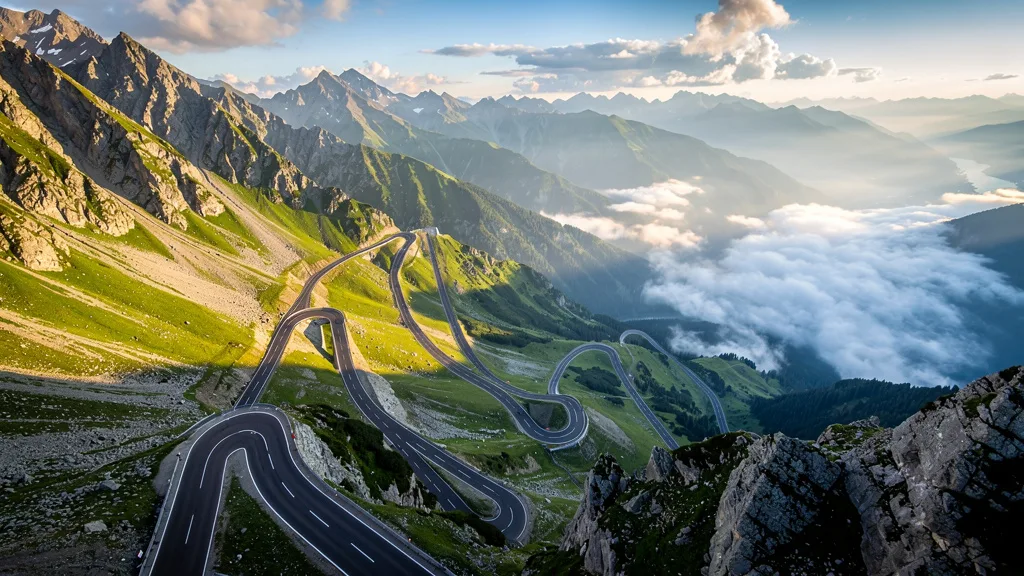
Book off-season. September and October offer the best combination of good weather (autumn foliage on the mountain roads), lower prices, and fewer crowds. The Transfagarasan is still open in October. Rental prices are 20-30% lower than July-August. We drove the Transfagarasan on an October Tuesday and had the famous switchback section almost entirely to ourselves.
Consider a Dacia. Romania is where Dacias are manufactured (the Mioveni factory near Pitesti). The rental fleets are full of them. The Logan, Sandero, and Duster are cheap to rent, practical on Romanian roads, and parts are available everywhere. You are unlikely to feel deprived in a Dacia Duster on a mountain pass – they handle it well and cost half what a VW Tiguan would.
Use ATMs for cash. Romanian restaurants, guesthouses, and rural fuel stations often prefer cash. Exchange rates at Romanian ATMs (bancomat) are typically better than exchange bureaux at airports. Use a card with no foreign transaction fees for best results. The Leu (RON) is the currency – do not bring Euros to pay directly, as most vendors are not set up for Euro payments (unlike in Croatia or Montenegro, where Euro payments are routine at tourist-facing businesses).
Pensiune accommodation. Romanian guesthouses (pensiuni, singular pensiune) throughout Transylvania and Bucovina offer rooms with breakfast included for EUR 25-45 per night per room. The quality is often excellent – home-cooked breakfast, genuine hospitality, and local knowledge about the area that no hotel can match. Booking.com and the proprietors’ own websites are the main booking channels. Many pensiuni are run by families and can be contacted directly via the phone number listed – a call in basic English is usually understood and welcomed.
Payment and Deposits
Credit card required. All agencies require a credit card for the security deposit. Debit cards are not accepted for the deposit at most agencies. Romanian agencies typically accept Visa and Mastercard. International agencies accept Amex as well. Local agencies may not.
Deposit amount: EUR 300-1,000 depending on vehicle and coverage level. If you take the full CDW buy-down, the deposit is usually the lower end of this range. The amount is blocked (not charged) and released within 7-14 days after return.
Currency: Romanian Leu (RON). The exchange rate in early 2026 is approximately 5 RON = 1 EUR. Rental rates are typically quoted in EUR on international booking sites. Local agencies quote in RON but accept EUR-denominated cards. ATMs (bancomat) are widely available for cash withdrawals in RON. Petrol stations, restaurants, and shops all accept card payment.
Currency tip: Bring a card with no foreign transaction fees. Some cards charge 1-3% on non-EUR transactions (since Romania uses RON, not EUR). Over a 10-day trip with EUR 500 in card transactions, this adds EUR 5-15 – not critical but avoidable.
Tipping the rental agent: Not expected or customary. Romania is not a tipping culture in the rental car context.
Regional Cost Comparison
For context on Romania’s value proposition:
| Country | Compact Car (7 days) | Fuel (per liter) | Road Tax | Parking (city center) |
|---|---|---|---|---|
| Romania | EUR 125-190 | EUR 1.44 | EUR 3.60 (7 days) | EUR 0.60-2/hour |
| Bulgaria | EUR 150-220 | EUR 1.38 | Vignette EUR 8-13 | EUR 0.50-1/hour |
| Hungary | EUR 175-250 | EUR 1.65 | Vignette EUR 10 | EUR 1-3/hour |
| Czech Republic | EUR 200-280 | EUR 1.60 | None | EUR 2-4/hour |
| Western Europe | EUR 300-500+ | EUR 1.80-2.20 | Varies | EUR 3-6/hour |
Romania consistently undercuts its Central European neighbors on rental costs, fuel, and living expenses. For a budget-conscious European road trip, it has no peer in terms of quality-to-cost ratio.
Fuel Costs in Depth
Romania has some of the cheapest fuel in the EU, a combination of domestic petroleum production, lower taxes, and a cost of living that keeps margins compressed.
Petrol stations comparison:
| Chain | Average Price vs. Market | Acceptance | Notes |
|---|---|---|---|
| Petrom (OMV) | Market average | Cards always | Largest network, most reliable |
| Rompetrol | Slightly below average | Cards always | Good rural coverage |
| Lukoil | Similar to Petrom | Cards always | Less common but reliable |
| MOL | Slightly above average | Cards always | Good motorway coverage |
| Independent stations | Variable | Sometimes cash only | Lowest prices possible, verify card acceptance |
| Motorway service areas | 5-10% above market | Cards | Premium for convenience |
Mountain driving fuel calculation: The Transfagarasan round trip (Curtea de Arges and back via Cartisoara) is approximately 180 km. A compact Dacia Sandero averaging 8L/100km on the mountain sections uses about 14.4 liters – approximately EUR 21 in fuel. The Transalpina (Novaci to Sebes and return) is 296 km at similar mountain consumption – approximately EUR 34. Factor this into your daily budget for mountain driving days.
Diesel vs. petrol: Romanian rental cars are split between diesel and petrol. Diesel (motorina) is currently slightly more expensive than petrol 95 in Romania, which is unusual by European standards where diesel is often cheaper. Check which fuel type your vehicle uses – putting petrol in a diesel engine (or vice versa) is a costly mistake not covered by standard CDW.
The Real Cost of a Romania Road Trip
Here is what the full experience costs at different levels, beyond just the car:
Budget week (2 people, low season, all budget choices):
- Car rental: EUR 140 (economy, manual, Klass Wagen, 7 days)
- Insurance: EUR 42 (CDW buy-down only)
- Fuel: EUR 95 (1,200 km, compact)
- Accommodation: EUR 210 (EUR 30/night at pensiuni with breakfast)
- Food: EUR 105 (EUR 15/day per person at local restaurants)
- Entrance fees: EUR 40 (castles, monasteries, museums)
- Total for 2 people: approximately EUR 632 (~EUR 316 per person)
Mid-range week (2 people, September):
- Car rental: EUR 195 (compact SUV, Autonom)
- Insurance: EUR 84 (full buy-down + tire/windscreen)
- Fuel: EUR 120
- Accommodation: EUR 350 (EUR 50/night at 3-star hotels)
- Food: EUR 175 (EUR 25/day per person)
- Entrance fees: EUR 50
- Total for 2 people: approximately EUR 974 (~EUR 487 per person)
These numbers are genuinely striking by European standards. A mid-range week in Romania – mountain passes, medieval cities, extraordinary landscapes – costs less than 3 nights in a similar-quality hotel in Paris.
For airport pickup specifics, see our airport rental guide. For city rental details, check our top cities guide. For road rules and driving conditions, read our driving guide. Comparing Balkan road trip costs? Our Bulgaria costs guide covers the neighbor to the south.