 DriveAtlas
Car Rental in Romania 2026
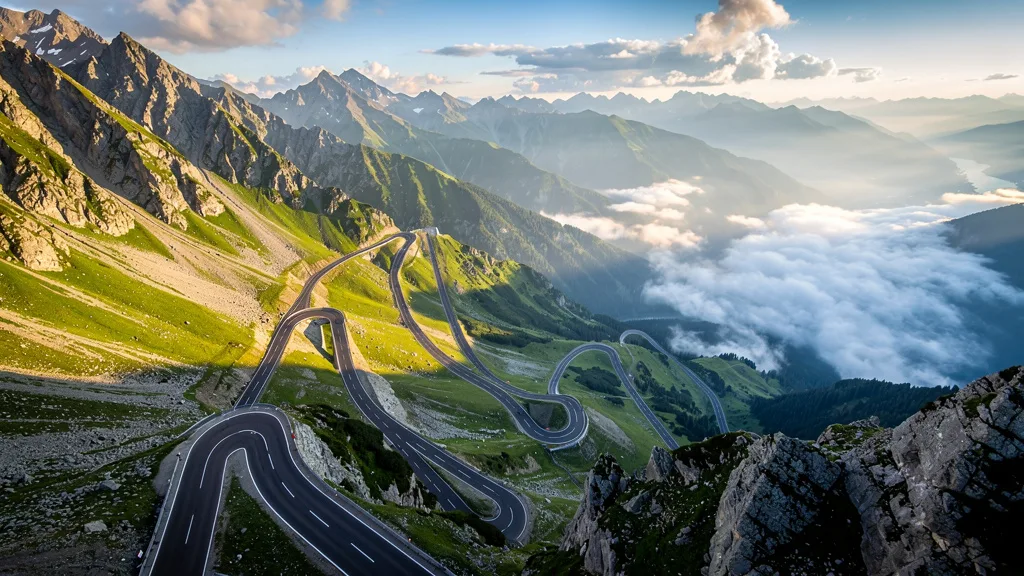
Jeremy Clarkson once called the Transfagarasan Highway the best road in the world. We are not sure he was wrong. The road climbs from Transylvanian foothills through dense forest, crosses the Fagaras Mountains at 2,042 meters through a series of switchbacks that look like a child drew them, and descends the other side past Vidraru Dam and Curtea de Arges. We drove it on a Tuesday in September. The clouds parted at the summit, the lake below was turquoise, and we had the hairpins largely to ourselves. Romania has roads like this, and it has them in abundance.
But Romania is not just the Transfagarasan. It is Transylvania’s medieval towns – Brasov, Sibiu, Sighisoara – connected by roads that wind through the Carpathians. It is the painted monasteries of Bucovina, where you drive through rolling farmland and villages where horse carts share the road with modern cars. It is the Danube Delta, where the road simply ends and the water begins. And it is Bucharest, a capital city that mixes Parisian-style boulevards with communist concrete and a traffic pattern that requires both courage and patience.
A rental car is by far the best way to experience Romania. The train network connects the major cities but misses the scenic roads entirely. Buses serve small towns but on schedules that work for commuters, not tourists. The distances are manageable – Bucharest to Brasov is three hours, Brasov to Sibiu is three hours, Sibiu to Cluj-Napoca is four hours – and the driving, once you escape Bucharest, is genuinely enjoyable.
Your Romania Driving Guides
Driving in Romania covers road rules, the rovinieta vignette system, license requirements, speed limits, and what to expect on Romanian roads – including the horse carts, the aggressive overtaking, and the variable quality of rural roads.
Best Road Trips in Romania maps out the Transfagarasan Highway, the Transalpina, the Transylvania medieval towns loop, the Bucovina painted monasteries route, and the Danube Delta drive. Each route includes distances, driving times, stops, and seasonal timing.
Airport Car Rental covers the pickup process at Bucharest Henri Coanda Airport, Cluj-Napoca Airport, and the smaller regional airports. Agency comparisons, insurance, and tips for getting on the road quickly.
Best Cities for Car Rental breaks down the rental scene in Bucharest, Brasov, and Cluj-Napoca – the three main pickup locations for different Romanian road trip itineraries.
Costs and Tips gives you the complete pricing picture: daily rates, insurance packages, the rovinieta vignette, fuel costs, and how to keep your budget under control.
Why Romania Works for a Road Trip
The Carpathians are spectacular. The mountain chain arcs through the center of the country, creating a natural barrier between Transylvania and Wallachia. The roads that cross these mountains – the Transfagarasan, the Transalpina, the Bicaz Gorges – are among the best driving roads in Europe. The Transfagarasan alone is worth flying to Romania for. Built by Ceausescu in the 1970s as a military road, it climbs to 2,042 meters through a series of switchbacks that look like someone laid a road over a geography exam. Jeremy Clarkson called it the best road in the world on Top Gear, and while we have some reservations about taking motoring advice from Jeremy Clarkson, on this particular point he was not wrong.
The distances are right. Romania is big enough to be interesting (about the size of the UK) but small enough that you can see the highlights in 7-10 days. Bucharest to Brasov is three hours. Brasov to Sibiu is another three hours. Sibiu to Cluj-Napoca is four hours. The entire country is connected at a pace that feels exploratory rather than exhausting. No single day’s drive needs to exceed four hours to reach something genuinely worth seeing.
It is affordable. Romania is one of the cheapest countries in the EU for car rental, fuel, food, and accommodation. A compact rental car from a local agency costs EUR 20-30 per day. Fuel runs EUR 1.44-1.56 per liter. A good hotel in Brasov costs EUR 40-60 per night. A traditional pensiune in Transylvania with breakfast included runs EUR 25-40. A week-long road trip through Transylvania and the mountain passes costs less than two nights in Paris.
The culture is extraordinary. Medieval Saxon towns built by Transylvanian Saxons who arrived in the 12th century. Fortified churches in villages that have barely changed in 600 years. Romanian Orthodox monasteries in Bucovina with exterior walls covered in 500-year-old frescoes that have somehow survived the weather. Bran Castle, which is Dracula’s castle in the tourist sense if not the strict historical one. Traditional villages in Maramures where horse carts share the road with cars and wooden churches from the 18th century are still in active use. And the food: mici (small grilled sausages), sarmale (cabbage rolls), ciorba de burta (tripe soup that will challenge and then convert you), and papanasi (fried cheese doughnuts with sour cream) – hearty, cheap, and unlike anything in Western Europe.
The roads reward drivers who pay attention. Romania has the full spectrum: modern motorways where you can cruise at 130 km/h, national roads through every village with all the complications that implies, county roads of variable quality that are fine one kilometer and potholed the next, and mountain passes that require genuine skill and concentration. Driving Romania is never passive. You are always doing something – navigating, adjusting to a new road surface, slowing for a village, or simply staring at a landscape that seems implausible for central Europe.
Quick Facts for Driving in Romania
| Detail | Information |
|---|---|
| Currency | Romanian Leu (RON); 1 EUR ~ 5 RON |
| Driving side | Right-hand traffic |
| License | EU license valid; non-EU requires IDP |
| Vignette required | Yes (rovinieta) – approx. EUR 3.60 for 7 days |
| Blood alcohol limit | 0.0% – zero tolerance, strictly enforced |
| Speed limits | 50 km/h urban, 90 km/h rural, 100 km/h expressway, 130 km/h motorway |
| Fuel (benzina 95) | RON 7.20/liter (~EUR 1.44) |
| Compact car rental | EUR 20-30/day (Romanian agency), EUR 28-42/day (international) |
| Main airports | Bucharest OTP, Cluj-Napoca CLJ, Timisoara TSR, Sibiu SBZ |
| Emergency number | 112 |
| Mountain passes open | Late June through late October (Transfagarasan, Transalpina) |
Practical Tips
- The rovinieta is mandatory. This electronic road tax vignette must be purchased before driving on national roads. Available at gas stations, online, or through the rental agency. A 7-day vignette costs about RON 18 (~EUR 3.60). Most rental agencies include it, but verify.
- Mountain roads are seasonal. The Transfagarasan and Transalpina are typically open from late June to late October, weather dependent. Check current status before planning your route.
- Horse carts are real. On rural roads in Transylvania, Maramures, and Bucovina, you will share the road with horse-drawn carts. They are slow, unlit at night, and sometimes occupy the center of the road. Drive carefully, especially at dusk.
- Bucharest driving is an experience. The capital has aggressive drivers, creative parking, and traffic that rivals any European capital. If this is your first time, consider picking up the car on your way out of the city rather than navigating it by car.
- Romania is an EU member. EU driving licenses are valid. Non-EU visitors need an International Driving Permit (IDP).
Practical Notes for First-Time Visitors
The rovinieta is not optional. This electronic road vignette is checked by automated cameras on national roads and motorways. A 7-day vignette costs approximately RON 18 (EUR 3.60). Most rental agencies include it, but verify at pickup. Driving without one risks a fine of RON 250-1,000.
Zero alcohol is the law. The Romanian blood alcohol limit for drivers is 0.0%. Not the 0.05% common in most of Europe – zero. One glass of wine at lunch and you are over the limit. The penalties include license suspension and criminal charges. This is not a rule that gets overlooked.
Mountain passes are seasonal. The Transfagarasan (DN7C) and Transalpina (DN67C) are typically open from late June to late October, depending on snowfall. The Romanian road authority (CNAIR) announces exact dates. Do not build a trip around these roads without checking current status.
Horse carts are not a joke. In Transylvania, Maramures, and Bucovina, horse-drawn carts share the road with cars. They are slow, sometimes unlit at night, and can occupy the center of a narrow road without much awareness of traffic behind them. Slow down on rural roads, especially at dusk.
Bucharest driving requires a specific mindset. Lane markings are decorative, double-parking is standard, and aggressive overtaking is normal. If you are landing in Bucharest and heading directly to Transylvania, consider picking up the car at the airport and driving straight to the motorway without stopping in the city.
Start with our driving guide for the rules and road conditions, plan your routes with best road trips, or head straight to costs and tips for the complete budget picture. Romania pairs naturally with Bulgaria to the south and Hungary to the west for a broader Balkan or Central European road trip.