 DriveAtlas
Best Road Trips in Serbia
We almost skipped Serbia on our Balkans road trip. The plan was to drive straight from Budapest to Montenegro, passing through Belgrade with maybe a lunch stop. Then we saw the Djerdap gorge on the map — a narrow section where the Danube squeezes between mountain walls — and decided to take what we thought would be a small detour. That “small detour” turned into three days, two bottles of local wine, one spontaneous overnight in a fisherman’s guesthouse, and the firm conviction that Serbia might be the most underrated driving destination in Europe.
The country’s geography is more varied than most people expect. The flat, agricultural Vojvodina plain in the north gives way to rolling hills around Belgrade, which then build into the forested mountains of western and southern Serbia. The Danube and its tributaries cut dramatic valleys through the landscape. And nearly everywhere, the roads are quiet enough that you can actually enjoy the drive rather than white-knuckling through traffic.
Route Comparison
| Route | Distance | Drive Time | Best For | Difficulty |
|---|---|---|---|---|
| Djerdap Gorge & Danube Drive | 260 km (one way) | 4-5 hours | River scenery, Roman ruins, nature | Easy-moderate |
| Zlatibor & Tara Mountain Loop | 350 km loop | 6-7 hours | Mountains, villages, rafting | Moderate |
| Fruska Gora Monastery Circuit | 120 km loop | 2-3 hours | History, wine, monasteries | Easy |
| Belgrade to Nis via Morava Valley | 240 km | 3-4 hours | Cities, fortresses, food | Easy |
| Western Serbia Grand Tour | 550 km loop | 3-4 days | Everything | Moderate-challenging |
| Kopaonik & Southern Serbia Loop | 400 km loop | 2-3 days | Mountains, spa towns, nature | Moderate |
Route 1: The Djerdap Gorge — Belgrade to Kladovo Along the Danube
This is, without qualification, one of the most spectacular river drives in Europe. The Djerdap gorge (also known as the Iron Gates) is where the Danube narrows to just 150 meters wide while cliffs rise 300 meters on either side. The Romans built a road here. You get to drive on its modern successor.
Route details:
- Start: Belgrade
- End: Kladovo (or loop back via Zajecar and Paracin)
- Distance: 260 km one way
- Drive time: 4-5 hours (without stops)
- Recommended duration: 2 days with overnight in Donji Milanovac or Kladovo
The drive:
Leave Belgrade heading east on the E75 toward Nis, then exit at Pozarevac and follow signs toward Veliko Gradiste and the Danube. The first section is through flat farmland — pleasant but unremarkable. Things change dramatically once you reach Golubac, about 130 kilometers from Belgrade.
Golubac Fortress sits at the entrance to the gorge, its medieval towers rising directly from the riverbank. The recently restored fortress is worth a stop — allow 1-2 hours. The restoration work is exceptional, and the views back across the Danube toward Romania are already giving you an idea of what the gorge holds. From here, the road enters the Djerdap National Park and the scenery becomes extraordinary.
The road follows the Danube’s south bank through increasingly dramatic gorge sections:
| Stop | Distance from Belgrade | Highlight |
|---|---|---|
| Golubac Fortress | 130 km | Medieval fortress on the Danube |
| Lepenski Vir | 155 km | 8,000-year-old Mesolithic settlement |
| Donji Milanovac | 175 km | Best base for exploring the gorge |
| Mali Kazan (Little Cauldron) | 183 km | First gorge narrows, impressive cliff walls |
| Veliki Kazan (Big Cauldron) | 190 km | Narrowest section, most dramatic views |
| Tabula Traiana | 200 km | Roman inscription carved into cliff face |
| Diana Fortress | 240 km | Roman fortress ruins |
| Kladovo | 260 km | End point, views of the Iron Gates dam |
Lepenski Vir is one of the oldest known urban settlements in Europe — a Mesolithic community that lived here around 6,500 BCE. The site museum houses extraordinary fish-head sculptures found at the site. It requires about an hour and is worth every minute. The original location was submerged when the Djerdap dam was built in the 1970s, but the artifacts and reconstructed structures were moved to higher ground.
The Veliki Kazan section is the highlight. The Danube narrows to about 150 meters here, and the cliffs reach their maximum height. Across the river, you can see the Romanian side of the gorge, equally dramatic. There are several pullover points where you can park and simply stare. We spent 45 minutes at one of them without feeling the need to move.
Tabula Traiana is a Roman inscription carved into the gorge wall by Emperor Trajan’s engineers around 100 AD, commemorating the road they built along the Danube. It is visible from the road — look for the viewing platform on the right, about 200 km from Belgrade. The inscription itself is not large, but the idea of it — a 2,000-year-old road sign carved into a cliffside above one of Europe’s great rivers — makes it one of the most remarkable roadside sights anywhere in Europe.
Practical tips:
- The road through the gorge is two-lane and generally in good condition, but it is winding with limited overtaking opportunities. Driving time is longer than the distance suggests.
- Donji Milanovac is the best place to stay overnight — several guesthouses and restaurants with terrace views over the river, most charging 35-60 EUR for a double room with breakfast.
- Fish restaurants along the route serve excellent Danube fish soup (riblja corba) and fresh carp — do not skip this. The stretch between Golubac and Donji Milanovac has several riverside konobas serving excellent local fish.
- The return trip can go via Zajecar, Paracin, and back to Belgrade on the E75, making a complete loop of about 500 km.
- Mobile coverage is spotty in the deepest gorge sections — download offline maps before setting out.
Route 2: Zlatibor and Tara Mountain Loop
Western Serbia’s mountain country is where the landscape turns alpine. Zlatibor and Tara are the two main mountain areas, connected by roads that wind through forests, cross rivers, and pass through villages where time moves at a different speed. This is some of the finest mountain driving in the Balkans.
Route details:
- Start/End: Belgrade
- Loop distance: ~350 km
- Drive time: 6-7 hours (driving only)
- Recommended duration: 2-3 days
The drive:
Take the A2/E763 motorway from Belgrade toward Cacak. This is a modern highway that crosses the Ovcar-Kablar gorge — itself a worthwhile stop, with monasteries carved into the canyon walls and the Western Morava River below. The gorge contains nine medieval Serbian Orthodox monasteries in a 10-kilometer stretch, making it one of the highest concentrations of religious sites anywhere in the region. Exit at Cacak and continue toward Uzice.
| Stop | Distance from Belgrade | Highlight |
|---|---|---|
| Ovcar-Kablar Gorge | 150 km | River gorge with nine medieval monasteries |
| Uzice | 200 km | Historic city, former WWII republic capital |
| Zlatibor | 230 km | Mountain resort, broad plateau |
| Kremna | 245 km | Mountain village with valley views |
| Mokra Gora / Drvengrad | 260 km | Kusturica’s film village, Sargan Eight railway |
| Tara National Park | 280 km | Dense forest, canyon viewpoints |
| Banjska Stena viewpoint | 285 km | Best panoramic view in western Serbia |
| Bajina Basta | 300 km | Drina River, house on the rock, kayaking |
Zlatibor is a broad mountain plateau at about 1,000 meters elevation. The landscape is distinctly different from the forested mountains around it — open meadows, scattered pine trees, and views that stretch for miles. It is Serbia’s most popular mountain resort, with hotels, restaurants, and a gondola lift. The area is pleasant rather than dramatic — think ski resort in summer rather than wilderness. The Cajetina area just south of Zlatibor town has some excellent traditional restaurants serving local lamb and trout.
The drama comes when you continue to Mokra Gora. This is where filmmaker Emir Kusturica built Drvengrad (Wooden Town), a quirky village of traditional wooden houses that now functions as a hotel and cultural center. Street names after Che Guevara, Maradona, and Dostoevsky. An eccentric cinema. A church. It is exactly what you would expect from Kusturica, which is to say it is unlike anything else. Admission is around 500 RSD (4.25 EUR).
Just below Drvengrad, the Sargan Eight railway — a narrow-gauge heritage line that makes a figure-eight loop through the mountains — is one of the most unusual railway experiences in Europe. Built by the Austro-Hungarians in 1927 to overcome a 350-meter altitude difference, it achieves this through an elaborate double-loop with spirals and viaducts. You can ride it for about 900 RSD (7.50 EUR) per person, and the 15-km journey takes about 45 minutes. Worth it.
Tara National Park is the real prize. Dense spruce and fir forests, limestone gorges, and the Drina River canyon — the deepest canyon in Serbia and one of the deepest in Europe. The viewpoint at Banjska Stena offers a 360-degree panorama: the canyon drops away below you, the Perucac Lake reflects the mountains, and the forest stretches to the horizon in every direction. We have seen a lot of viewpoints across the Balkans. This one ranks in the top three.
The famous house on the Drina (Kucica na Drini) is near Bajina Basta — a tiny wooden house perched on a rock in the middle of the river. It is one of the most photographed spots in Serbia and makes for a good stop. The house has been here since 1968, when a group of young men built it on a flat rock to use as a changing cabin for swimming. Local residents periodically repair it when river floods damage it.
Practical tips:
- The road from Uzice to Mokra Gora involves steep descents and tight switchbacks — drive carefully, especially in wet conditions. The road is narrow in places and local buses use it too.
- Tara’s forest roads are narrow but well-maintained. The main viewpoint road to Banjska Stena is paved.
- Accommodation in Zlatibor is plentiful and varied (hotels, apartments, mountain lodges); in Tara, options are fewer but more atmospheric. Pansion Mitrovicev Konak near Bajina Basta comes recommended for location and value.
- The Drina River area is famous for rafting — if you have time, a half-day trip is outstanding. The Drina between Foča (Bosnia) and Bajina Basta runs through an extraordinary canyon. Companies in Bajina Basta offer guided trips for around 2,000-3,500 RSD (17-30 EUR) per person.
- Fill up with fuel in Uzice or Zlatibor — options are limited between there and Bajina Basta.
Route 3: Fruska Gora Monastery Circuit
This is the perfect half-day or full-day drive from Novi Sad. Fruska Gora is a low mountain range (maximum elevation 539 meters) in Vojvodina, just south of Novi Sad. It contains 16 medieval Serbian Orthodox monasteries, most built between the 15th and 18th centuries, scattered through the forested hills along with vineyards and small villages. The driving is easy, the scenery is lovely, and the concentration of remarkable things to see is extraordinary.
Route details:
- Start/End: Novi Sad
- Loop distance: ~120 km
- Drive time: 2-3 hours (driving only)
- Recommended duration: Full day (to visit 4-6 monasteries and a winery)
The drive:
From Novi Sad, head south toward Sremski Karlovci — a small baroque town that was once the seat of the Serbian Orthodox Church and the scene of several major peace treaties in the 18th century. Stop for wine tasting (the Bermet dessert wine is a local specialty that Titanic first-class passengers once drank — look it up) before continuing into Fruska Gora.
| Monastery | Distance from Novi Sad | Period | Notable Feature |
|---|---|---|---|
| Krusedol | 25 km | 16th century | Royal burial site, stunning frescoes |
| Novo Hopovo | 30 km | 16th century | Well-preserved church paintings |
| Staro Hopovo | 32 km | 16th century | Ruins in a forest setting |
| Velika Remeta | 35 km | 16th century | Distinctive tower, active monastery |
| Grgeteg | 38 km | 15th century | Important icon collection |
| Jazak | 42 km | 16th century | Peaceful hilltop location |
| Vrdnik | 30 km | 13th century | Contains relics of Prince Lazar |
| Sisatovac | 40 km | 16th century | Famous Fruska Gora wine cellar |
You do not need to visit all 16 monasteries (though some people do, turning it into a multi-day pilgrimage). Four to six gives you a good sense of the range and allows time to enjoy the forest drives between them.
The roads through Fruska Gora are narrow, winding, and canopied by trees. They are beautiful and easy to drive, with minimal traffic. Between the monasteries, the forest opens up to reveal vineyards — Fruska Gora is one of Serbia’s main wine regions. The local grapes — Grasevina, Rizling, and the red Frankovka — produce wines that are genuinely worth the tasting.
Practical tips:
- Dress modestly for monastery visits — shoulders and knees covered, women may need a head covering at some sites. This is an active religious community, not a tourist attraction.
- Several wineries along the route offer tastings — Kovacevic, Kiš, and Ivanovic are well-regarded. Most are open to walk-in visitors but appreciate a call ahead.
- The forest roads are ideal for cycling too — consider renting bikes in Novi Sad for a different perspective if you have more time.
- Combine with Sremski Karlovci for a full cultural day trip — the town is small but perfectly preserved and worth 1-2 hours.
- The area around Irig and Vrdnik has several kafana restaurants serving excellent roasted meats. Lunch here is strongly recommended.
Route 4: Belgrade to Nis via the Morava Valley
This is the backbone route of Serbia — the main north-south corridor that connects the country’s two largest cities. While you can blast through it on the E75 motorway in under three hours, taking the slower road along the Morava River turns this into a proper cultural road trip through the agricultural heart of the country.
Route details:
- Start: Belgrade
- End: Nis
- Distance: 240 km (motorway) / 280 km (scenic route)
- Drive time: 2.5-3 hours (motorway) / 5-6 hours (scenic)
- Recommended duration: 1-2 days
The drive:
The scenic alternative follows the Great Morava River valley south from Jagodina, passing through Serbia’s agricultural heartland — orchards, vineyards, and small towns with Ottoman and Austro-Hungarian architectural remnants.
| Stop | Distance from Belgrade | Highlight |
|---|---|---|
| Smederevo | 50 km | Massive medieval fortress on the Danube |
| Pozarevac | 70 km | Commercial hub, gateway to Djerdap region |
| Jagodina | 135 km | Quirky museums, zoo, city park |
| Cicevac | 175 km | Wine region of Zupa begins |
| Krusevac | 195 km | Capital of medieval Serbia, Lazarica church |
| Jastrebac mountain | 200 km | Optional detour to mountain resort area |
| Aleksinac | 220 km | Spa town, gateway to Nis |
| Nis | 240 km | Roman ruins, fortress, Skull Tower |
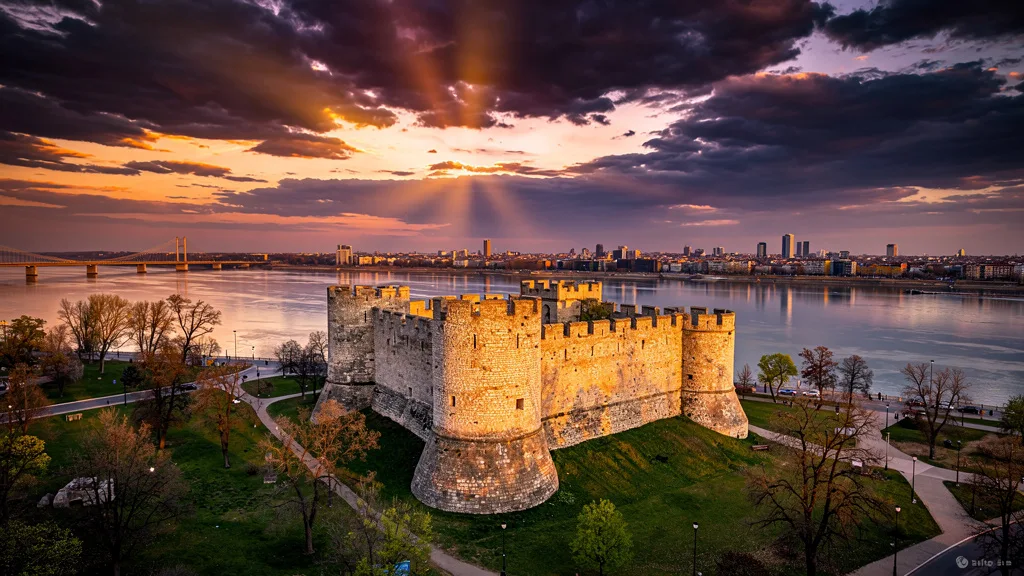
Smederevo Fortress is one of the largest medieval fortifications in Europe — 25 towers defending a triangular riverside compound that covers nearly 11 hectares. Entry is free and you can walk the walls. The fortress was begun in 1428 and served as the last capital of the medieval Serbian state before the Ottoman conquest. It is remarkably intact and surprisingly undervisited for something of this scale.
Krusevac was the capital of medieval Serbia under Prince Lazar, who died at the Battle of Kosovo in 1389 — an event that still resonates in Serbian national consciousness. The Lazarica Church, built in the 1370s, is an elegant example of Serbian-Byzantine architecture. The city’s fortress ruins are in the town center park. Spend 1-2 hours here.
The Zupa wine region between Krusevac and Aleksinac produces some of Serbia’s best red wines — particularly Vranac and Prokupac. Several wineries offer tastings along the road; the Aleksandrovic Estate is the most notable.
Nis itself deserves at least half a day. The city is Serbia’s third largest and has a distinct atmosphere — more relaxed than Belgrade, with excellent food (Nis claims to have the best cevapi in Serbia, which is a bold statement and one we are inclined to agree with after extensive research), a well-preserved Ottoman fortress spanning both banks of the Nisava River, and the uniquely macabre Skull Tower (Cele Kula). Built by the Ottomans from the skulls of Serbian soldiers killed in the 1809 Battle of Cegar, the tower originally contained 952 skulls set into the mortar. Most were removed for burial over the following decades, but 58 remain in the tower today. It is as unsettling as it sounds and strangely moving.
The Roman Emperor Constantine the Great was born in Nis (then called Naissus), and the city takes this seriously — there are ruins of the imperial palace and several Roman structures scattered around the city, plus a modern museum of Roman culture.
Practical tips:
- The E75 motorway between Belgrade and Nis has tolls totaling about 790 RSD (6.75 EUR)
- The scenic route via Smederevo and the Morava Valley is toll-free
- Nis makes an excellent base for exploring southern Serbia, or as a stopping point on the way to Montenegro or North Macedonia
- Try the Nisavska cevapi in Nis — specifically at Nislijska Mehana in the old town
- Fuel up in Nis before heading south — the road toward Vranje has fewer stations
Route 5: Western Serbia Grand Tour (3-4 Days)
For those with more time, this route combines the best of the individual routes into one comprehensive western Serbia loop.
Day 1: Belgrade to Zlatibor (230 km, 3-4 hours)
Belgrade → E763 motorway → Ovcar-Kablar gorge (stop, 1-2 hours) → Uzice (lunch, local roasted meats at Carda Sljiva) → Zlatibor (overnight)
Overnight in Zlatibor: Hotels and apartments are plentiful. Budge: Mountain Lodge Mona (3 stars, 45-65 EUR/night). Mid-range: Mona Hotel (4 stars, 80-110 EUR/night).
Day 2: Zlatibor to Bajina Basta (100 km, 3-4 hours with stops)
Zlatibor → Kremna (mountain village viewpoint) → Mokra Gora / Sargan Eight railway (2-3 hours) → Drvengrad / Kusturica’s village → Tara National Park / Banjska Stena viewpoint → Bajina Basta (overnight)
Overnight in Bajina Basta: The town is small. Best option is a private guesthouse along the Drina — expect to pay 30-50 EUR for a double room. The setting above the Perucac Lake is worth any price.
Day 3: Bajina Basta to Novi Sad (350 km, 5-6 hours)
Bajina Basta → Valjevo (lunch stop) → Fruska Gora monasteries (2-3 monasteries, wine tasting at Kovacevic) → Sremski Karlovci → Novi Sad (overnight)
Overnight in Novi Sad: Centrally located hotels run 60-100 EUR/night. The area around Zmaj Jovina pedestrian street is ideal.
Day 4: Novi Sad to Belgrade (80 km, 1 hour)
Novi Sad → Petrovaradin Fortress (morning visit, 1-2 hours) → Belgrade
Return the car from a Belgrade city location to avoid airport surcharges if your flight is not until the next day.
This loop covers approximately 550 km of driving over four days and hits all the major highlights of western Serbia. It can be compressed into three days by cutting the Fruska Gora section, but we recommend keeping it — the monastery circuit is one of the highlights of the entire trip.
Route 6: Kopaonik and Southern Serbia Loop
This less-traveled route rewards those with an interest in Serbia beyond the main tourist circuit.
Route details:
- Start/End: Nis
- Loop distance: ~400 km
- Drive time: 2-3 days
- Best season: June-September (ski resort roads are open, mountain landscape at its best)
Day 1: Nis to Kopaonik (130 km, 2-2.5 hours)
Take the road via Prokuplje and Kuršumlija into the Kopaonik massif. The road climbs steadily through forests before emerging onto the Kopaonik plateau at around 1,700 meters. This is Serbia’s largest mountain resort and a significant ski destination in winter.
| Stop | Distance from Nis | Highlight |
|---|---|---|
| Prokuplje | 45 km | Ottoman-era town, Prokuplje Fortress |
| Kuršumlija | 85 km | Gateway to Djerdap, spa resort history |
| Đavolja varos | 95 km (detour) | Devil’s Town rock formations |
| Kopaonik | 130 km | Mountain resort, national park |
Đavolja varos (Devil’s Town) is a detour worth taking — about 20 km off the main road. This geological formation consists of 202 earth pyramids up to 15 meters tall, shaped over centuries by erosion. The landscape looks genuinely otherworldly, and the two natural spring formations (Đavolja voda) have highly acidic and mineral-rich water that locals have attributed supernatural properties to for centuries.
Day 2: Kopaonik to Raska and Studenica (80 km, 1.5-2 hours)
Drive down from Kopaonik to Raska and then to Studenica Monastery — one of Serbia’s most important medieval monasteries and a UNESCO World Heritage Site since 1986. The white marble church, built by Grand Župan Stefan Nemanja in 1183, contains some of the finest Byzantine-influenced frescoes in Serbia. Allow 2-3 hours.
Day 3: Studenica to Nis via Krusevac (180 km, 3 hours)
Return via Krusevac (see the Lazarica Church and medieval fortress), then south to Nis on the E75.
Planning Tips
Car choice: An economy or compact car is fine for all these routes, including the mountain roads. You do not need an SUV unless you plan to drive unpaved forest roads in Tara (and those are rare). A car with decent ground clearance (like a Dacia Duster or similar crossover) gives extra confidence on rougher mountain sections and is worth considering for Routes 2 and 6.
Navigation: Google Maps works well throughout Serbia. Offline maps are recommended for the mountain areas where mobile coverage can be spotty (Tara and parts of the Djerdap gorge in particular). Download the Serbia map before your trip.
Accommodation: Serbia offers excellent value. Guesthouses in mountain areas run 30-50 EUR per night for a double room, often including breakfast. Hotels in Zlatibor and Novi Sad are slightly pricier during peak season (July-August) but still very affordable by European standards. Booking.com has good coverage; local sites like srbijahostels.rs sometimes offer better rates.
Fuel planning: Fill up in major towns before entering the mountain areas. Gas stations are sparse between Uzice and Bajina Basta, and between Donji Milanovac and Kladovo. The motorway network has regular fuel stops every 50-70 km.
Food and budget: Serbian road trip food is a genuine highlight. Roadside kafana restaurants serve grilled meats (meso sa roštilja), slow-roasted lamb (jagnjetina), fresh trout from mountain streams, and homemade bread that puts most urban bakeries to shame. A full meal at a roadside kafana costs 700-1,200 RSD (6-10 EUR) per person including a drink. Budget accordingly — this is one of those countries where you eat exceptionally well on very little.
Road trip playlist essential: Serbian music ranges from turbo-folk (genuinely an acquired taste, but grows on you) to surprisingly good jazz and rock scenes. Belgrade’s radio stations will keep you entertained, but download some playlists for the mountain areas where reception fades. We recommend Radio Beograd 202 for pop and Radio S2 for a relaxed mix.
For driving rules and toll details, see our Serbia driving guide. For information on how much all this will cost, check car rental costs in Serbia. And if you want to extend your trip beyond Serbia’s borders, both Montenegro and Bosnia and Herzegovina are natural next stops — the borders are close and the scenery only gets more dramatic.