 DriveAtlas
Best Road Trips in Bahrain
Let us be honest about something upfront: Bahrain is not a road trip country in the traditional sense. The entire main island is 48 km long. You can drive from the northernmost point to the Tree of Life in the south in about 40 minutes. There are no mountain passes, no winding coastal highways, no multi-day odysseys through changing landscapes. What Bahrain does offer is something different: a compact island where every turn reveals another layer of 5,000 years of civilization, from Dilmun burial mounds to Portuguese forts to F1 racetracks, and where a car gives you the freedom to weave between them at your own pace.
We spent three days driving around Bahrain and covered the entire island twice over. These routes are the best way to organize your exploration, whether you have a single day or a full week.
Route 1: The Heritage Trail — Manama to Qal’at al-Bahrain and Beyond (50 km, half day)
This route covers Bahrain’s historical highlights, from the modern capital to a 4,000-year-old fort, and it works perfectly as a morning outing before the midday heat.
Start: Manama Corniche. Begin at the waterfront corniche near the Bahrain Financial Harbour. The contrast between the gleaming glass towers and the flat desert interior visible to the south is immediate and striking. Take a moment to look across the bay — on clear mornings you can see the Saudi coastline in the distance.
Stop 1: Bahrain National Museum (2 km from city center)
One of the best museums in the Gulf, and significantly more interesting than many visitors expect. The museum covers the Dilmun civilization (one of the oldest in the world), the subsequent Kassite, Greek, and Islamic periods, and modern Bahrain. The artifacts recovered from the burial mounds are here — ancient pottery, jewelry, tools, and personal objects that make the mounds feel inhabited rather than archaeological.
The building itself, designed by a Danish architectural firm and positioned overlooking the sea, is worth seeing. Entry: 1 BHD ($2.65). Budget 1-2 hours and do not rush through it. If you have children, they are genuinely engaged by the burial mound reconstructions.
Stop 2: Qal’at al-Bahrain / Bahrain Fort (12 km from Manama)
The crown jewel of this route and one of the most impressive sites in the Gulf. Qal’at al-Bahrain is a UNESCO World Heritage Site and a remarkable place to stand — a mound created by successive civilizations building on top of each other for 4,500 years. The Portuguese fort at the top dates to the 16th century, when Bahrain was a strategic trading post on the Persian Gulf. Below the fort, excavations reveal Dilmun-era foundations, Kassite layers, Greek-influenced buildings from the Hellenistic period, and Islamic-era structures, all compressed into a single artificial hill visible for miles.
The museum at the fort site is modern, well-curated, and explains the layers of occupation clearly enough that you leave with a genuine sense of the timeline. Entry: free (the museum is included). Budget 1-2 hours. The fort is best in the early morning when the light is golden and the heat manageable. By 11:00 in summer, the exposed site becomes uncomfortable.
Drive to the fort: From Manama, follow the coastal road northwest. The fort is signposted. Parking is free at the designated lot below the mound.
Stop 3: Barbar Temple (5 km from Qal’at al-Bahrain)
A Dilmun-era temple complex dating to around 2000 BC, predating the Portuguese fort by over three millennia. The temples (there are three superimposed structures) were dedicated to water deities — appropriate for a civilization that depended on the freshwater springs beneath the island for survival in an otherwise arid environment. The spring that fed the temple is still visible.
Barbar is less dramatically preserved than Qal’at al-Bahrain but important for understanding the Dilmun civilization’s religious practices. Entry: free. Allow 30-45 minutes.
Stop 4: A’ali Burial Mounds (8 km from Barbar Temple)
The numbers are staggering: Bahrain has an estimated 170,000 burial mounds scattered across the island, making it one of the largest prehistoric cemeteries in the world. The A’ali cluster is the most impressive and accessible, with Royal Mounds reaching 15 meters in height and 45 meters in diameter. These were built for Dilmun royalty and elite — ordinary mounds are smaller, but there are far more of them.
Standing among the A’ali mounds, looking out across the flat desert toward the Manama skyline, you feel the weight of four millennia. People have been burying their dead here since 2050 BC, and the landscape is dotted with their monuments as far as you can see.
The surrounding A’ali village is also interesting — it is one of Bahrain’s oldest continuously inhabited settlements and has a thriving pottery tradition. Local potters still use traditional techniques, and you can watch them work and buy pieces at modest prices.
Entry: free. Allow 45 minutes to an hour.
Stop 5: Al Jasra Handicrafts Centre (10 km from A’ali)
A welcome break from the heat and history. This complex showcases traditional Bahraini crafts — weaving, pottery, and dhow (traditional boat) building — in a pleasant courtyard setting. The Al Jasra House, a restored traditional Bahraini courtyard home, is attached and gives a sense of how middle-class Bahrainis lived in the 19th and early 20th centuries.
Entry: 0.200 BHD ($0.53). Allow 30-45 minutes. The craft items for sale are reasonably priced and make better souvenirs than airport gift shop fare.
Route 1 Details
| Segment | Distance | Drive Time | Highlights |
|---|---|---|---|
| Manama to National Museum | 2 km | 5 min | Gulf museum, Dilmun artifacts |
| Museum to Qal’at al-Bahrain | 10 km | 12 min | UNESCO fort, 4500 years of layers |
| Fort to Barbar Temple | 5 km | 8 min | Dilmun water temple, 2000 BC |
| Barbar to A’ali Mounds | 8 km | 10 min | 170,000 mounds, largest Dilmun cemetery |
| A’ali to Al Jasra | 10 km | 12 min | Traditional crafts, Bahraini pottery |
| Return to Manama | 15 km | 15 min | Via King Faisal Highway |
| Total | ~50 km | Half day with stops | Multiple UNESCO sites |
Best time: Start by 08:00 to visit the outdoor sites before the heat builds. The route works year-round but is most comfortable October through March.
Route 2: The Southern Circuit — Beaches, Desert, and the Tree of Life (90 km loop, full day)
This route heads south from Manama into a different Bahrain — quieter, more open, with beaches, desert terrain, and the country’s most famous natural curiosity. The contrast with the modern capital is significant, and the drive through the oil fields and desert gives a sense of what Bahrain looked like before the towers.
Start: Manama, heading south on the King Faisal Highway.
Stop 1: Al Zallaq Beach (25 km from Manama)
The best public beach on Bahrain’s west coast, and the most consistently clean and accessible. The beach stretches for several kilometers along the coastline, with shallow, warm waters (the Gulf is more lagoon than ocean in most of Bahrain) and fine sand. On weekdays, it is blissfully empty — a few families, maybe a couple of joggers. On Fridays, it fills up.
Facilities vary along the beach: some sections have cafes, shower facilities, and changing rooms; others are undeveloped. The undeveloped sections are often the best. Bring water and snacks for the sections without facilities. Free parking along the road.
Al Jazayer Beach is a nearby alternative with a dedicated beach park (entry 0.500 BHD / $1.33) — cleaner facilities but less natural feel.
Stop 2: Bahrain International Circuit (10 km from Al Zallaq)
Even if you are not visiting for the Grand Prix, the Bahrain International Circuit is worth a stop. The facility offers track experiences that go well beyond spectating — you can book a lap in a sports car or a go-kart session on the circuit itself, or take a guided behind-the-scenes tour.
The circuit was built in the desert in 2004 and the contrast between the ultra-modern facility and the surrounding sand is striking. The pit lane walk, the control tower, and the grandstands give a sense of the scale of what happens here each spring. Tour: 7 BHD ($19). Track experiences: from 15 BHD ($40) for go-karts.
Stop 3: Tree of Life (15 km from the circuit)
A lone 400-year-old mesquite tree (Prosopis cineraria) standing in barren desert with no visible water source within kilometers. How it survives is genuinely unknown — theories include deep root systems tapping into an ancient aquifer, or even the tree’s own biological water cycle. The mystery is partly the point.
The tree is not spectacular in a postcard sense — it is a single tree in a flat, featureless desert. But its defiant existence in this landscape, the fact that it is the only living thing visible for a considerable distance, is oddly moving. Stand under it for a few minutes and you start to understand why Bahrainis consider it sacred.
The drive to the tree crosses active oil fields — pipeline infrastructure, flare stacks, and pump stations visible in every direction. The last few kilometers are on an unpaved but well-traveled road, easily passable in a standard rental car at normal speeds. Free entry. The site has minimal facilities — a small information board and a viewpoint platform.
Timing: The tree is best in the early morning (before 10:00) when the light is soft and the heat has not yet peaked. Afternoon visits in summer are brutal. There is no shade except the tree itself.
Stop 4: Bahrain’s First Oil Well (near the Tree of Life)
Bahrain’s first commercial oil well was drilled here in 1932, making Bahrain the first country in the Arabian Gulf to discover and export oil. The site has a small museum and the preserved original well equipment. Entry: free.
The context is important: pearl diving was Bahrain’s economy until the 1930s, and the discovery of oil (followed rapidly by independence movements and the development of the modern state) transformed the island within a generation. Standing at the first well while surrounded by modern oil infrastructure on all sides makes the transition visceral.
Stop 5: Sar Burial Mounds and Sar Settlement (on the return route)
Less visited than A’ali but well-preserved and sometimes more atmospheric for the lack of crowds. The settlement ruins at Sar give a clearer picture of how Dilmun people actually lived — houses, streets, and communal areas laid out in a pattern that is recognizably a village. The adjacent burial mounds are smaller than at A’ali but the setting is quieter and the signage is good.
Return to Manama via the Shaikh Khalifa bin Salman Highway (20 km, 20 minutes).
Route 2 Details
| Segment | Distance | Drive Time | Highlights |
|---|---|---|---|
| Manama to Al Zallaq Beach | 25 km | 25 min | West coast beach, swimming |
| Al Zallaq to BIC | 10 km | 10 min | F1 circuit, track experiences |
| BIC to Tree of Life | 15 km | 20 min | Desert drive, ancient tree |
| Tree of Life to First Oil Well | 3 km | 5 min | Oil discovery, Bahrain’s transformation |
| Return via Sar ruins | 35 km | 30 min | Dilmun settlement on the way |
| Total | ~90 km | Full day with stops | Beaches, desert, history |
Best time: October through April, starting by 08:30. Summer visits require an early start (07:00) to reach the Tree of Life before the heat becomes unpleasant.
Route 3: The Pearl Trail — Muharraq Heritage Circuit (30 km, half day)
This route explores Muharraq Island’s UNESCO-listed pearl diving heritage and the historical old town that was Bahrain’s capital until 1923. It is a walking and driving combination — park and explore on foot in the heritage area, drive between the points.
Start: Muharraq waterfront, near the Sheikh Isa bin Ali House. Take the Sheikh Isa bin Salman Causeway from Manama to Muharraq — the drive itself takes 10 minutes and offers good views of the harbor.
Muharraq Heritage Area
The Pearl Trail (Al Lulu Trail) is a UNESCO World Heritage Site and covers a 3.5 km walking route through the old town’s pearl-diving heritage. The route connects restored historic buildings, wells, and anchoring points used by the pearl diving industry that dominated Bahrain’s economy for centuries before oil.
Key stops on the Pearl Trail:
- Sheikh Isa bin Ali House: The finest example of traditional Bahraini architecture on the island, built in the late 19th century. Courtyards, wind towers, and intricately carved plasterwork. Entry: 0.200 BHD ($0.53). Worth an hour.
- Siyadi House: Another restored merchant house, reflecting the wealth generated by the pearl trade.
- Bu Maher Fort: A small fort at the water’s edge, guarding the traditional pearling areas.
- The Old Muharraq Souq: Less touristy than Manama’s souq and more authentically local — the vendors here are largely serving Muharraq residents, not tourists.
Park at the designated parking area near the Sheikh Isa bin Ali House. Walk the heritage route (about 1 hour for the full trail), then drive to Arad Fort.
Arad Fort
A 15th-century fort built by the Omani Yaruba dynasty, overlooking the sea. Well-preserved and recently restored, with good signage explaining its history. The fort was built to defend the pearl-diving fleet and the island’s freshwater springs from maritime raiders. Entry: free. Allow 30-45 minutes.
The evening lighting on the fort is particularly good — if you time your visit for late afternoon, the golden hour illuminates the stone beautifully.
Dilmun Burial Mounds (Hamad Town area, 15 km from Muharraq)
A secondary UNESCO World Heritage inscription covers the Dilmun burial mounds across Bahrain. The Hamad Town area has extensive mound fields that are less visited than A’ali but impressive in scale. Drive through the residential development areas to find the preserved mound zones — they sit incongruously between modern villas and apartment blocks.
Route 3 Details
| Segment | Distance | Drive Time | Highlights |
|---|---|---|---|
| Manama to Muharraq heritage | 10 km | 15 min | Via Sheikh Isa Causeway |
| Pearl Trail walk | 3.5 km walk | 1 hour | UNESCO pearling heritage |
| Muharraq to Arad Fort | 5 km | 8 min | 15th century fort |
| Arad to Hamad Town mounds | 15 km | 15 min | Dilmun burial fields |
| Return to Manama | 10 km | 15 min | |
| Total | ~30 km driving | Half day | UNESCO x2, traditional Bahrain |
Route 4: The King Fahd Causeway — Bahrain to Saudi Arabia Day Trip (120 km round trip, full day)
This is Bahrain’s most unique driving experience and something genuinely unlike anything else in Gulf travel. The 25-km causeway crosses open water connecting two countries with very different atmospheres, and the border crossing is an experience in its own right.
Requirements before you drive:
- Valid Saudi visa (e-visa available for many nationalities at visa.visitsaudi.com)
- Rental car cross-border permission (confirm with your agency in writing, arrange additional insurance)
- Passport and vehicle registration documents
- Causeway toll: 2 BHD ($5.30) each way, paid at the Bahrain departure gate
The Causeway Drive
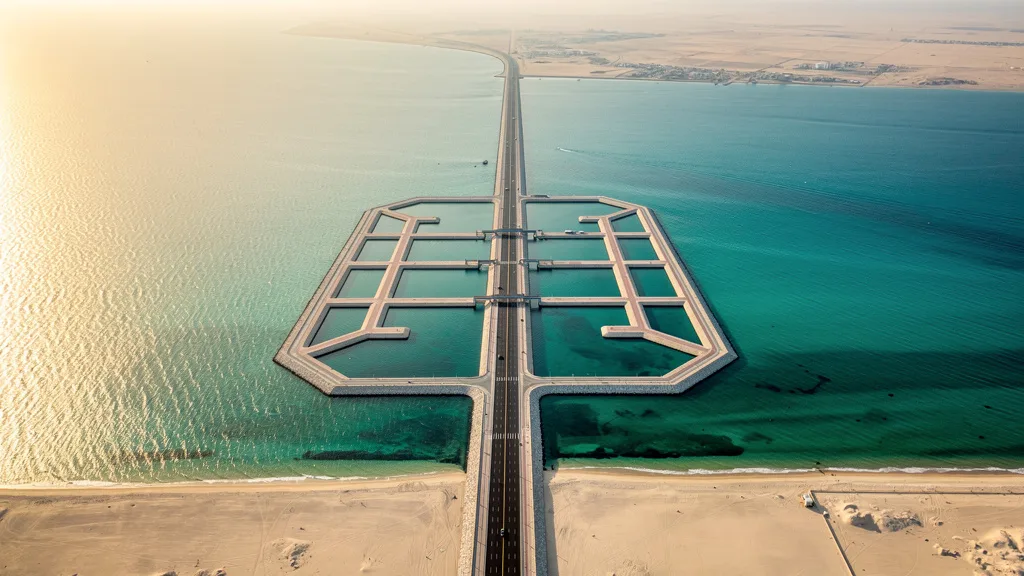
The causeway opened in 1986 and was named after King Fahd of Saudi Arabia. At 25 km, it is one of the longest causeways in the world. Four lanes in each direction, speed limit 120 km/h, with artificial islands midway containing a service area and immigration checkpoint facilities. The views are excellent — flat blue Persian Gulf in every direction, with the Bahrain skyline receding behind you and the Saudi coast appearing ahead. On clear days, tankers and dhows are visible on the water.
The drive across (without border processing) takes about 15-20 minutes. Total time from departure to arrival in Khobar, including both border checkpoints, typically runs 45-90 minutes depending on queue length.
Border Processing
Bahrain exit: Queue at the Bahrain checkpoint. Submit passport, vehicle registration, rental agreement with cross-border permission. Pay the 2 BHD toll. Processing: 10-30 minutes.
Saudi entry: Queue at Saudi immigration. Submit passport (visa is checked), vehicle registration, insurance documents. Customs check may occur — declare any medications and do not carry alcohol (illegal in Saudi Arabia). Processing: 15-45 minutes.
Weekday mornings (Tuesday-Thursday before 10:00) are fastest. Thursday evenings and Fridays (the Gulf weekend) are worst. Total border processing on a weekday morning: 30-60 minutes. On Thursday evening: 90-180 minutes.
What to Do on the Saudi Side
Khobar (first Saudi city, 10 km from the border) is the most tourist-accessible entry point. The Al Corniche waterfront stretches along the Gulf shore and is a pleasant walk. The Al Rashid Mall is the main shopping center. Restaurants here serve excellent mandi (slow-cooked lamb and rice) — it is one of the better food experiences in the Gulf.
Dammam (capital of Eastern Province, 20 km from Khobar) is the administrative center of the region. The Heritage Village near the old corniche gives a sense of traditional Eastern Province life. Less oriented toward tourists but worth seeing if you have time.
Al Khobar waterfront walk: The 15-minute drive from the border to the Khobar corniche, followed by a walk along the waterfront, lunch at a mandi restaurant, and a drive back covers the Saudi day trip experience efficiently. You do not need to go further than Khobar for a satisfying crossing.
Dress code for Saudi Arabia: More conservative than Bahrain. Women should cover shoulders and knees. Men in shorts are generally acceptable but long trousers are better received. Public displays of affection are illegal.
Route 4 Details
| Segment | Distance | Time | Notes |
|---|---|---|---|
| Manama to Causeway toll | 10 km | 15 min | Follow causeway signs |
| Causeway + Bahrain border | 25 km | 30-60 min | Varies heavily by time of day |
| Saudi border to Khobar | 10 km | 10 min | First Saudi city |
| Khobar to Dammam (optional) | 20 km | 20 min | Eastern Province capital |
| Return to Bahrain (same route) | 60 km | 45-120 min | Saudi exit, Bahrain entry |
| Total | ~120 km round trip | Full day | Unique cross-border experience |
Critical note: Not all Bahrain rental agencies permit cross-border driving. Some prohibit it entirely; others allow it with additional insurance (typically 5-10 BHD / $13-27 per day). Always confirm in writing before booking. Driving a rental car across without permission voids your insurance and risks confiscation at the border.
Route Comparison Table
| Route | Distance | Duration | Difficulty | Best Season | Highlights |
|---|---|---|---|---|---|
| Heritage Trail | 50 km | Half day | Easy | Oct-Apr | Fort, burial mounds, national museum |
| Southern Circuit | 90 km | Full day | Easy | Oct-Apr (morning) | Beaches, Tree of Life, F1 circuit |
| Pearl Trail / Muharraq | 30 km driving | Half day | Easy | Year-round | UNESCO pearling heritage |
| King Fahd Causeway | 120 km | Full day | Easy (border waits) | Weekday mornings | Cross-border Saudi day trip |
Planning Your Bahrain Driving Trip
Three days covers everything. You can complete all four routes in three full days. Suggested order:
- Day 1: Heritage Trail (morning) + Muharraq Pearl Trail (afternoon)
- Day 2: Southern Circuit (full day, early start)
- Day 3: King Fahd Causeway (if visa arranged) or a combination of revisiting favorites
Morning starts are essential from May through October. The heat peaks between 12:00 and 16:00. Outdoor sites are uncomfortable at best and inadvisable at worst during those hours. Start by 08:00 to get the outdoor portions done before the heat.
Friday is different. Friday morning is quiet (prayers at midday). Friday afternoon is busy as families come out. The Causeway is worst on Thursday evening and Friday morning as residents cross to Saudi Arabia. The souq is busy on Friday evenings.
Download offline maps. Google Maps works well in Bahrain, but download the offline map before you go. Some southern roads near the Tree of Life have weak cell coverage, and having offline maps ensures you can navigate without signal.
Watch the fuel gauge near the Tree of Life. The southern desert area has limited fuel stations. Fill up before heading south from Al Zallaq — the BAPCO station on the main road south of Manama is your last reliable option before the desert area.
The route to the Tree of Life includes gravel. The final 2-3 km is on an unpaved track. Standard rental cars handle it fine at normal speeds. Avoid in heavy rain (which is rare but does happen in winter).
F1 weekend logistics. If visiting during the Grand Prix (typically March/April), add 30-60 minutes to any drive times near Sakhir and plan your route to avoid the circuit area unless you are attending.
For driving rules and regulations, see our Bahrain driving guide. For general road trip planning, our road trip planning guide has wider context. And if the Causeway trip to Saudi Arabia interests you, our Saudi Arabia best routes guide covers what awaits beyond the border.