 DriveAtlas
Best Road Trips in Slovenia
We drove the Vrsic Pass for the first time on a clear September morning, starting from the north side at Kranjska Gora. The road begins innocently enough — a gentle climb through pine forest. Then hairpin bend number 1 appears, marked by a stone pillar, and the road begins winding upward in a series of tight cobblestoned switchbacks that somehow manage to be both technically demanding and visually overwhelming. By hairpin 12, we had stopped twice to photograph the valley falling away below. By hairpin 24, at the summit, we were looking at mountain ranges in three directions and seriously reconsidering whether we needed to drive anywhere else ever again.
Slovenia’s road trips are short in distance but extraordinarily dense in scenery. The entire country is smaller than many US counties, yet its landscapes range from Alpine peaks to Mediterranean coast to underground caves — all connected by roads that are, without exaggeration, among the best-engineered and most beautiful in Europe. The density of remarkable driving per square kilometer here is almost unfair.
Route Comparison
| Route | Distance | Drive Time | Best For | Difficulty |
|---|---|---|---|---|
| Vrsic Pass & Soca Valley | 95 km | 2.5-3.5 hours | Alpine scenery, river valley, WWI history | Moderate (mountain hairpins) |
| Lake Bled to Lake Bohinj | 30 km | 40 min | Iconic lakes, mountain backdrop | Easy |
| Karst Wine & Cave Road | 120 km loop | 3-4 hours | Caves, wine, limestone villages | Easy |
| Adriatic Coast Circuit | 50 km | 1.5-2 hours | Venetian towns, Mediterranean feel | Easy |
| Logar Valley & Kamnik Alps | 80 km loop | 2-3 hours | Glacial valley, Alpine meadows | Easy-moderate |
| Complete Slovenia Grand Tour | 400+ km | 5-7 days | Everything | Moderate |
Route 1: Vrsic Pass and the Soca Valley
This is Slovenia’s signature drive and one of the finest mountain road experiences in Europe. The route crosses the Julian Alps via the Vrsic Pass (1,611 m) and descends into the impossibly turquoise Soca River valley, creating a journey that transitions from high Alpine to Mediterranean-feeling in about 90 km.
Route details:
- Start: Kranjska Gora
- End: Tolmin (or Kobarid)
- Distance: 95 km
- Drive time: 2.5-3.5 hours without stops
- Recommended time: Full day
- Season: May to November (pass closed in winter, typically November to late April)
The North Side Ascent (Kranjska Gora to Summit)
24 hairpin bends climbing 900 meters. Each bend is numbered with a stone marker and has a cobblestone surface at the turn itself (smooth asphalt between bends). The road is well-maintained and wide enough for two vehicles at most bends, though you will encounter buses during peak summer — and they require full concentration when passing.
| Hairpin/Stop | Elevation | Highlight |
|---|---|---|
| Kranjska Gora start | ~800 m | Last fuel, last town |
| Hairpin 1 | ~840 m | The climb begins; pine forest |
| Russian Chapel | ~1,100 m | WWI memorial, small wooden chapel |
| Hairpin 15 | ~1,350 m | Valley views open dramatically |
| Summit Cafe | 1,611 m | Panoramic views, refreshments |
| Hairpin 24 | 1,611 m | Summit; transition to south side |
The Russian Chapel is one of the most moving stops on the pass. A modest wooden Orthodox chapel built in 1916 by Russian prisoners of war who were used as labor to construct the road during World War I. Many of them died in an avalanche in March 1916, and the chapel commemorates their deaths. The Austrian military had the road built to supply the Isonzo Front — the same front that Hemingway wrote about in “A Farewell to Arms.” The chapel is maintained by the local municipality and Slovenian Orthodox community.
The summit has a small mountain restaurant/cafe (Koča na Vršiču), parking for about 50 vehicles, and access to hiking trails. On clear days, Triglav (2,864 m), Slovenia’s highest peak, is visible to the south. The parking area fills quickly in summer peak — arrive before 10:00 for guaranteed parking. The cafe serves warm food and excellent kranjska klobasa (Carniolian sausage) with mustard.
The South Side Descent (Summit to Trenta)
26 hairpin bends descending into the Trenta Valley. The south side is slightly steeper and wilder than the north. The cobblestone hairpins here are tighter, and the views include the massive limestone wall of Jalovec rising to the left. Use low gear for the descent — this section is where brake overheating is most likely if you rely solely on brake pressure.
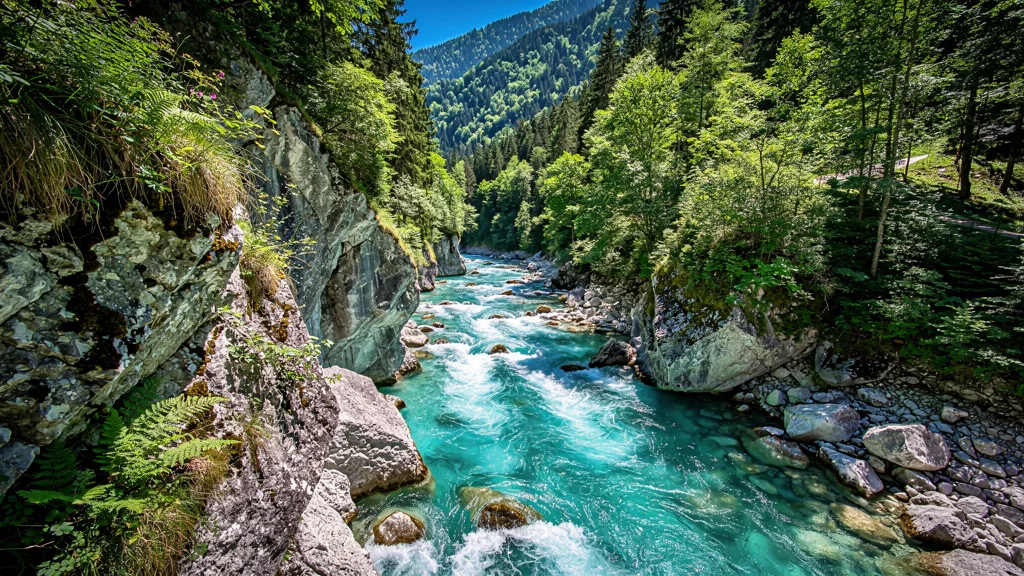
The road drops into the upper Soca Valley, where the river appears as an almost unbelievable shade of emerald blue. The color is caused by the high mineral content of the limestone water — it looks photoshopped but is entirely natural.
The Soca Valley (Trenta to Tolmin)
Once you reach the valley floor, the road follows the Soca River downstream through one of the most beautiful valleys in the Alps. The river is crystal clear with a turquoise color that becomes deeper and richer as tributaries join.
| Stop | Distance from Summit | Highlight |
|---|---|---|
| Trenta village | 18 km | Visitor center, information about Triglav National Park |
| Soca source (Izvir Soce) | 20 km | 20-min walk to the river’s spring emerging from a cave |
| Bovec | 35 km | Adventure sports town, rafting base |
| Soca suspension bridge | 45 km | Ancient bridge over the turquoise Soca |
| Kobarid | 55 km | WWI museum, Kobarid gorge walk |
| Napoleon Bridge | 58 km | Historic stone arch bridge, swimming hole |
| Tolmin | 70 km | Tolmin Gorge, valley end |
The Soca Source (Izvir Soce) is a 20-minute walk from the parking area near the Trenta Lodge. The river emerges from a cave in the limestone and immediately takes on its characteristic blue-green color. The path through alpine meadows and forest to reach it is part of the experience.
Bovec is the adventure capital of Slovenia. The town is small but equipped with multiple rafting companies, kayaking outfitters, and adventure sport operators. If you have time, book a rafting trip on the Soca — half-day trips cost about 40-55 EUR per person, and the river runs through the canyon at class II-III with spectacular scenery. Paragliding and ziplining are also available.
Kobarid is a small town with an outsized historical reputation. The Kobarid Museum covers the Isonzo Front and the 1917 Battle of Caporetto — one of the decisive battles of World War I — with extraordinary detail and human perspective. It won the Council of Europe’s Museum Prize in 1993. Ernest Hemingway served as an ambulance driver on this front and set much of “A Farewell to Arms” in the area. Budget 1-2 hours for the museum. Kobarid also has some of the best restaurants in the Soca Valley — the Topli Val hotel restaurant is excellent.
The Kobarid Gorge Walk: A 90-minute circular trail from Kobarid descends to the Soca River through a limestone gorge with natural waterfalls and turquoise pools. Free and not to be missed. The path is well-maintained and can be done in standard walking shoes.
Napoleon Bridge (Napoleonov most) is a reconstructed stone arch bridge over the Soca with a swimming hole below it. The original bridge was built by Napoleonic forces in the early 19th century and was a strategic crossing point. The pool beneath the bridge is one of the most beautiful natural swimming spots in Slovenia.
Practical tips:
- Start early to avoid tour buses on the pass (they arrive mid-morning)
- The cobblestone hairpins are slippery when wet — drive carefully in rain
- An economy car handles the pass fine; no SUV needed
- Fuel up in Kranjska Gora before starting — no fuel stations on the pass or in upper Trenta
- The Soca Valley road can flood briefly after heavy rain; check conditions in late spring
Route 2: Lake Bled to Lake Bohinj
This short drive connects Slovenia’s two most famous lakes and passes through countryside that looks like it was painted by a Romantic-era artist with a generous color palette.
Route details:
- Start: Lake Bled
- End: Lake Bohinj
- Distance: 30 km
- Drive time: 40 minutes
- Recommended time: Full day (combining both lakes with hikes and swimming)
Lake Bled needs no introduction — the island church, the cliffside castle, the ring of mountains. It is the most photographed spot in Slovenia and genuinely earns its fame. The key is managing the crowds:
| Viewpoint | Access | Best Time | For |
|---|---|---|---|
| Mala Osojnica | 20-min hike from west shore | Early morning | Classic overhead shot of island and castle |
| Ojstrica | 15-min hike from south shore | Morning/evening | Island and Triglav in background |
| Bled Castle | 10-min walk from east shore | Anytime | Lake views, museum inside |
| Boat to island | 14 EUR round trip | Anytime | Close-up island experience |
The Bled Cream Cake (kremna rezina): A dessert that has been served at the Park Hotel Bled since 1953 — layers of custard cream and whipped cream between a thin vanilla pastry. Having one at the terrace overlooking the lake is obligatory. Cost: approximately 4.50 EUR.
Parking at Lake Bled: Multiple lots around the lake, 2-5 EUR for several hours. In peak summer (July-August), arrive before 09:00. By 10:00, the main lots fill and a queue forms. The lot at the southern shore (near the rowing stadium) is often less congested than the main east-side lots.
The drive to Bohinj follows a valley road south through Bohinjska Bistrica. The road is easy and scenic, passing through small Slovenian villages with traditional architecture and views of the Julian Alps ahead. The transition from the busy Lake Bled area to the quieter Bohinj valley is noticeable.
Lake Bohinj is larger, deeper, and far less crowded than Bled. It sits at the foot of the mountains with dense forest on its shores. There is no island, no castle — just the lake, the mountains, and the silence. In many ways, Bohinj is the more impressive lake once you are actually standing at the shore; it just does not photograph as dramatically as Bled.
Bohinj activities by car:
- The Savica Waterfall: 20-minute drive to the western end of the lake, then a 20-minute hike to a 78-meter waterfall. Entry: 3 EUR. One of the sources of the Sava River.
- Vogel Cable Car: Near the western end of the lake, a cable car climbs to 1,800 m with views over the Julian Alps. In winter, this is a ski resort; in summer, it offers hiking and extraordinary views. Cable car ticket: approximately 25 EUR round trip.
- Swimming: The lake is warm enough for swimming in July-August (up to 22°C). The area near the Stara Fužina village on the north shore has a grassy lake beach.
- Ukanc: At the far western end of the lake, the road ends and hiking trails begin. The atmosphere is more remote here than at the tourist-heavy eastern end.
Route 3: Karst Wine and Cave Road
The Karst (Kras) region of southwestern Slovenia is limestone country — the same geological formation that gives us the word “karst” in every language. Underground rivers have carved enormous cave systems over millions of years, and above ground, the thin soil supports vineyards producing Teran — a robust red wine with deep history.
Route details:
- Start/End: Ljubljana (or Postojna)
- Loop distance: ~120 km
- Drive time: 3-4 hours without stops
- Recommended time: Full day
| Stop | Distance from Ljubljana | Highlight | Time Needed |
|---|---|---|---|
| Postojna Cave | 53 km | Europe’s most visited cave, underground railway | 2 hours |
| Predjama Castle | 62 km | Castle built into a cliff face above a cave opening | 1 hour |
| Stanjel | 85 km | Medieval hilltop village, Ferrari Garden | 1 hour |
| Karst wineries | 85-95 km | Teran wine tastings, direct from producers | 1-2 hours |
| Skocjan Caves (UNESCO) | 105 km | Underground canyon, more dramatic than Postojna | 2 hours |
| Lipica | 110 km | Origin of Lipizzaner horses, stud farm tours | 1 hour |
Postojna Cave is the most visited attraction in Slovenia — and for good reason. The cave system extends over 24 km (though only the public section is accessible), and an electric railway carries visitors 3.5 km underground before the walking tour begins. The formations include the Concert Hall, a chamber large enough to seat 10,000 people. The cave is home to the Proteus anguinus (olm) — a blind cave salamander that can live up to 100 years. Entry: 29.90 EUR for adults. Book ahead online for summer visits to avoid queues.
Predjama Castle is 9 km from Postojna and looks like something from a fantasy novel. The castle is literally built into the mouth of a cave 123 meters up a cliff face — an architectural solution to the problem of building a medieval fortress in a location that required food and water deliveries by secret cave passages. The last owner, the outlaw knight Erasmus of Lueg, held out here for a year against Habsburgs in the 1480s. Entry: 16 EUR (combo ticket with Postojna: 42.90 EUR). Visit time: 45-60 minutes.
Stanjel is a compact medieval hilltop town with stone walls, a church tower, and sweeping views over the Karst plateau. The Ferrari Garden (Ferrarijev vrt) — a terraced garden designed in the 1920s by an Italian architect — is an unexpected horticultural delight in this austere landscape. Entry: 5 EUR.
Skocjan Caves (UNESCO World Heritage Site since 1986) are less visited than Postojna but arguably more spectacular. The cave system contains a massive underground canyon — the Silent Cave and Murmuring Cave — through which the Reka River flows. The main chamber has a ceiling height of 150 meters, making it one of the largest underground spaces accessible to tourists in Europe. The final section of the tour crosses a suspension bridge above the canyon. Entry: 28 EUR for adults. More physically demanding than Postojna (stairs, walking). Not suitable for wheelchairs or those with mobility difficulties.
The Karst wine country: The thin terra rossa soils of the Karst plateau produce Teran, a red wine made from the Refosco grape. Teran is high in polyphenols and was historically credited with medicinal properties. Several small producers offer tastings and direct sales along the road between Stanjel and Komen. Klinec, Parovel, and Rencel are names to look for. A tasting of three or four wines typically costs 5-10 EUR per person.
Lipica is the original home of the Lipizzaner horses. The Lipica Stud Farm was established in 1580 by Archduke Charles II of Austria to breed horses for the Vienna Riding School. Tours run twice daily; performances (in the classical riding arena) take place on weekends. Entry: 14-17 EUR for a guided tour.
Route 4: Adriatic Coast Circuit
Slovenia’s coastline is only 47 km long — the shortest of any Mediterranean country. But those 47 km contain three historic Venetian towns, salt pans that have operated since the Middle Ages, and seafood restaurants that rival anything on the Italian coast 20 km to the north.
Route details:
- Start/End: Koper
- Distance: ~50 km
- Drive time: 1.5-2 hours without stops
- Recommended time: Full day
| Stop | Distance from Koper | Highlight |
|---|---|---|
| Koper | Start | Venetian architecture, Titov trg main square, cathedral |
| Izola | 7 km | Fishing village, working harbor, seafood restaurants |
| Strunjan | 12 km | Salt pans, nature reserve, sea cliff walk |
| Piran | 17 km | Venetian old town, Tartini Square, best seafood |
| Portoroz | 20 km | Beach resort, wellness hotels, casino |
| Secovlje Salt Pans | 25 km | Medieval salt harvesting methods, museum |
Piran is the highlight of the Slovenian coast and one of the most beautiful small towns in the Mediterranean. A compact Venetian old town on a narrow peninsula, with terracotta roofs, a harbor, and the elegant Tartini Square (named for the Baroque composer Giuseppe Tartini, who was born here). The cathedral of St. George sits on a hill above the town with views over the Adriatic.
Parking at Piran: The old town is car-free. There is a large paid parking lot at the entrance to the town (approximately 1-2 EUR/hour or 10-15 EUR for the day). Walking from the lot to the central Tartini Square takes about 10 minutes.
Seafood in Piran: The town has several excellent restaurants overlooking the harbor. Neptun and Riva are reliable choices for grilled fish (morska ribica) and octopus salad. Expect to pay 15-25 EUR per person for a main course. Fresh bread and local Malvazija white wine (a crisp, slightly mineral coastal variety) complete the experience.
The Secovlje Salt Pans are still operational using methods dating from the 14th century. The unique feature of Secovlje is the use of natural salt crust from the bottom of the pans rather than evaporation alone — a technique that produces a fleur de sel-quality product. The salt museum shows the full process. Entry: 7 EUR.
The Strunjan Nature Reserve protects a stretch of cliff and wetland between Izola and Piran. A coastal path runs along the cliff edge with views over the Adriatic to the Venetian Lagoon on clear days. The salt pans within the reserve are still partially active.
Koper is the largest town on the Slovenian coast and the country’s main port. The historic center (Praetorian Palace, Titov Square cathedral) is compact and easily walkable. Less touristed than Piran, which makes it more pleasantly authentic for a local lunch or coffee.
Route 5: Logar Valley and Kamnik-Savinja Alps
Less famous than the Julian Alps but arguably more serene, the Logar Valley (Logarska dolina) is a glacial valley carved into the Kamnik-Savinja Alps in northeastern Slovenia. This route combines the valley with the Pavlicevo Sedlo mountain road for a circular drive through landscapes that feel genuinely remote.
Route details:
- Start/End: Celje or Ljubljana
- Loop distance: ~80 km
- Drive time: 2-3 hours without stops
- Recommended time: Half to full day
| Stop | Highlight |
|---|---|
| Rinka Waterfall | 90-meter waterfall at the head of the valley |
| Slap Rinka viewing point | Overlook of the entire glacial valley |
| Palenk farm | Traditional Slovenian mountain farm stay, cheese and food |
| Pavlicevo Sedlo | Mountain pass with views into Austria |
| Solcava | Tiny mountain village, gateway to the valley |
Logar Valley is entered through a narrow gorge and opens into a broad glacial cirque surrounded by limestone peaks. The valley is privately owned and managed — there is an entry fee of 5 EUR per car. The road through the valley is unpaved in sections but manageable in any rental car in dry conditions.
Rinka Waterfall is at the head of the valley — the water drops 90 meters from the cliff above. The 30-minute walk from the parking area to the base of the falls passes through forest and alpine meadow.
Pavlicevo Sedlo is a mountain pass at 1,273 m connecting the Logar Valley to the Austrian border region. The road is paved but narrow, with switchbacks. The views from the saddle into both the Slovenian and Austrian valleys are outstanding.
Route 6: Complete Slovenia Grand Tour (5-7 Days)
For those with a week, this loop covers the country’s highlights:
Day 1: Ljubljana
Arrive, pick up car at airport or downtown agency. Store luggage and explore the car-free center on foot: Ljubljana Castle (10-minute walk from center), Triple Bridge over the Ljubljanica, the riverside market, Metelkova alternative culture area. Overnight Ljubljana.
Day 2: Ljubljana to Lake Bled (55 km, 45 min)
Morning: Bled Castle, island boat trip, cream cake at Park Hotel. Afternoon: drive to Lake Bohinj (30 km, 40 min), swim or hike to Savica Falls. Overnight in Bled or Bohinj area.
Day 3: Bled to Bovec via Vrsic Pass (95 km, 3-4 hours with stops)
Full day on the Vrsic Pass and descent into the Soca Valley. Stop at Russian Chapel, summit (lunch at mountain cafe), Soca source trail (30 min walk). Arrive Bovec afternoon. Optional rafting. Overnight in Bovec.
Day 4: Soca Valley to Coast (120 km, 2.5 hours)
Morning: Kobarid WWI Museum (2 hours), Napoleon Bridge swimming hole, Kobarid Gorge walk. Drive through the Vipava Valley (good food and wine stops) to the coast. Afternoon in Piran. Overnight on coast.
Day 5: Karst Region (80 km loop)
Postojna Cave (morning, pre-book tickets). Predjama Castle. Lunch in Karst village. Skocjan Caves (afternoon) or Stanjel and wine tasting. Overnight in Karst area or back to coast.
Day 6: Coast to Maribor (220 km, 2.5 hours via A1 motorway)
Drive northeast through Ljubljana to Maribor. Old Vine (Stara Trta) — the world’s oldest cultivated grapevine, in the center of the city. Lent waterfront promenade. Wine tasting in the Stajerska wine region. Overnight Maribor.
Day 7: Return to Ljubljana (130 km, 1.5 hours)
Drive back via Celje (stop at Celje Old Castle). Return car in Ljubljana.
Planning Tips
Car choice: An economy or compact car handles everything in Slovenia, including the Vrsic Pass. The roads are well-engineered and do not require SUV clearance. A car with responsive steering and good brakes makes mountain driving more enjoyable. If you plan to drive unpaved tracks in Logar Valley, a car with slightly more ground clearance is helpful.
Navigation: Google Maps works well throughout Slovenia. Offline maps are recommended for mountain areas where cellular coverage can be patchy (particularly the upper Soca Valley near Trenta and the Logar Valley).
Vignette reminder: Buy your e-vignette (16 EUR for 7 days) before entering the motorway. See our driving guide for purchase options and details.
Accommodation: Lake Bled is the priciest area in Slovenia (80-150 EUR/night for a decent hotel in summer). The Soca Valley and Karst region offer much better value (40-80 EUR/night for guesthouses). Ljubljana has good variety across all price ranges. Booking.com and the local Booking.si both have good coverage.
September timing: September is the sweet spot — warm weather, thinner crowds, lower prices, and all mountain passes open. The Soca River is clear and calm after the summer flow. The vineyards in the Karst and Vipava Valley are at harvest, and some allow you to participate.
Cross-border extensions: Slovenia’s routes connect naturally with Croatia to the south and Italy to the west. The drive from Piran to Trieste (Italy) is 30 minutes. From Maribor to Graz (Austria) is 1 hour. From Ljubljana to Zagreb (Croatia) is 1.5 hours.
For driving rules and vignette details, see our Slovenia driving guide. For cost planning, check car rental costs in Slovenia. Slovenia may be small, but it is one of those rare countries where the scenery-per-kilometer ratio is almost unreasonably high.