 DriveAtlas
Best Cities to Rent a Car in Oman
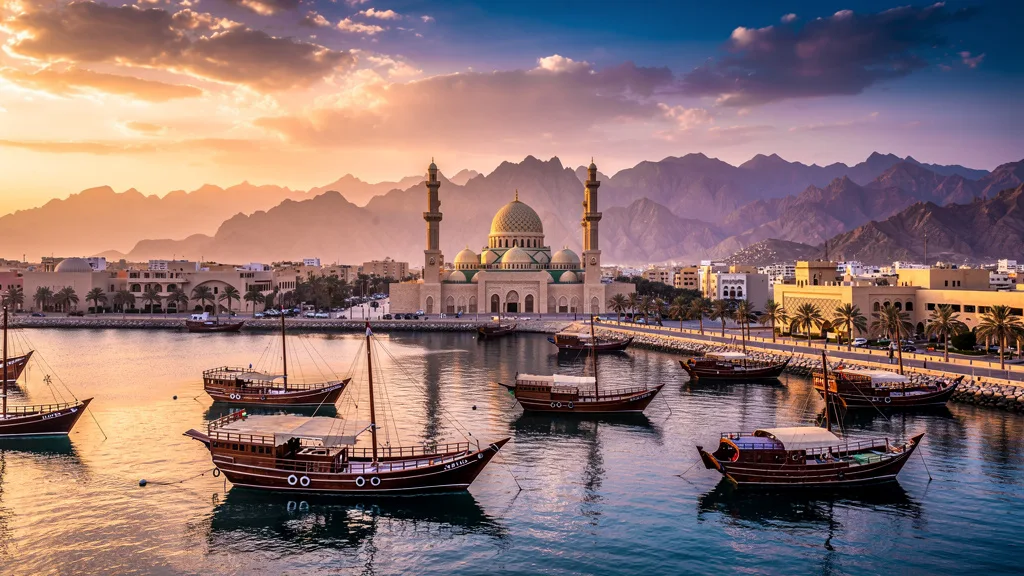
Oman has three cities relevant for car rental, and they could hardly be more different. Muscat is a long, linear capital stretched along the coast between mountains and sea, with modern highways and a cosmopolitan character that surprises first-time visitors. Salalah, 1,000 km to the south, feels almost tropical – frankincense trees, coconut palms, and a laid-back atmosphere that seems to belong to a different country entirely. Sohar, on the northern coast, is a smaller industrial city that serves as a gateway to the Al Batinah coast and the UAE border.
Most visitors rent in Muscat and explore from there, which makes perfect sense given the central location and best rental selection. But each city has its own logic as a starting point depending on your itinerary, and understanding the differences helps you plan a better trip.
City Comparison
| City | Best For | Rental Options | Driving Difficulty | Parking |
|---|---|---|---|---|
| Muscat | Most itineraries; mountains, coast, desert | Excellent (10-12 agencies) | Moderate (spread-out city) | Easy to moderate |
| Salalah | Dhofar region, Khareef season | Good (5-7 agencies) | Easy | Easy |
| Sohar | Northern coast, UAE border crossing | Limited (3-4 agencies) | Easy | Easy |
| Nizwa | Mountain and desert trips (no airport) | Very limited (1-2) | Easy | Easy |
| Sur | Eastern coast, turtle watching | Very limited | Easy | Easy |
Nizwa and Sur note: Both towns have a small number of rental cars available through Muscat-based agencies on request, but neither has proper walk-in rental facilities. If your itinerary centers on the eastern coast or the interior, rent in Muscat and drive. The roads from Muscat to both towns are excellent and the drives themselves are part of the experience.
Muscat
Muscat defies the expectation of a Gulf capital. Instead of a single cluster of skyscrapers, the city stretches 60 km along the coast in a series of distinct neighborhoods separated by mountain ridges and highway tunnels. This means driving is not optional – Muscat is a car city by design. The old port district of Muttrah, the modern commercial area of Ruwi, the upscale Qurum beach area, and the government quarter of Old Muscat are all separated by highways that wind through mountain gaps and along coastal ledges.
It sounds complicated, but the road network is logical and well-signed. Once you understand that the Sultan Qaboos Highway is the spine running everything together, the city’s geography clicks into place. The airport is at the far western end, Old Muscat is at the far eastern end, and everything else is strung between them.
What Muscat lacks in compact walkability, it makes up for with what it provides as a driving base. Within two hours in different directions, you can reach Nizwa (the historical interior capital), the coastal wadis of the Sur coast, or the base of the Al Hajar Mountains for a climb to Jebel Akhdar. Few cities in the world offer quite this combination of day-trip destinations.
Rental Scene
Muscat has the best rental selection in Oman, with all international and major local agencies represented at the airport and across multiple downtown locations.
Airport (MCT): Full range of agencies in the arrivals hall, covered parking lot adjacent to terminal, 30 km west of the city center. This is the most convenient pickup point for most visitors arriving by air. See our airport rental guide for the complete agency comparison.
Downtown agencies: Several agencies have offices in the Qurum, Al Khuwair, and Ruwi neighborhoods. Downtown pickup can save the airport surcharge (1-3 OMR/day that some agencies add) and is convenient if you are spending your first night in the city before heading out. The agencies along Sultan Qaboos Highway in Azaiba and Al Khuwair offer some of the best walk-in deals in Oman, particularly for longer rentals.
Typical prices: Compact car from 7-15 OMR/day ($18-39), depending on agency and season. 4WD (Toyota Fortuner, Nissan Patrol) from 15-28 OMR/day ($39-73). Muscat has the most competitive pricing in the country due to the density of agencies.
Best season for prices: May-September brings the lowest rental rates at Muscat airport, sometimes 30-40% below peak season, because the summer heat keeps international tourists away. If you can tolerate 40°C coastal temperatures (or you are planning coastal driving with heavy AC use), this is when the deals are best.
Driving in Muscat
Highway system: Muscat’s main highway, Sultan Qaboos Highway (SQH), runs along the coast connecting most neighborhoods on multiple lanes. It is a proper expressway with clearly marked exits, lane markings, and consistent signage. During rush hours (7-9 AM, 4-7 PM), the highway slows to a crawl in the Azaiba-Ghubrah-Qurum section, which is worth avoiding if possible. At other times, driving is smooth and fast.
Navigation: The city’s linear layout means you are usually on one highway with exits to the left or right. Google Maps handles Muscat well, including real-time traffic data. Addresses can be inconsistent in residential areas (neighborhood name + block number is more useful than street addresses in some districts), but major landmarks and malls work reliably as navigation destinations.
Roundabouts: Muscat has a notable fondness for roundabouts. They are large, well-marked, and function efficiently once you understand the basic rule: vehicles already in the roundabout have priority. The multi-lane roundabouts at major intersections can look intimidating initially but become routine quickly.
Hazards: The primary driving hazard in Muscat is tailgating on the Sultan Qaboos Highway. Some drivers drive very fast in the left lane and expect slower traffic to move right immediately. Flash your right indicator to signal that you are moving over, and do so at the next safe opportunity. Do not brake-check, do not match speed, just move right. The other hazard is the gap between lane discipline expectations and actual practice at busy intersections during rush hour – patience and mirror-checking matter more than precision lane selection.
Key areas and roads:
- Sultan Qaboos Highway (SQH): the main arterial running east-west, the backbone of Muscat
- Al Seeb area: near the airport, industrial and residential mix
- Azaiba: major commercial and residential area, many agencies and malls
- Ghubrah: central, near the sea, hotels and embassies
- Qurum: upscale beach area, restaurants, malls, popular with expats
- Ruwi: commercial center, central Muscat, some older architecture
- Muttrah: old port area, the souq (Mutrah Souq is one of Oman’s most atmospheric markets), corniche
- Old Muscat: government quarter, Al Alam Palace, Portuguese forts
Parking in Muscat
| Location | Type | Price |
|---|---|---|
| Shopping malls (City Centre, Avenues, Grand) | Free lots/garages | Free |
| Muttrah Corniche/Souq | Metered and some free | 0.100-0.300 OMR/hour |
| Qurum beach area | Free lots | Free, fills Friday evenings |
| Hotels | Private lot | Usually included for guests |
| Old Muscat | Limited street parking | Free, limited spaces |
| City Centre Muscat | Mall multi-story | Free |
| Qurum Natural Park area | Street parking | Free |
| Royal Opera House | Dedicated lot | Free for performances |
Parking in Muscat is largely stress-free for visitors. The city is designed around cars – malls have multi-story garages with thousands of spaces, office areas have adjacent surface lots, and street parking in residential areas is unrestricted. The only genuinely challenging area is Muttrah, where the narrow streets around the souq and corniche get congested on weekday evenings and especially on Thursday nights and Friday afternoons (the weekend in Oman). Budget 10 minutes of patience and a short walk.
Day Trips from Muscat
| Destination | Distance | Drive Time | Highlights | Notes |
|---|---|---|---|---|
| Wadi Shab | 170 km | 2 hours | Swimming pools, canyon hike | Most popular day trip; boat crossing to pools |
| Nizwa | 170 km | 1.5 hours | Round fort, souq, mountain gateway | Best combined with Jebel Akhdar |
| Bimmah Sinkhole | 130 km | 1.5 hours | Turquoise swimming hole by highway | Easy 30-minute stop |
| Jebel Akhdar | 200 km | 2.5 hours | Mountain terraces, rose gardens, canyon | 4WD mandatory (police checkpoint) |
| Nakhal Fort and hot springs | 120 km | 1.5 hours | Fort + 43°C natural springs | Perfect morning trip |
| Rustaq | 175 km | 2 hours | One of Oman’s largest historical forts | Multiple towers, authentic town atmosphere |
| Quriyat | 80 km | 1 hour | Coastal fort, fish market | Good for a morning trip from Muscat |
| Sur | 330 km | 3.5 hours | Turtle beach (Ras Al Jinz), dhow building | Better as an overnight than a day trip |
| Wadi Bani Khalid | 220 km | 2.5 hours | Beautiful pools, accessible without 4WD | Slightly further but worth it |
The Wadi Shab day trip in detail: The drive from Muscat takes you along Route 17 southeast along the coast, past Quriyat, through increasingly dramatic mountain-meets-sea scenery. At Wadi Shab, you park above the village, take a short boat ride across the channel (0.5 OMR), and then walk 45 minutes through the wadi on a trail that involves occasional stepping-stones and shallow crossings. The reward is a series of emerald pools in a narrow canyon, the deepest of which requires swimming through a tunnel to reach a hidden waterfall. It is genuinely spectacular and exactly as good as the photos suggest.
The Nizwa day trip in detail: Route 15 southwest from Muscat is a smooth, well-signed dual carriageway that climbs through the foothills of the Al Hajar range. Nizwa’s round fort (the largest round tower in the Arabian Peninsula) is visible from the highway approach and worth at least two hours. The adjacent souq sells halwa (Omani sweet), silver jewelry, pottery, and the ubiquitous khanjars (curved daggers). On Friday mornings, there is a livestock market outside the fort walls that draws locals from across the region. Combine the Nizwa visit with a drive up to Jebel Akhdar if you have a 4WD.
Salalah
Salalah is southern Oman’s capital and the center of the Dhofar region. It feels distinctly different from Muscat – tropical trees line the boulevards, the frankincense trade still shapes the local culture and economy, and the pace of life is several notches slower. The call to prayer sounds different here, the food has different influences, and the language has its own dialect. Driving into Salalah from the north, after 1,000 km of Oman’s desert highway, is a genuine arrival.
During the Khareef season (July-September), the surrounding mountains are covered in green grass, fog rolls through the valleys, and waterfalls appear on cliff faces that are bone-dry for the other nine months of the year. It is a startling contrast to the rest of Oman’s arid landscape and is precisely what draws tens of thousands of Omani and Gulf families south every summer.
What makes Salalah worth the 1,000 km drive from Muscat (or the 70-minute Oman Air flight) is the combination of cultural distinctiveness and natural beauty. Dhofar has its own traditions and a connection to the ancient frankincense trade that shaped world commerce for millennia. The landscape in Khareef looks like nothing else in Arabia.
Rental Scene
Salalah has a solid but smaller rental market than Muscat. The airport has most of the main agencies, and a few downtown offices operate along Al Salam Street and near the main hotels.
Key agencies: Budget, Europcar, Hertz, Avis at the airport. Salalah Car Rental as a local option. For 4WD availability, book ahead – selection is more limited than Muscat.
Typical prices: Compact car from 8-16 OMR/day ($21-42). 4WD from 15-25 OMR/day ($39-65). Prices increase significantly during Khareef season (July-September) – plan on 30-50% higher than off-season rates, and inventory gets tight in August.
Khareef strategy: If you are visiting during the monsoon season, book your rental 6-8 weeks ahead. The vehicles you actually want (not just “whatever is left”) sell out well before arrival. Confirm the booking 48 hours before your flight.
Driving in Salalah
Salalah is extremely easy to drive. The city is compact enough to cross end-to-end in 20 minutes on the main road, with light traffic and clear signage. The streets are wide and modern – Salalah was effectively rebuilt after the 1970s – and the grid layout makes navigation intuitive. Rush hour barely registers compared to Muscat.
The central boulevard: Route 47 runs east-west through the city, connecting the airport at the eastern end to the western neighborhoods. Most of what you want to see or access branches off this road.
Khareef driving note: During the monsoon season, mountain roads above Salalah can be slippery and visibility drops significantly in fog. The main highways remain fine, but caution is needed on mountain passes (Route 41 north through the Dhofar range) and coastal cliff roads. Wadi crossings between Salalah and Mughsail may have water running across them after rain – do not cross if the flow looks strong. The Khareef waterfalls are beautiful; being swept across the road is not.
Key roads in Salalah:
- Route 47 (coastal highway): the main east-west artery through the city
- Route 41 (north to Thumrait): crosses the Dhofar Mountains, extremely scenic in Khareef, more dramatic in green season
- Mughsail coast road: west along the coast to the beach and blowholes, 40 km
Parking in Salalah
Parking in Salalah is almost universally free and easy. Street parking is unrestricted in most areas, malls have large surface lots, and even the most popular Khareef viewpoints have adequate parking (though they fill to overflowing on Friday afternoons during peak season – arrive before 9 AM or after 4 PM for the busiest spots).
| Location | Type | Notes |
|---|---|---|
| Al Husn Souq | Street and lot | Free, can be busy Khareef |
| Mughsail Beach | Open lot | Free, arrives early in Khareef |
| Wadi Darbat viewpoints | Open area | Free, crowded on weekends |
| Hotels | Private lot | Usually included |
| Al Hafah Souq | Street | Free, busy evenings |
Day Trips from Salalah
| Destination | Distance | Drive Time | Highlights | Best Season |
|---|---|---|---|---|
| Mughsail Beach and blowholes | 40 km | 45 min | Dramatic coast, natural rock spouts | Year-round; best in high swell |
| Wadi Darbat | 40 km | 1 hour | Waterfall (Khareef), lake, birds | Khareef most dramatic |
| Wadi Dawkah frankincense trees (UNESCO) | 40 km | 45 min | Boswellia sacra groves, ancient trade | Year-round |
| Al Balid Archaeological Park (UNESCO) | In Salalah | 10 min | Ancient port ruins, museum | Year-round |
| Mirbat | 70 km | 1 hour | Historic fort, khor inlet, coast scenery | Year-round |
| Taqa | 35 km | 40 min | Whitewashed castle, fishing village | Year-round |
| Jebel Samhan Nature Reserve | 90 km | 1.5 hours | Mountain views, wildlife (leopard, gazelle) | Year-round |
| Hasik (via coastal road) | 180 km | 2.5 hours | Remote fishing village, dramatic cliffs | Dry season |
| Khor Rori (Sumhuram) | 40 km | 45 min | Ancient port city ruins, bird-rich khor | Year-round |
Mughsail in detail: The road west from Salalah to Mughsail is one of the more beautiful coastal drives in Arabia. The road climbs onto cliffs above the Indian Ocean, offering views down to turquoise water and offshore rock stacks. Mughsail beach itself is a wide crescent of white sand – impressive in any season, but extraordinary when the Khareef fog rolls over the headland and the blowholes are shooting sea spray 10-15 meters into the air. The blowholes are most active when swell is running from the southwest, which corresponds to the Khareef season.
Wadi Darbat in Khareef: In the dry months, Wadi Darbat is a dramatic limestone canyon with viewpoints from the plateau above. In Khareef, it transforms. A 20-meter waterfall appears on the canyon face, a shallow lake forms at the wadi bottom thick with flamingos and other wading birds, and the normally bare limestone turns green with grass and succulents. Driving the cliff road above the wadi in July or August, with the cloud layer below you and the ocean visible on the horizon, feels like driving in Scotland except that the temperature is a pleasant 25°C instead of 8°C.
The frankincense connection: Oman’s frankincense trees (Boswellia sacra) grow in the Dhofar mountains and on the Nejd plateau above Salalah. The UNESCO-listed Wadi Dawkah grove is the most accessible, with hundreds of trees growing in a shallow valley. Frankincense has been harvested here for at least 5,000 years – the resin appears in Egyptian tomb texts, in the Bible, and in the accounts of Greek and Roman traders. Seeing the actual trees is worth 45 minutes.
Sohar
Sohar is Oman’s third city, an industrial port on the Al Batinah coast about 230 km northwest of Muscat. It has a modest tourist profile – a well-restored fort overlooking the sea, a fish market that comes alive before sunrise, and pleasant beaches where few tourists bother to stop. Its main value to road trippers is geographical: Sohar is perfectly positioned for two scenarios – approaching or departing via the UAE border, or exploring the northern Al Batinah coast without backtracking to Muscat.
Historically, Sohar was one of the great ports of the Arab world. The legendary Sinbad the Sailor is said to have come from here – though Sohar and Muscat both claim this distinction with roughly equal conviction. The city controlled maritime trade routes to India and East Africa during the Abbasid Caliphate, and its port was busy when London was a small river town. The modern city preserves relatively little of this heritage physically, but the fort and the Sohar Heritage Village tell the story well if you have an afternoon.
Rental Scene
Sohar has limited rental options. A few agencies operate in the city center, but the selection is thin and pre-booking is not reliably possible.
Most practical approach: Rent in Muscat and drive to Sohar (2.5 hours on Route 1 along the coast), or rent in Muscat and arrange a one-way drop to the UAE via Sohar if the agency permits. Local Sohar agencies exist but should be verified by phone before counting on them.
Typical prices: Comparable to Muscat rates where available.
Driving in Sohar
Sohar is a small, easy city to navigate. The main highway (Route 1) passes through, and city driving involves a simple grid of wide streets. Traffic is light at all times, signage is clear in Arabic and English, and the city can be crossed in about 15 minutes without traffic.
Key road: Route 1 (the coastal highway) runs directly through Sohar and connects northwest to the UAE border at Al Buraimi (Oman side) / Al Ain (UAE side), about 160 km further along the coast. The road quality on Route 1 is excellent throughout.
Parking in Sohar
Parking in Sohar is entirely uncomplicated. Wide streets, surface lots, free parking everywhere. The fort has a designated lot adjacent to it.
Day Trips from Sohar
| Destination | Distance | Drive Time | Highlights |
|---|---|---|---|
| Rustaq Fort | 100 km | 1.5 hours | One of Oman’s largest historical forts, hot springs nearby |
| Al Hazm Fort | 90 km | 1.5 hours | Impressive Yaruba dynasty fort with watchtowers |
| Nakhal Fort and hot springs | 120 km | 1.5 hours | Beautifully restored fort, 43°C natural springs |
| UAE border (Al Buraimi/Al Ain) | 160 km | 2 hours | Cross to UAE; Al Ain has UNESCO oasis + heritage district |
| Wadi Al Abyad | 130 km | 2 hours | Accessible wadi, cool pools, less crowded |
| Liwa fishing village | 40 km | 40 min | Historic fort, traditional fishing community |
| Falaj Al Qabail | 30 km | 30 min | Traditional falaj (irrigation) system, UNESCO listed |
The Rustaq and Nakhal combination: If you have a day from Sohar, combining Rustaq Fort with the Nakhal hot springs makes an excellent inland loop. Rustaq Fort is genuinely impressive – multiple towers of different eras, interior rooms with original doors and mechanisms, and a setting that looks like it was placed for dramatic effect in a valley. From Rustaq, it is about 60 km back north along a different road to Nakhal, where the hot springs flow at 43°C from the base of a cliff topped by a beautifully restored 17th-century fort. The springs are popular with Omani families on weekends – arrive before 9 AM for a quieter experience.
The UAE crossing: Driving north from Sohar to Al Buraimi takes you through an increasingly industrial landscape (Sohar’s free trade zone is significant) before the border post at Al Buraimi. This is a simple crossing – show passport and vehicle documents, ensure your rental agreement permits UAE entry, and confirm you have the Green Card insurance. The Omani side at Al Buraimi is somewhat unremarkable; the UAE side at Al Ain opens into a pleasant and surprisingly heritage-rich city with a UNESCO-listed oasis and excellent date palm groves.
Which City Should You Choose?
Choose Muscat if: You want the best rental selection, competitive prices, and central access to mountains, coast, and desert. This covers approximately 90% of Oman itineraries. The airport rental experience is smooth, the 4WD selection is good, and the day-trip options are unmatched.
Choose Salalah if: Your trip is focused on the Dhofar region, you are visiting during Khareef season specifically for the monsoon landscape, or you are flying one-way into Salalah to begin (or end) an overland trip. Salalah to Muscat by road is a 1,040 km journey that can be done in 2-3 days with stops – it is genuinely worth doing.
Choose Sohar only if: You are crossing from the UAE and want to start your Oman exploration from the north, or you have specific business or family in the Al Batinah region. For most tourists, Sohar is a day-trip destination from Muscat rather than a rental base.
Decision Table
| Priority | City | Why |
|---|---|---|
| Best overall rental selection | Muscat | Most agencies, most competition |
| Cheapest daily rates | Muscat | Most competition drives prices down |
| Khareef season (green landscape) | Salalah | The region itself is the attraction |
| Dhofar cultural exploration | Salalah | Positioned for frankincense country, archaeology |
| 4WD needed for mountains | Muscat | Best 4x4 selection and availability |
| UAE border crossing start | Sohar | Closest to Al Buraimi crossing |
| Mountain exploration (Jebel Akhdar) | Muscat | Direct access via Route 15 |
| Desert (Wahiba Sands) | Muscat | 3-4 hours via inland route through Nizwa |
| Eastern coast (Sur, Ras Al Jinz) | Muscat | Route 17 connects directly, 3.5 hours |
| Off-season value | Muscat (May-Sep) | Lowest rates, hot but manageable on coast |
Multi-City Itinerary Structure
If you have 10+ days, the most satisfying Oman itinerary combines both airports:
Option 1 – Muscat in, Salalah out: Fly into Muscat, rent a car, drive south over 2-3 days stopping at Nizwa, Wahiba Sands, and the Sur coast, drop the car in Salalah, spend 3-4 days in Dhofar, fly back to Muscat. Total driving distance: 1,040 km. Cost of one-way rental drop: 30-60 OMR.
Option 2 – Muscat loop: Fly into Muscat, rent, do a northern loop (Jebel Akhdar, Nizwa, Wahiba Sands, Sur coast), return to Muscat. Fly separately to Salalah for 2-3 days with a local rental. This keeps the driving manageable and lets you see both regions without the long central desert drive.
Option 3 – Classic northern loop: Muscat out, Sohar up the coast, UAE border day trip, return via Rustaq and Nakhal. Works as a 5-6 day trip without the long southern drive.
For airport-specific rental advice, see our Oman airport rental guide. For driving rules, check our driving guide. And for costs and budget planning, visit our costs and tips page. The UAE is a natural extension from Oman via the Al Buraimi or Hatta border crossings.