 DriveAtlas
Driving in Armenia
We were driving south from Yerevan toward Khor Virap monastery when a Lada Niva overtook us on a blind curve, casually, as if the concept of oncoming traffic was theoretical. The driver waved cheerfully as he passed. This is Armenia in a nutshell: beautiful, warm, occasionally terrifying behind the wheel, and always memorable. The good news is that the roads have improved dramatically in recent years, the main highways are genuinely good, and as long as you drive defensively and keep your expectations calibrated, the country is a fantastic place for a road trip.
Armenia sits in the South Caucasus, which means mountains. Lots of mountains. The lowest point in the country is about 400 meters above sea level, and most of the road network runs between 1,000 and 2,500 meters. This affects everything from driving speed to engine performance to weather conditions. A car that runs fine at sea level will breathe harder at 2,000 meters. Fuel economy drops. Brakes work differently on the long descents. None of this is dangerous if you are paying attention — it is just different.
We have driven extensively throughout Armenia, from the Ararat Valley to the Selim Pass and down to Tatev in the south. What follows is everything we learned, organized so you do not have to learn it the hard way.
Road Rules at a Glance
| Rule | Details |
|---|---|
| Side of road | Right |
| Speed limit — urban | 60 km/h |
| Speed limit — rural | 90 km/h |
| Speed limit — highway | 110 km/h |
| Blood alcohol limit | 0.0% (zero tolerance) |
| Headlights | Required at all times (day and night) |
| Seatbelts | Mandatory for all passengers |
| Phone use | Hands-free only |
| Minimum driving age | 18 |
| Children under 12 | Must use child seat |
| Right of way at roundabouts | Vehicles in the roundabout have priority |
| Winter tires | Required November 1 - April 1 |
Important: Armenia has a zero-tolerance policy for alcohol. Any detectable amount results in a fine and potential loss of license. This is strictly enforced, especially at police checkpoints near cities and on highways.
Driving License Requirements
An International Driving Permit (IDP) is required for all foreign drivers alongside your national license. This applies to EU, US, Canadian, Australian, and UK license holders alike. Armenian traffic police regularly check for IDPs at roadside checkpoints, especially on the main highways. Getting caught without one results in a fine of 10,000 AMD ($26) and a lecture you do not want.
Do not think you can skip the IDP. We have met travelers who assumed it was optional and faced real complications — not just fines but rental agency problems when the car was returned and the agency discovered there had been police interactions. Sort out the IDP before you leave home. Your national automobile association issues them in 5 minutes for about $20.
The minimum rental age varies by agency but is typically 21 years, with some agencies renting to drivers aged 19 and above with a surcharge. Most require at least one year of driving experience. Drivers under 25 face a young driver fee of 2,000-5,000 AMD ($5-13) per day at most agencies.
Carry your license, IDP, passport, and rental agreement in the car at all times. Police checkpoints are common, professional, and usually quick. Have documents ready and the interaction will take under a minute.
Documents Required
| Document | Required? | Notes |
|---|---|---|
| National driving license | Yes | Must be original, not photocopy |
| International Driving Permit (IDP) | Yes | Required for all foreigners |
| Passport | Yes | Keep in the car |
| Rental agreement | Yes | Must show insurance details |
| Insurance certificate | Yes | Provided by the rental agency |
Road Conditions
Armenia’s road network has seen significant investment in the past decade, but quality still varies enormously depending on where you are driving.
M-class highways (M1, M2, M3, M4, M6): These are the main arteries connecting major cities and are generally in good to excellent condition. The M1 from Yerevan to Gyumri and the M2 from Yerevan to Sevan are well-maintained two-lane highways with clear markings. The M2 to the Georgian border via Vanadzor is Armenia’s busiest route and is kept in good shape.
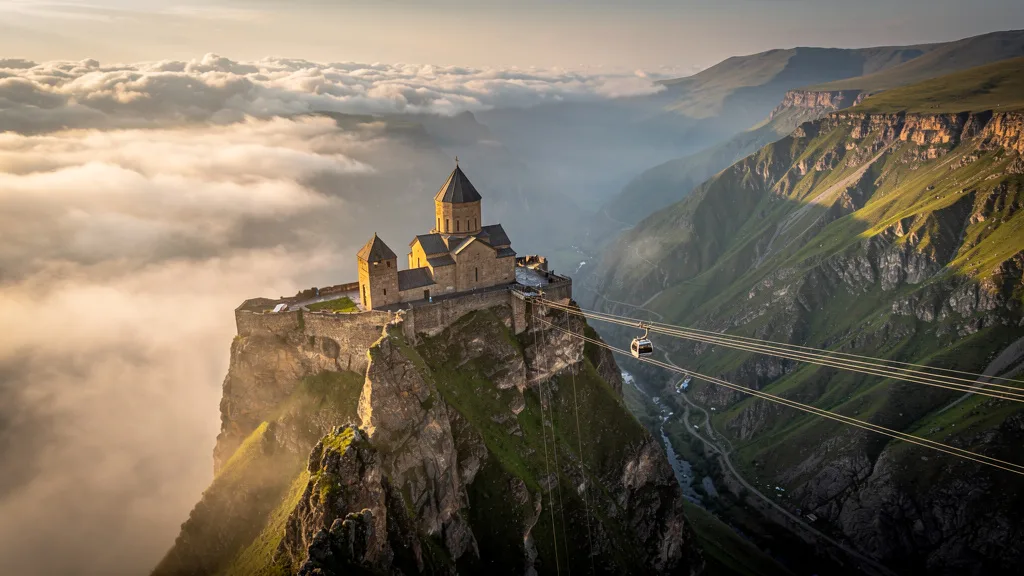
H-class roads (regional highways): These secondary routes connect smaller towns and access most tourist sites. Quality ranges from acceptable to challenging. The H-42 to Tatev Monastery has been significantly improved thanks to the Wings of Tatev tramway project, but it still includes narrow sections and sharp switchbacks. The road to Noravank through the red canyon is paved but narrow — two vehicles can pass, but only just.
Local and village roads: These can be anything from reasonable gravel to deeply potholed asphalt to unpaved tracks. Roads to monasteries like Haghpat and Sanahin require careful driving but are manageable in a compact car. The road to Jermuk is currently being improved but includes construction zones. The road beyond Goris into the far south (toward Kapan and Meghri) is paved but winding and takes longer than the distance suggests.
Road construction: Major projects in 2026 include the North-South Highway Corridor (connecting Yerevan to the Georgian border via a modern highway), which is being built in stages. Expect construction zones and detours, particularly on the M6 between Vanadzor and the border. The construction is ongoing and sometimes affects traffic flow significantly — allow extra time on these stretches.
Road Quality by Region
| Region | Road Quality | Notes |
|---|---|---|
| Yerevan surroundings | Good-Excellent | M-class highways, well-maintained |
| Ararat Valley | Good | Flat, easy driving |
| Lake Sevan corridor | Good | M2 highway, some winding sections |
| Dilijan / North | Good | Forest roads, some narrow sections |
| Selim Pass / South | Mixed | Good highway, challenging pass |
| Tatev area | Mixed | Improved but still demanding |
| Far south (Kapan) | Fair | Long drive, winding |
| High mountain areas | Poor-Fair | Unpaved sections, requires SUV |
Speed Limits and Enforcement
Armenia has been installing speed cameras at a rapid pace. The country now has hundreds of fixed cameras, concentrated on highways and city approaches. Mobile police radar units are also common.
| Zone | Speed Limit |
|---|---|
| Urban areas | 60 km/h |
| Rural roads | 90 km/h |
| Highways | 110 km/h |
| Residential zones | 20 km/h |
| Near schools | 20 km/h |
Fines for speeding are processed automatically via camera and charged to the vehicle registration. For rental cars, the fine goes to the rental agency and then to your credit card, often with an administrative fee added on top.
| Violation | Fine (AMD) | Fine (USD approx.) |
|---|---|---|
| 1-10 km/h over limit | 10,000 | $26 |
| 10-30 km/h over limit | 25,000 | $65 |
| 30-50 km/h over limit | 50,000 | $130 |
| 50+ km/h over limit | 200,000 | $519 |
| Running a red light | 25,000 | $65 |
| Not wearing seatbelt | 15,000 | $39 |
| Phone use while driving | 20,000 | $52 |
| DUI (any detectable alcohol) | 200,000+ | $519+ |
Google Maps and Waze both show speed camera locations in Armenia. Use them. The cameras on the approaches to Yerevan (especially the M1 approach from Gyumri and the M2 from Sevan) catch travelers who have been driving at highway speeds and forget the limit drops to 60 km/h at the city boundary.
Where the Cameras Are
Fixed cameras are concentrated at key locations: the entrances and exits of all major cities, motorway overpasses, and school zones. The Yerevan-Gyumri M1 is heavily monitored in both directions. The M2 between Sevan and Yerevan has multiple camera installations. Mobile radar units operate from police cars parked in lay-bys — Waze users often report these in real time.
The southern routes (M2 toward Areni and Tatev) have fewer cameras but more police checkpoints. Officers at these checkpoints are primarily looking for documents and sobriety rather than speeding, but they will write a ticket if your radar shows excessive speed as you approach.
Fuel and Gas Stations
Armenia has a good network of fuel stations in and around major cities and along the M-class highways. The major chains are Eko (Greek-owned), Flash, CityPetrol, and Lukoil.
Fuel types:
- Regular gasoline (92): Available but not commonly used in modern rental cars
- Premium gasoline (95): Standard grade, widely available at all chains
- Super (98): Available at larger stations in cities
- Diesel: Available everywhere
- LPG/CNG: Very common — many Armenian cars run on gas. Available at most stations throughout the country
Fuel prices (early 2026):
| Fuel Type | Price per Liter (AMD) | Price per Liter (USD) |
|---|---|---|
| Gasoline 95 | 300-330 | $0.78-0.86 |
| Gasoline 98 | 340-370 | $0.88-0.96 |
| Diesel | 350-380 | $0.91-0.99 |
| LPG | 150-180 | $0.39-0.47 |
Armenia has some of the cheapest fuel in the Caucasus and wider region. A full tank in a compact car (45 liters) costs approximately 14,000-15,000 AMD ($36-39).
Station availability: Plentiful in the Ararat Valley and along highways. In remote mountain areas (southern Armenia, roads to some monasteries), stations can be 50-80 km apart. The rule is simple: fill up before leaving any major town if you plan to go somewhere remote. In particular:
- Fill up in Yerevan before heading south toward Tatev
- Fill up in Goris if going further south to Kapan
- Fill up in Vanadzor before going into the Debed Canyon area
- Fill up in Sevan before going north toward Dilijan and Ijevan
Most stations accept cards, but carry cash for smaller or rural stations. Some accept only Armenian dram cash. The Eko chain is the most reliable for card payments. Flash and Lukoil are also generally fine.
Fuel Station Apps
The Petrol Armenia app (available on iOS and Android) shows station locations and current prices. Useful for finding the cheapest station near you, though the difference between chains is usually only 5-10 AMD per liter — not worth driving significantly out of your way.
Tolls and Road Fees
Armenia has no toll roads. There are no vignettes, no highway fees, and no bridge tolls. All roads are free to use. This is one of the most significant advantages of driving in Armenia versus neighboring Georgia (which has no tolls either) or Iran.
The only road-related fees:
- Parking fees in Yerevan (100-200 AMD / $0.26-0.52 per hour)
- National park entry fees (Dilijan NP, Lake Arpi NP: free for road access, small fees for hiking areas at some trailheads)
- The Wings of Tatev tramway (7,000 AMD / $18 round trip) is optional — you can drive to Tatev Monastery instead, though the tramway is an experience itself
Parking
Yerevan: The capital has a modern parking system. Street parking in the center is paid (100-200 AMD / $0.26-0.52 per hour) via attendants or the Parking app. Blue-line zones are paid, white-line zones are free. Republic Square and Northern Avenue areas are the most expensive. Underground garages at shopping malls (Dalma Garden, Yerevan Mall) offer parking for 100-200 AMD per hour.
The Parking app (available in Armenian and English) lets you pay remotely and extend your parking session from your phone. Registration requires an Armenian phone number — get a SIM at the airport.
Gyumri: Largely free street parking. The city is less crowded and finding a spot is rarely a problem, even near the central Vartanants Square.
Dilijan: Limited parking near the old town, but the town is small enough that you park once and walk. The Dilijan National Park access roads have designated parking areas at main trailheads.
Monastery parking: Most monasteries have free parking lots, though some are small. At popular sites like Geghard and Garni, weekend traffic in summer can fill the lots — arrive before 10:00 or after 15:00.
Practical notes on Yerevan parking: The double parking culture is alive and well. You will see Armenian drivers blocking other cars without apparent concern, knowing that the person will be back shortly and will wait. Your rental car will be fine, but plan your parking choices with some thought for how easy it will be to exit.
Traffic Culture and Driving Style
Armenian drivers are… confident. Overtaking on mountain roads, creative interpretation of lane markings, and a general belief that the horn communicates complex emotional states are all standard features. That said, Armenian drivers are not aggressive — they are experienced at navigating their own roads and generally accommodating toward other vehicles, including conspicuously foreign-plated rental cars.
What to expect:
- Frequent overtaking on two-lane roads, sometimes in questionable visibility
- Vehicles moving slower than the flow of traffic tend to stay in the right lane
- Horn use is communication, not anger — a light honk means “I am passing,” not “you are an idiot”
- Pedestrians cross roads at unmarked locations in cities and villages — the crosswalk concept has a somewhat theoretical status
- Livestock on rural roads is common — sheep, cows, and horses
- Some drivers use high beams as a signal to let you pass or to warn of police ahead
Defensive driving is essential. Keep your attention up, scan the road ahead, and expect the unexpected. Armenian mountain roads have curves where you cannot see oncoming traffic — reduce speed at blind corners. This is not optional; it is the difference between an adventurous drive and an accident.
Night driving: Avoid driving on mountain roads at night. Many secondary roads lack lighting, guardrails, and reflectors. Urban night driving in Yerevan is fine — the city is well-lit and traffic thins out significantly after 22:00. Peripheral neighborhoods can be poorly lit but are generally safe to navigate.
Roundabouts
Roundabouts in Armenia follow a specific convention that differs from the UK system: vehicles entering the roundabout generally have right of way over vehicles inside it, unless signs or road markings say otherwise. This is the opposite of how most Europeans expect roundabouts to work. When approaching a roundabout, watch what the local traffic is doing and follow suit rather than assuming the “normal” rules apply.
Mountain Road Etiquette
On single-lane mountain roads, the vehicle going uphill has right of way. The logic is sound: it is easier for a downhill vehicle to reverse than an uphill one. In practice, both drivers often stop and engage in a friendly negotiation about who will back up, which can take a few minutes. Accept this gracefully — it is part of the experience.
On switchbacks, honk before blind corners. This is not aggression; it is a safety signal letting uphill drivers know you are coming around. You will hear other drivers doing it — add your own honk to the chorus.
Navigating Armenian Cities
Yerevan is the most complex city to navigate. The city has a semi-radial layout centered on Republic Square, with arterial roads heading out in multiple directions. The ring road (Tigranyan Street area) helps bypass the center, but Yerevan lacks a proper ring road in the European sense. Rush hours (08:30-10:00 and 17:30-19:30) cause real congestion on Mashtots Avenue and around Republic Square.
Google Maps is accurate for Yerevan. Follow the GPS carefully — the city has one-way streets in the center that are not always intuitive. Waze is popular with locals and sometimes has better real-time routing around traffic.
Gyumri is straightforward. The city grid is roughly rectangular, centered on Vartanants Square. Traffic is light, road quality in the center is acceptable, and navigation is simple. The roads are wider than you might expect for a city of this size.
Vanadzor sits in a valley where three rivers converge, which gives the city an interesting topography but makes navigation slightly confusing. The main Tigranyan Boulevard runs through the center. Most sites of interest are within walking distance of the central park.
Dilijan is tiny and nearly impossible to get lost in. The old town is pedestrian-only, so you park at the entrance and walk. One road comes in and the same road goes out.
Border Crossings and Cross-Border Driving
Armenia shares land borders with Georgia, Iran, Turkey, and Azerbaijan. Currently:
- Georgia: Open. The main crossings are Bagratashen (near Alaverdi on the M6) and Bavra (from Gyumri area). Bagratashen is the busiest and most convenient for travelers continuing to Tbilisi. The crossing is modern and relatively quick.
- Iran: Open, but most rental agencies do not allow their vehicles to cross into Iran. If you want to drive from Armenia to Iran, check this specifically before booking.
- Turkey: Closed (border sealed since 1993 due to the Nagorno-Karabakh conflict and related disputes). No crossing possible.
- Azerbaijan: Closed. No crossing possible. This also means that the Nakhchivan Autonomous Republic (part of Azerbaijan but geographically separated from it) is inaccessible from Armenia by land.
For cross-border to Georgia, confirm in writing with your rental agency that it is permitted. Most established agencies allow it with advance notice and a cross-border insurance fee of 5,000-10,000 AMD ($13-26) per day. Naniko Rent a Car is particularly well-organized for this route, as they operate in both countries.
Seasonal Driving Considerations
Summer (June-August): Hot in the valleys (35-40°C around Yerevan), pleasant in the highlands (20-28°C). Air conditioning is essential for comfort in the Ararat Valley. Mountain passes are all open. Roads to Tatev, Sanahin, and Haghpat are at their best. This is peak tourist season — book the car and accommodations well in advance.
Autumn (September-October): Excellent driving conditions. The forests around Dilijan and Ijevan turn spectacular colors from mid-October. Grape harvest season in Areni — the valley smells of wine. Temperatures are comfortable everywhere. One of the best times for an Armenian road trip, with thinner crowds and good prices.
Winter (November-March): Winter tires are legally required from November 1 to April 1. Mountain passes, particularly the Selim Pass (2,410 m) and the road to Tatev, can be closed after heavy snowfall. The road to Lake Sevan remains open but requires winter driving skills. Yerevan gets cold (down to -15°C) but roads in the city are cleared quickly. Some rental agencies do not offer winter-tire-equipped cars — confirm when booking. The Debed Canyon road (to Haghpat and Sanahin) is generally open in winter but can be icy.
Spring (April-May): The country comes alive with wildflowers, especially in May. Some high mountain roads may still be snow-covered in April. The Ararat Valley is green and Mount Ararat is at its most photogenic with fresh snow cover. Excellent time for a road trip with lighter crowds than summer. The Selim Pass opens from late April, weather permitting.
Weather and Mountain Driving
Armenian mountain weather changes fast. Clear mornings can become stormy afternoons, particularly during the June-August thunderstorm season. Fog appears quickly at altitude, especially in October and November. If you see storm clouds building over the peaks while you are on a mountain road, start heading downhill.
Flash flooding is a hazard in some river valleys during spring snowmelt (April-May). Check conditions before driving in narrow gorge roads after heavy rain. The Debed Canyon road has a history of closures after flooding. The road to Tatev through the Vorotan Gorge can also be affected.
Emergency Information
| Service | Number |
|---|---|
| General emergency | 911 |
| Police | 102 |
| Ambulance | 103 |
| Fire department | 101 |
| Roadside assistance | 1-141 (paid service) |
In case of an accident:
- Activate hazard lights and place the warning triangle (100 meters behind on highways, 50 meters on urban roads)
- Call 911 for injuries, 102 for police
- Do not move the vehicles until police arrive
- Photograph the scene extensively — every angle, every vehicle, every piece of debris
- Get the police report — essential for insurance claims
- Call your rental agency immediately
Medical facilities are best in Yerevan, with several modern hospitals. The Mikaelyan Institute of Surgery and the Republican Medical Centre are well-equipped. Outside the capital, regional hospitals exist in Gyumri, Vanadzor, and Kapan, but facilities are more basic. Pharmacies (dghateun) are common in all towns and identifiable by a green cross sign.
Consider travel insurance with medical evacuation coverage, especially if you plan to drive in remote southern Armenia where the nearest adequate hospital may be 2-3 hours away.
Roadside Assistance Reality
Roadside assistance in Armenia is not as organized as in Western Europe. The 1-141 number connects to a paid service, but response times in remote areas can be very long. Your rental agency’s roadside assistance is typically faster for mechanical issues because they have a financial interest in getting their car moving again.
For tire punctures, the network of vulkanizim (tire repair shops) throughout Armenia is surprisingly good. Even small towns have one. They can fix a puncture for 1,000-2,000 AMD ($3-5) and often do so with impressive speed. They are usually identifiable by stacks of tires outside a small garage.
For more on route planning, check our best road trips in Armenia. For cost planning, see our Armenia rental costs guide. And if you are considering an IDP, our international driving permit guide explains the process. Heading to a neighboring country? Our Georgia driving guide covers the most common next stop.